TRANSMISSION // 2611.11445v1
Hydrogen stand-ins help transfer quantum circuit settings to larger molecules
Source published
Classical simulations suggest that small hydrogen models can supply useful quantum circuit parameters for hydrocarbons without retraining on each molecule. Accuracy depends on the parameter solver, circuit design and bonding environment; no quantum hardware advantage was demonstrated.
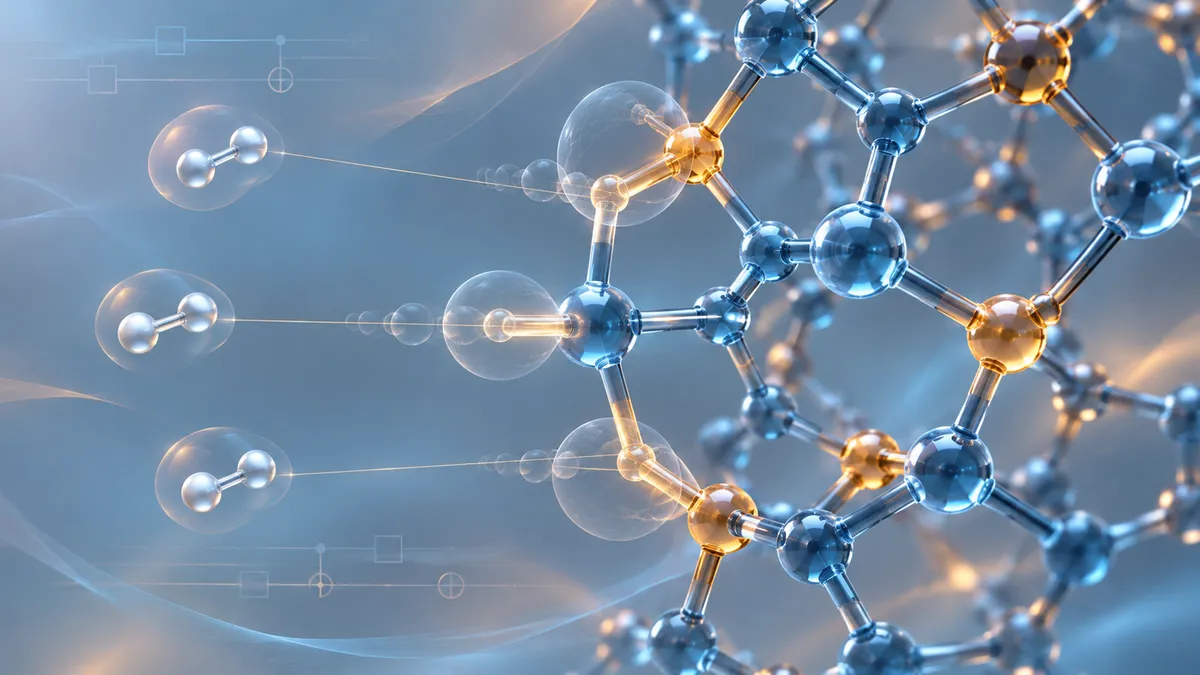
Could a model trained on hydrogen help prepare quantum calculations of more complicated molecules? A new preprint proposes a geometric translation between them—and finds promising results alongside clear limits.
Quantum chemistry calculations often involve a difficult search: adjusting a model of electrons until its energy is as low as possible. Jonas Motyl and Jakob S. Kottmann, of the University of Augsburg, propose borrowing those adjustments from simpler hydrogen systems instead of finding them afresh for every molecule.
Their study, submitted to arXiv on November 8, 2026, reports classical computer simulations, not experiments on a quantum processor. The supplied record does not establish peer review. Its central result concerns transferring circuit settings between molecular models—not demonstrating that a quantum computer outperforms a classical one.
Translating molecular bonds into hydrogen
A variational quantum eigensolver, or VQE, combines a quantum circuit with a classical optimizer. The circuit prepares an approximate electronic state; the optimizer repeatedly changes its settings to lower the calculated energy. Repeated energy measurements and gradient estimates can make that search expensive, while flat regions and local minima can obstruct progress.
Previous work had shown that machine-learning models could predict settings for structured circuits describing hydrogen systems. The question here was whether those solvers could also help with organic molecules without molecule-specific retraining.
The researchers construct hydrogen stand-ins for local bonding environments. Surrogate hydrogen atoms are placed along the original bond directions, on a sphere around an atomic center. The sphere’s radius is fitted on a small reference molecule and then reused for the same connection type in larger molecules. Methane supplies the carbon–hydrogen calibration; ethane introduces the carbon–carbon calibration.
Small hydrogen fragments then supply circuit parameters, which are assembled into the target molecule’s circuit. Crucially, the final energy is evaluated using the original molecule’s full electronic Hamiltonian—the mathematical description of its electronic energy—not by adding up surrogate hydrogen energies. The “alchemy” is a computational mapping, not a physical transformation of atoms.
Two different levels of accuracy
The main tests use the separable-pair approximation, or SPA, which describes electrons through independent pairs. These structured circuits are shallow and classically tractable, making them an inexpensive testbed. Calculations used the minimal STO-3G orbital basis and were simulated with the tequila software framework.
When the hydrogen fragments were individually optimized, mean energy differences from fully optimized target-molecule SPA calculations were about 0.022 millihartree for methane, 0.131 for ethane, 0.181 for propane and 0.553 for norbornane. Propane and norbornane required no additional radius fitting. Norbornane, a rigid seven-carbon bicyclic molecule, tested environments absent from the simpler calibration molecules.
But those figures are not the accuracy of the cheapest direct predictor. The authors also fitted a two-parameter, distance-based curve to optimized hydrogen-dimer circuit settings at 100 separations between 0.5 and 5 angstroms. Using that predictor directly gave larger mean transfer errors: 2.171 millihartree for propane and 6.301 for norbornane.
That distinction matters. The geometric mapping can transfer accurately when supplied with optimized fragment settings; the simple prediction model introduces additional error. Neither result establishes equally accurate molecular energies overall. For one propane configuration, the projected SPA energy remained roughly 113 millihartree above a full configuration-interaction reference within the chosen basis. Most of that gap came from SPA’s limited description, rather than parameter transfer.
A useful starting point, with costs attached
Predicted settings also helped initialize subsequent target-molecule optimization. Average circuit-evaluation counts fell from 69 to 30 for propane and from 103 to 56 for norbornane.
These counts exclude work on the hydrogen fragments, however, and are not an end-to-end timing comparison. Fragment calculations involve smaller systems, but the reported reductions alone do not establish total computational savings or quantum hardware performance.
The researchers also transferred parameters into a more expressive approach that combines several valence-bond configurations. Tests on butadiene and hexatriene considered selected electron orbitals involved in conjugated bonding, rather than the complete molecular electronic problem. In hexatriene, transfer errors stayed below about 0.03 millihartree through four configurations. Adding a fifth, more delocalized configuration raised the transfer error to approximately 7.40 millihartree and worsened the projected result.
Where the shortcut breaks down
The method depends on local hydrogen models resembling the target bonding environment. Norbornane’s carbon–carbon transfer error increased, which the authors attribute to ring strain. Lithium hydride exposed another limitation: the basic projection produced a mean error of 13.61 millihartree, reduced to 0.078 only with a more flexible, separately fitted mapping. Representing water required extra surrogate atoms for lone pairs and an additional fitted distance, yielding a 0.82-millihartree transfer error.
The evidence therefore supports a reusable shortcut for selected molecular models, not a universal replacement for optimization. Its promise is reducing the search for useful circuit settings; its boundaries remain the chemistry, the predictor and the electronic states the chosen circuits can represent.
- quantum chemistry
- variational quantum eigensolver
- parameter transfer
- hydrogenic projection
- molecular simulation
- quantum circuits
Related reading
Automatically matched by shared topic keywords. These links do not imply that the sources agree or establish a consensus.
A statistical correction helps VQE escape measurement plateaus
Source published
Shared keywords: quantum chemistry, variational quantum eigensolver
Quantum-assisted simulation follows a proton between two water molecules
Source published
Shared keywords: quantum chemistry
Quantum proposals improve a fixed-size molecular calculation
Source published
Shared keywords: quantum chemistry
Why finite quantum circuits cannot reproduce the quantum switch
Source published
Shared keywords: quantum circuits
Rotating local axes trims the memory cost of quantum simulations
Source published
Shared keywords: quantum circuits