TRANSMISSION // 2611.11395v1
A theoretical recipe for high-dimensional photon entanglement combines shaped light with carefully chosen modes
Source published
A theoretical study shows how shaping a pump beam and selecting nonconsecutive orbital-angular-momentum modes can produce nearly maximally entangled photon states within a chosen subspace. Calculations reach 12 dimensions per photon, but unwanted modes reduce the overlap of the full generated state with the target.
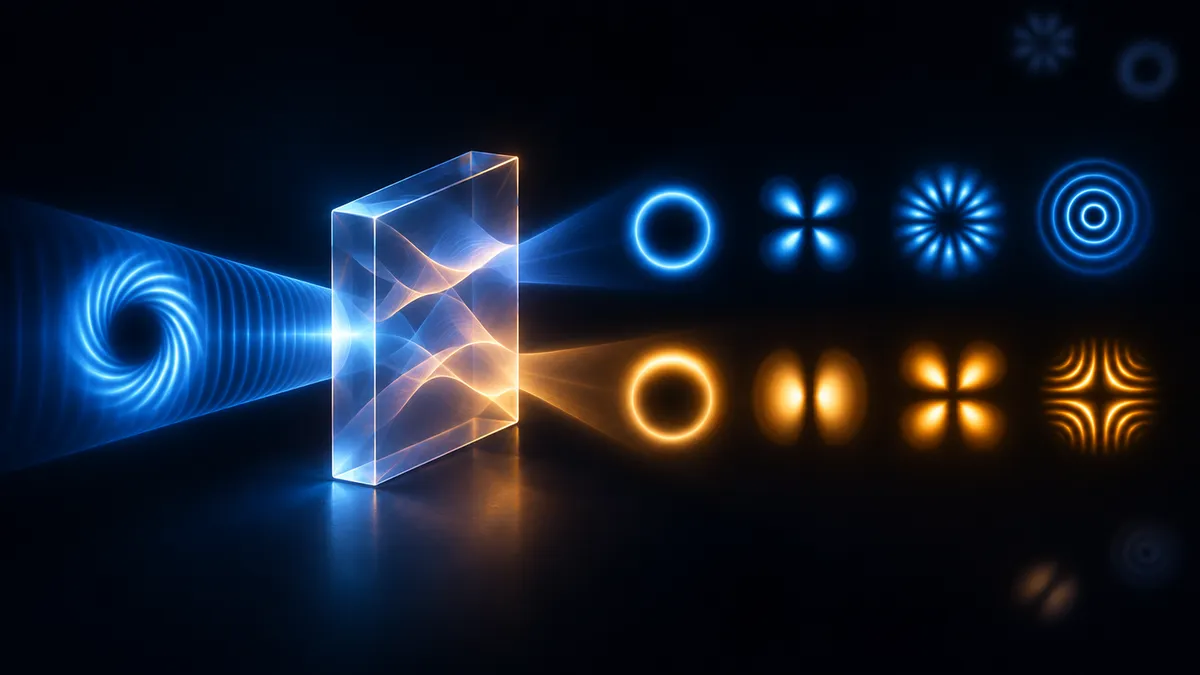
Shaping the light that generates entangled photons is only part of the design problem. A new theoretical study argues that researchers must also carefully choose which spatial modes they retain. Together, those choices offer a systematic route to high-dimensional entanglement—at the cost of discarding photon pairs outside the selected modes.
More possibilities are not enough
Entangled photons can share correlations across many spatial modes, rather than just two states per photon. But having many available modes does not automatically produce maximal entanglement. The relative amplitudes and the structure of the correlations matter.
Richard Bernecker, Baghdasar Baghdasaryan, Fabian Steinlechner and Stephan Fritzsche investigate how to control those features using orbital angular momentum, or OAM. These spatial modes of light are labeled by integer indices. Their theoretical study, submitted to arXiv on November 8, 2026, presents analytical constructions and calculated examples, not a new experimental demonstration. The supplied record does not establish peer-reviewed publication.
The central result is a joint design strategy: shape the beam that creates photon pairs, then select a carefully arranged set of modes for each photon. The authors describe a construction extendable, in principle, to arbitrary dimensionality, while calculating specific examples up to 12 dimensions per photon.
Shaping the source and the selection
The proposed source uses spontaneous parametric down-conversion, a probabilistic process in which a pump photon produces a signal–idler photon pair in a nonlinear material. Conservation of OAM requires the two output indices to add up to the pump index.
A pump containing a coherent superposition of OAM modes therefore creates several families of allowed photon-pair combinations. Adjusting the pump components’ relative weights changes the amplitudes of those families. Adjusting the pump waist can concentrate their distributions around the strongest mode pairs.
That control has limits. Each pump component also produces neighboring, unwanted pairs. Pump shaping alone cannot completely suppress those contributions for higher OAM indices.
The authors address this by designing the retained modes alongside the pump. Instead of always selecting consecutive OAM indices, they introduce “disassembled” subspaces: sets with deliberate gaps. Unwanted neighboring pairs can then fall outside the retained space.
For their target construction, the authors use a “Sudoku condition.” Imagine a grid with the signal modes along one axis and the idler modes along the other. The target has one populated pair in each row and column, with equal coherent amplitudes; other contributions inside the grid must be negligible. This is a design rule for their chosen targets, not a universal requirement that every maximally entangled state must look sparse in the OAM basis.
What the calculations show
For the authors’ narrow-bandwidth construction using lowest-radial-order pump modes, consecutive OAM subspaces support near-maximal entanglement only up to six dimensions. Beyond that, unwanted contributions interfere with the target pattern. This is not a fundamental six-dimensional limit on OAM entanglement: the appendices examine alternatives involving broader distributions or higher radial pump modes, with efficiency penalties.
Gapped selections allow the main construction to go further. An eight-dimensional example combines pump indices of plus and minus three and seven. A 12-dimensional example adds plus and minus fifteen, retaining output indices of plus and minus one, two, three, four, seven and eight.
The numerical results distinguish ideal targets from achieved approximations. For the 12-dimensional example, the calculated subspace fidelity is 0.995. The Schmidt-number measure is 11.89, compared with 12 for an ideal maximally entangled state.
But the full generated state has an overlap of only 0.370 with that target. This “global fidelity” accounts for unwanted spatial modes outside the retained subspace, including higher radial orders. It is not a measured detector efficiency. The corresponding three-dimensional example has global fidelity 0.679, illustrating the broad tradeoff between increasing dimensionality and keeping more of the generated state in the target.
Conditional quality has a cost
The proposed states are conditional: maximal or near-maximal entanglement emerges after selecting the specified modes. Pairs outside that selection reduce the effective usable pair rate.
Purity also requires more than equal populations. Unresolved radial or frequency structure can reduce coherence between OAM components. The main scheme selects the lowest radial order, and its target pairs share the same spectral dependence under the model’s assumptions, preserving spatial purity when frequency is disregarded.
The contribution is therefore a systematic theoretical design recipe, not a loss-free source or evidence of unlimited experimentally achievable dimensions. Its practical promise rests on balancing excellent entanglement within selected modes against the growing population left outside them.
- quantum entanglement
- orbital angular momentum
- photon pairs
- spontaneous parametric down-conversion
- pump-beam engineering
- high-dimensional quantum states
- modal postselection
Related reading
Automatically matched by shared topic keywords. These links do not imply that the sources agree or establish a consensus.
Quantum entanglement could build patterns that outlast it
Source published
Shared keywords: quantum entanglement
When does neutrino entanglement matter? Quantum simulations test the limits
Source published
Shared keywords: quantum entanglement
Entangled qutrits reach the quantum limit in a two-player hat game
Source published
Shared keywords: quantum entanglement
A theoretical route to detecting molecular entanglement with spectroscopy
Source published
Shared keywords: quantum entanglement
Let the measurements choose: adapting quantum entropy estimates
Source published
Shared keywords: quantum entanglement