TRANSMISSION // 2611.11180v1
Could trapped light retain the imprint of past interactions?
Source published
A theoretical study proposes converting an interacting light–matter condensate into confined photons while preserving much of its collective structure. Calculations predict surviving correlations, but preparing the initial state and controlling losses remain unresolved experimental requirements.
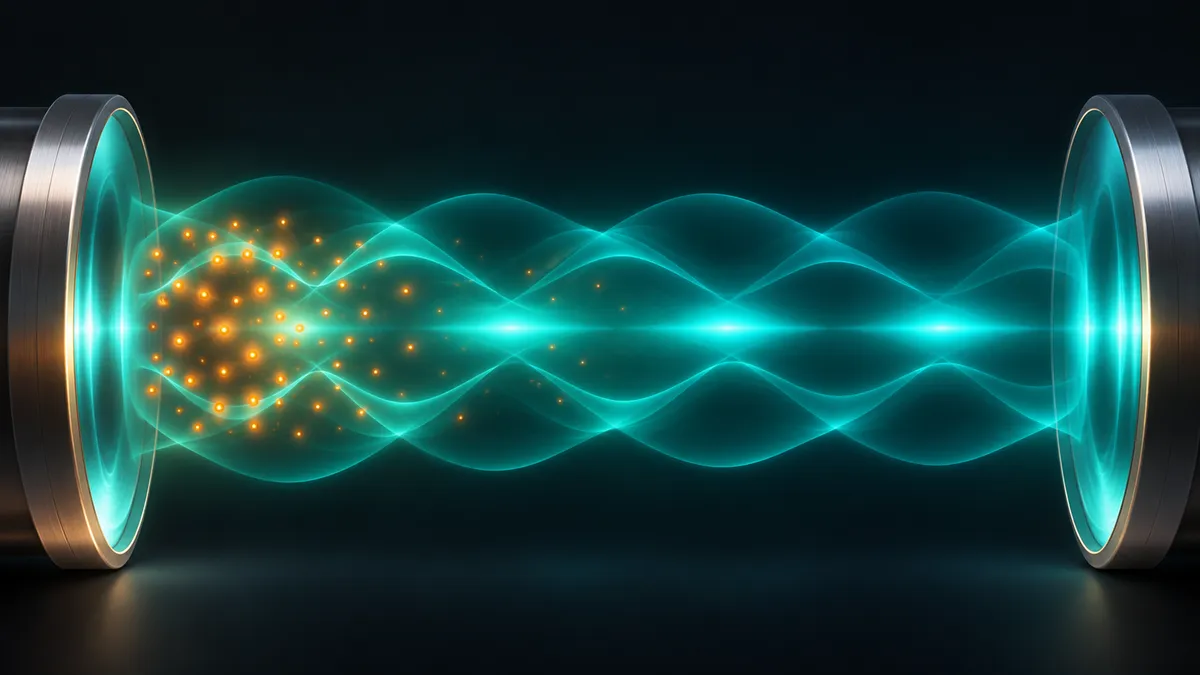
What remains when particles stop interacting? For a proposed gas of trapped photons, the answer includes correlations established while the light was coupled to atoms—even after that coupling disappears.
A photon gas could retain measurable traces of interactions that no longer act on it, according to a theoretical study by G. D. de Moraes Neto and colleagues. Their proposal separates two tasks: using matter to prepare an interacting condensate, then removing the light–matter coupling while keeping the photons inside a cavity.
The work combines analytical arguments with numerical calculations; it does not report an experiment. It is presented as an arXiv preprint, and the supplied record does not establish peer-reviewed publication.
Preparing light with matter
A Bose–Einstein condensate has a large population occupying one shared quantum state. For confined light, a central challenge is redistributing energy so that photons can accumulate in low-energy states. Matter can provide that redistribution, but continued coupling also influences the resulting photon gas.
The authors consider a cavity supporting multiple transverse light patterns, or modes. Inside it, an optical control field couples photons to long-lived collective atomic excitations. The resulting hybrid excitation is called a dark-state polariton: its light and matter components combine to avoid coupling to a short-lived atomic polarization.
The model assigns the atomic component a finite-range repulsive interaction. The researchers assume an equilibrium state with a fixed number of polaritons, then calculate how interactions change its condensate occupation and correlations.
That preparation is an important qualification. A proposed Raman-assisted process can move polaritons between modes without changing their total number. However, the paper's simplified redistribution calculation does not demonstrate preparation of the interacting equilibrium state. Reaching that state additionally requires transitions at the correct interacting energies and pathways connecting the relevant many-particle configurations.
Why spatial shape matters
The researchers track condensation using the most populated natural orbital—a quantum state extracted from the one-body density matrix, which describes mode populations and their mutual coherence. In an interacting gas, this orbital need not match the cavity's lowest-energy free mode.
Both effective mass and atomic content influence the result. Here, effective mass describes transverse motion in the cavity, not a change to a photon's fundamental rest mass. Changing it can alter both energy-level spacings and the spatial extent of the modes.
To separate those effects, the authors construct a mathematical comparison in which the trapping potential changes with mass to keep every single-particle energy level fixed. The noninteracting condensate fraction then remains near 54%, yet its sensitivity to weak repulsion increases in magnitude by about 45% across the chosen mass range.
The explanation is spatial: narrower orbitals overlap differently within the finite-range interaction. Identical free-particle energies therefore do not guarantee identical interacting behavior. The 45% figure describes a change in weak-coupling sensitivity, not a 45% loss of condensate population.
Removing the atomic component
After preparation, the proposed sequence switches off the redistribution reservoir, increases the optical control field and moves the atoms toward a node of the cavity's standing wave. A final step removes residual atom–cavity coupling while the control remains active. Only afterward is the control switched off.
That ordering matters because a finite-width atomic cloud still couples weakly at a node. Simply turning off the control too early would not leave an isolated photon state.
For an ideal loss-free conversion described by a unitary transformation between modes, the authors prove that all natural-orbital occupations survive unchanged. Finite-duration conversion can introduce additional rearrangement. In a three-particle calculation restricted to six transverse orbitals, interacting preparation reduces the leading occupation by about 3.2%, whereas the subsequent 1.25-microsecond conversion changes the occupation fraction by only about four parts per million in a representative case.
Those numerical results are exact within the restricted model, not a demonstration of equally accurate transfer in a large experimental condensate.
Correlations beyond a density picture
After decoupling, interference between different cavity energies produces oscillations in photon density. Certain pair correlations behave differently: the paired configurations have equal total energy in the harmonic model, allowing their coherence to persist during free evolution.
These pair correlations distinguish the output from a quadratic thermal reference matched to its complete one-body density matrix. Matching populations and ordinary coherence therefore does not reproduce every feature of the prepared state. The authors explicitly caution that this pair signal alone does not establish entanglement.
Experimental feasibility remains conditional. Photon leakage, imperfect mode preservation and departures from harmonic confinement can modify the outcome. Uniform loss can preserve normalized condensate fractions while making survival of the entire fixed-number state much less likely. The proposal thus identifies signatures of interacting preparation that might remain in light—not an experimentally demonstrated, loss-proof photon condensate.
- photon condensate
- dark-state polaritons
- Bose–Einstein condensation
- quantum correlations
- optical cavity
- light–matter interactions