TRANSMISSION // 2611.11159v1
Why PUNCH’s wide view needs a pixel-by-pixel polarization correction
Source published
A geometrical analysis finds that PUNCH’s wide-field cameras see their fixed polarizers at slightly different effective angles across each image. The resulting measurement bias can be corrected in software, alongside optical distortion.
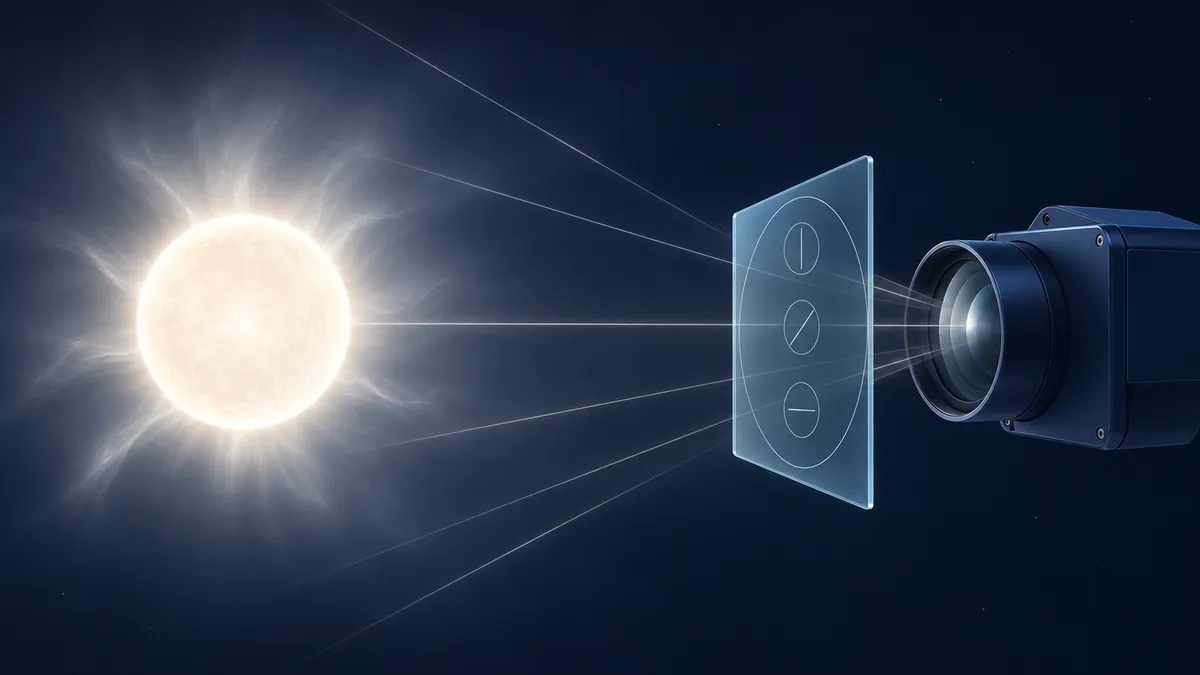
A polarizing filter can stay perfectly still while its effective orientation changes across an image. For PUNCH, which measures faint polarized sunlight scattered by electrons around the Sun, that wide-angle geometry matters.
A fixed filter, a changing viewpoint
How accurately can a camera measure polarization when it takes in a very broad patch of sky? Ritesh Patel and colleagues examine this question for the Polarimeter to Unify Corona and Heliosphere, or PUNCH. Their analysis identifies a small, predictable geometrical effect—not a moving component or a newly discovered solar phenomenon.
Linear polarization describes a preferred orientation of light’s electric-field oscillations. Sunlight scattered by electrons in the corona and heliosphere becomes polarized, giving researchers information about the material doing the scattering. Accurate measurements can help constrain electron distributions and the three-dimensional positions of coronal structures.
PUNCH combines four fields of view into a region about 90 degrees across. Three cameras are Wide Field Imagers, whose individual fields are described as approximately 40 degrees in diameter, with a truncated-square outline extending more than 50 degrees along its maximum diagonal. That breadth makes a usually small projection effect worth correcting.
Why the angles change
Each camera measures light through polarizers nominally oriented at minus 60 degrees, zero degrees and plus 60 degrees relative to the instrument. Combining the three brightness measurements reveals the light’s polarization.
But those nominal angles describe the filters in the instrument’s own plane. Light arriving away from the camera’s central viewing direction encounters a different projected geometry. The effective polarizer orientation therefore depends on the viewing direction associated with each pixel.
The authors introduce the idea through a familiar perspective effect: a circle viewed obliquely appears elliptical. Different directions are shortened by different amounts, so an inclined line can also appear to change angle. They connect this geometry to polarization issues in wide-screen 3D cinema, while calculating the correction specifically for the camera and sky coordinates.
Their method first considers geometrical foreshortening, then accounts for mapping detector-plane directions onto the curved sky. For each pixel, they calculate its angular distance from the field center and the polarizer’s orientation relative to the local radial direction. These quantities produce a map of the difference between detector-plane and sky-projected orientations.
Across the full square field used in the calculation, the effective angles deviate by up to about plus or minus 2.5 degrees for the two nominal 60-degree polarizers, and approximately plus or minus 3.5 degrees for the zero-degree polarizer. The paper separately marks the instrument’s useful field within those maps. The effect is negligible near the center and generally grows farther out.
What that does to brightness measurements
To explore the consequences, the researchers model an idealized three-polarizer system receiving light with a 10% linear polarization fraction and a specified polarization direction. They propagate the calculated angular departures into errors in reconstructed brightness and polarization components.
For that setup, they report a systematic variation of roughly 0.5% from the center to the edge. This is a modeled result under stated assumptions, not a measured error that applies universally to every PUNCH observation.
The paper also examines how altered polarizer angles change the range of polarization states represented by the three measurements. The authors describe a slight restriction that matters particularly for strongly polarized light. They do not expect it to significantly constrain WFI observations, because the incoming light mixes polarized and unpolarized contributions.
Matching the correction to the right pixels
Real optics also shift where light lands on a detector. To characterize that distortion, the team used 540 night-sky images collected with a WFI engineering model at McDonald Observatory in June 2022. They compared detected star positions with catalog positions, iteratively refining camera pointing and a distortion model.
The paper reports shifts below 10 pixels, with most of the image displaced by only a few pixels. Folding this mapping into the angle correction ensures that each correction follows the appropriate viewing direction.
The authors state that PUNCH-specific corrections are included in the open-source solpolpy software. Correcting individual images and transforming them into a common polarization reference frame are especially important when joining overlapping camera fields near their edges.
This briefing uses the arXiv version 1 manuscript, posted on November 8, 2026. Its older manuscript header says “Submitted to ApJ,” while the arXiv landing page reports that the paper has been accepted for publication in ApJ. The analysis combines geometrical approximations, an idealized polarization calculation and ground-based optical characterization. It does not quantify an end-to-end improvement in reconstructing solar structures. Its practical contribution is narrower: explaining a predictable wide-angle bias and how software can account for it.
- PUNCH
- polarimetry
- wide-field imaging
- polarizer foreshortening
- solar corona
- heliosphere
- optical distortion
Related reading
Automatically matched by shared topic keywords. These links do not imply that the sources agree or establish a consensus.