TRANSMISSION // 2611.11107v1
Faint radio signals probe two growing galaxy clusters
Source published
Radio observations of two distant protoclusters identify three strong candidates for active galactic nuclei, while the combined emission of individually undetected galaxies is consistent with star formation. Brighter stacked signals near dense regions do not establish an environmental effect.
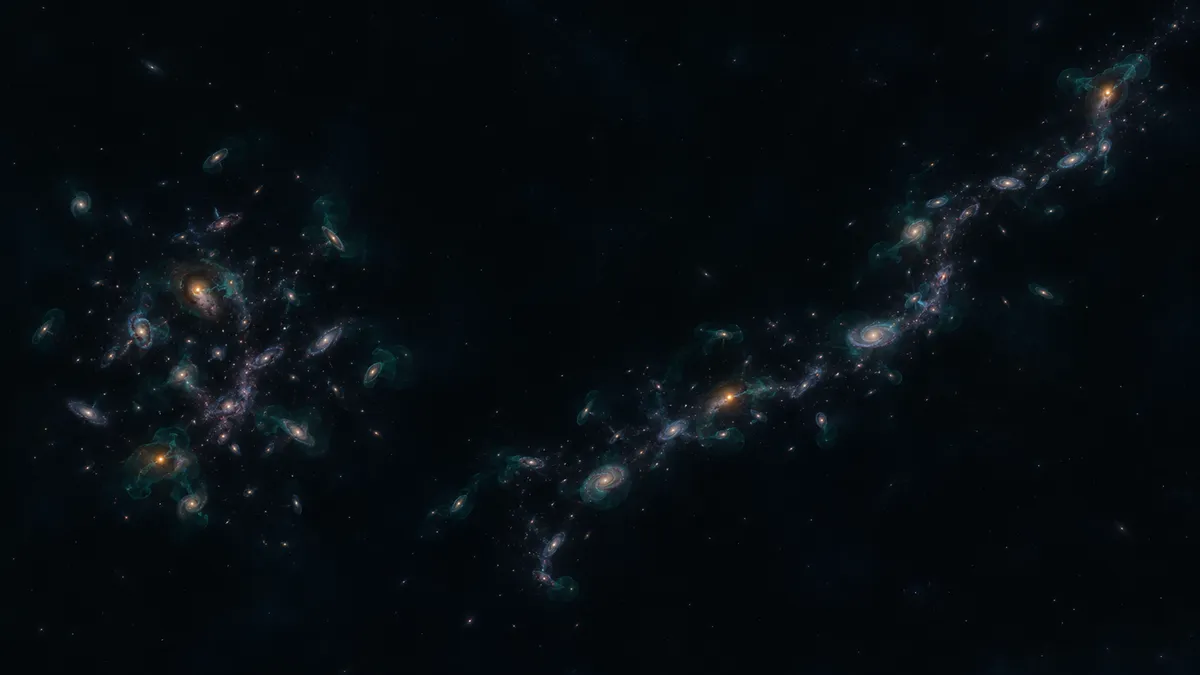
What powers the faint radio emission of galaxies assembling into clusters: star formation, feeding central black holes, or both? Observations of two contrasting protoclusters separate some strong candidates for active nuclei from a quieter population, but leave the influence of environment unresolved.
A radio signal from a distant galaxy does not come with a label identifying its source. Star formation and activity around a central black hole can both produce radio emission. Distinguishing them becomes particularly difficult when individual galaxies are too faint to detect.
A study by Yuheng Zhang and colleagues, available on arXiv and listed as in press at Astronomy & Astrophysics, investigates this problem in BOSS1244 and BOSS1542, two protoclusters at redshift 2.24. These are large structures still assembling into galaxy clusters. The researchers find several strong candidates for active galactic nuclei, or AGNs, but the typical faint radio signal does not require black-hole activity to explain it. Their results also fall short of establishing whether denser surroundings change that emission.
Two different environments
The systems offer contrasting settings. BOSS1244 contains several galaxy concentrations and a possible emerging core hosting massive galaxies with little star formation. BOSS1542 has a more extended, filamentary structure. Comparing them lets the team investigate radio emission both near a developing core and along a filament.
The researchers observed the fields at 1.26 gigahertz with the upgraded Giant Metrewave Radio Telescope. They removed interference and corrected imaging artifacts from bright sources before searching for counterparts to galaxies selected through hydrogen-alpha emission. This spectral line provides an estimate of star formation, although dust and AGN activity can complicate its interpretation.
Within the usable radio images, the samples contained 187 hydrogen-alpha emitters in BOSS1244 and 105 in BOSS1542. Ten and two, respectively, had robust radio counterparts. Measuring directly at known galaxy positions recovered five additional potential counterparts below the robust detection threshold.
When radio emission exceeds expectations
To investigate the source of the radio emission, the team compared radio luminosity with the amount expected from the estimated star-formation rate. A substantial excess can point to an AGN contribution.
Two hydrogen-alpha emitters in BOSS1244, HAE40 and HAE47, showed strong excesses. Their classifications also held when the researchers used star-formation estimates inferred from submillimeter measurements instead. A massive galaxy with little star formation, called QG1, showed a strong excess as well.
These three objects remain AGN candidates rather than secure identifications. Several other galaxies had only marginal excesses, which are harder to interpret. In particular, dust-obscured star formation could make hydrogen-alpha estimates too low, exaggerating an apparent radio excess. The radio images also cannot resolve every possible compact nuclear component.
Bringing faint galaxies into view together
For galaxies lacking individual detections, the researchers used median stacking: aligning small radio images on galaxy positions and taking the median value at each pixel. This measures a representative population signal without requiring each galaxy to be visible separately.
After excluding both robust and potential counterparts, they stacked 173 galaxies in BOSS1244 and 102 in BOSS1542. Comparison with matched random-position stacks yielded positive signals at 2.8 and 3.2 sigma, respectively—modest statistical significance.
The inferred radio luminosities were consistent with expectations from the samples’ median hydrogen-alpha star-formation rates. Star formation can therefore account for the faint population’s representative emission at the current sensitivity. That does not establish that every galaxy lacks an active nucleus: weak activity in a subset could remain hidden in a median stack.
An environmental hint, not a detection
For a separate environmental analysis, the team excluded robust radio counterparts but retained the potential ones. They grouped galaxies by projected distance from QG1 in BOSS1244 and from the filament spine in BOSS1542.
Both systems showed the largest stacked radio luminosity in the group nearest the denser region. However, the differences were consistent with zero. Tests that shuffled galaxies’ environmental assignments produced p-values of 0.60 and 0.66, providing no statistically significant evidence for an environmental dependence. Stellar mass also showed no significant relationship with environmental distance.
Small groups, uncertain star-formation estimates and distances measured only in projection limit the interpretation. The shared ordering cannot establish enhanced black-hole activity, a common mechanism across both systems, or even a genuine environmental effect.
Although the study is in press at Astronomy & Astrophysics, these observational uncertainties remain. Deeper observations at multiple radio frequencies, sharper imaging and better infrared star-formation measurements are needed to distinguish weak nuclear activity from variations in radio emission associated with star formation.
- protoclusters
- radio astronomy
- active galactic nuclei
- star formation
- median stacking
- BOSS1244
- BOSS1542
- uGMRT
Related reading
Automatically matched by shared topic keywords. These links do not imply that the sources agree or establish a consensus.
Ammonia Maps Offer a Closer Look at Gas Near the Milky Way’s Centre
Source published
Shared keywords: radio astronomy, star formation
Radio galaxies masquerade as tiny gravitational lenses
Source published
Shared keywords: radio astronomy
Why missing radio signals do not rule out black holes in dwarf galaxies
Source published
Shared keywords: radio astronomy
Hyperion’s Densest Regions Show More X-ray-Active Black Holes
Source published
Shared keywords: active galactic nuclei
Twin radio bubbles offer clues to the mystery of odd radio circles
Source published
Shared keywords: active galactic nuclei