TRANSMISSION // 2611.11096v1
Small magnetic patches can bring a simulated solar eruption forward
Source published
Three-dimensional simulations suggest that a small patch of emerging magnetic field can accelerate an already developing solar eruption by helping a thin electric-current layer collapse. The patch’s reach into twisted surrounding fields mattered more than simply increasing its magnetic flux.
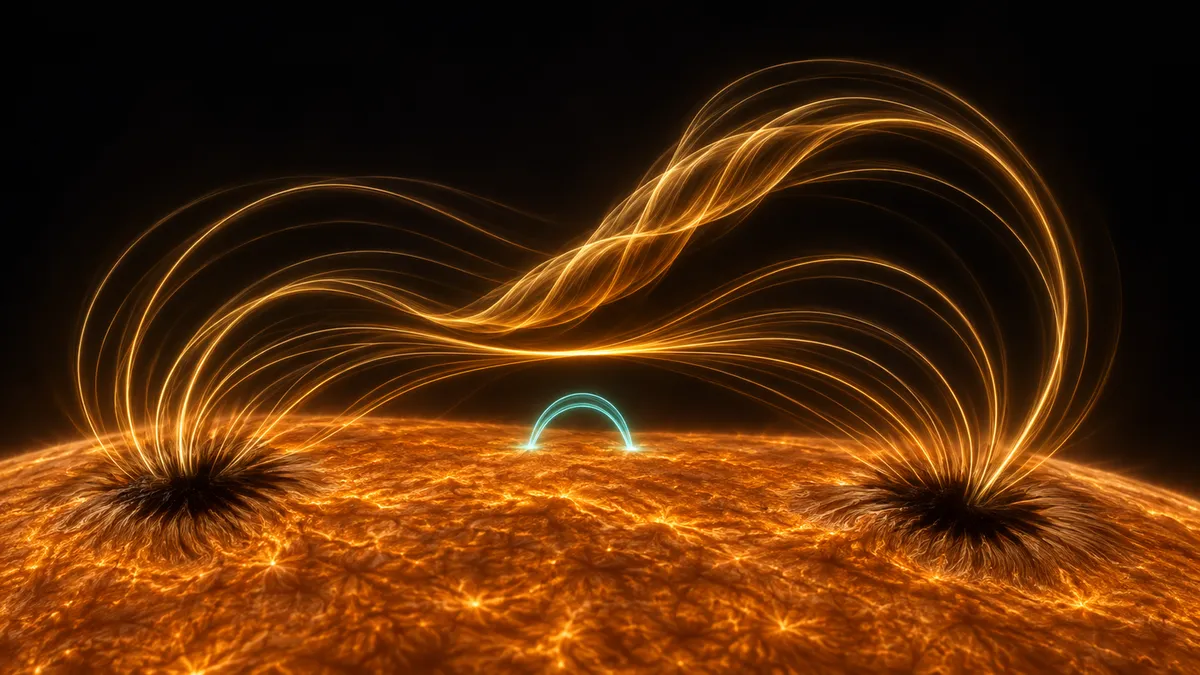
Does a small magnetic patch appearing near sunspots trigger an eruption, or merely hasten a process already underway? A simulation study supports the second possibility in an idealized solar active region—and shows why the surrounding magnetic geometry matters.
Small magnetic structures sometimes emerge at the Sun’s surface shortly before a flare. But appearing before an eruption does not establish that they caused it. A study by Satoshi Inoue and Huu Minh Triet Nguyen asks a narrower, testable question: how does a small emerging field change the evolution of a magnetic configuration already storing energy?
Their paper, submitted to arXiv on November 8, 2026, and accepted for publication in The Astrophysical Journal, describes three-dimensional computer experiments rather than observations of a particular eruption. In the modeled setting, emerging flux brought the eruption forward without producing an immediate outburst.
Building a stressed magnetic region
The researchers began with a simplified pair of sunspots of opposite magnetic polarity. They calculated an initially current-free magnetic field above them, then imposed rotational motions at the surface. Those motions sheared and twisted the field into an inverse-S-shaped structure.
The boundary between opposite surface polarities is called the polarity inversion line. Above it, the stressed field developed a current sheet: a narrow layer where electric current becomes concentrated. Such layers are important sites for magnetic reconnection, in which field connections change and stored magnetic energy can be released.
The team compared a reference simulation without emerging flux against five simulations containing a small emerging magnetic structure at the center of the sunspot pair. Its polarity arrangement opposed that of the main pair, and its magnetic flux ranged from 0.6% to 3% of the region’s total. Some experiments changed the structure’s radius while keeping its flux constant; others increased flux at fixed radius.
The calculations used magnetohydrodynamics, which describes the coupled behavior of magnetic fields and electrically conducting fluid. Their zero-beta approximation neglected gas pressure, focusing on magnetic forces.
Earlier, not immediate
In the reference run, the system’s kinetic energy began rising rapidly around simulation time 26. In Run 1, with emerging flux equal to 0.6% of the region’s total, that rise began around time 21. These are normalized simulation times, not a demonstrated warning interval in minutes on the real Sun.
Crucially, the reference case also erupted. The emerging structure therefore accelerated an eruption in this experiment rather than separating an erupting system from one that remained stable.
The authors interpret the acceleration as a local change that develops into a larger reorganization. Interaction with the emerging field removes some low-lying sheared field above the emergence site, reducing magnetic pressure locally. Downward flows appear, and the current sheet thins and intensifies more rapidly. Reconnection then helps assemble a magnetic flux rope—a coherent bundle of twisted field lines—which erupts.
The broad evolution remained similar with and without the emerging patch. The important difference was how quickly the current sheet developed toward rapid reconnection.
Geometry matters more than added flux alone
At constant emerging flux, a wider patch produced an earlier eruption. Increasing the flux at fixed patch size, however, made comparatively little difference.
The proposed explanation lies in which surrounding field lines the patch could reach. Shorter, less-twisted lines crossed the center of the modeled region, while longer, more-twisted lines lay beside them. A wider emerging structure could involve more of those strongly twisted lines earlier, helping build the erupting rope sooner. Simply strengthening a narrow patch did not provide the same access.
The researchers also examined torus instability, which can occur when the surrounding field’s restraining influence weakens sufficiently with height. Although the pre-eruption configuration was compatible with that instability, increasing rope-associated magnetic flux and electric current led them to favor reconnection as the main driver of initiation. That diagnosis relies partly on a surface-current proxy and geometric assumptions; it does not exclude an instability contribution.
What the model cannot settle
Numerical resolution is a central limitation. The authors acknowledge that reconnection develops partly because the thinning current sheet cannot be fully resolved. That affects the reference eruption too, so the onset times should not be treated as precise solar predictions.
The emerging structures were also larger than some observed examples. The model used a simplified sunspot pair and prescribed emergence, rather than reproducing the complexity and migration of real magnetic patches.
The result is therefore a mechanism to investigate, not a flare-forecasting rule. Whether emerging flux can directly trigger a rapid eruption in a different surrounding geometry remains open.
- solar eruptions
- emerging magnetic flux
- magnetic reconnection
- current sheets
- magnetic flux ropes
- magnetohydrodynamic simulations
- space weather
Related reading
Automatically matched by shared topic keywords. These links do not imply that the sources agree or establish a consensus.
Magnetic field geometry changes the pace of simulated reconnection
Source published
Shared keywords: magnetic reconnection, magnetohydrodynamic simulations
Simulations explore how three antennas could locate solar radio signals
Source published
Shared keywords: space weather
Cosmic-ray fluctuations reveal disturbed space weather, but fail a storm-warning test
Source published
Shared keywords: space weather
Finding Earth’s shifting magnetic boundary in simulated X-ray images
Source published
Shared keywords: space weather
Magnetic disturbances could reshape polarized light around black holes
Source published
Shared keywords: magnetic reconnection