TRANSMISSION // 2611.11084v1
Quantum-assisted simulation follows a proton between two water molecules
Source published
A hybrid quantum–classical method reproduced a short proton-transfer trajectory using a 40-qubit electronic model. Larger, 52-qubit calculations captured the energy landscape but were less accurate, and the study does not establish a computational speed advantage.
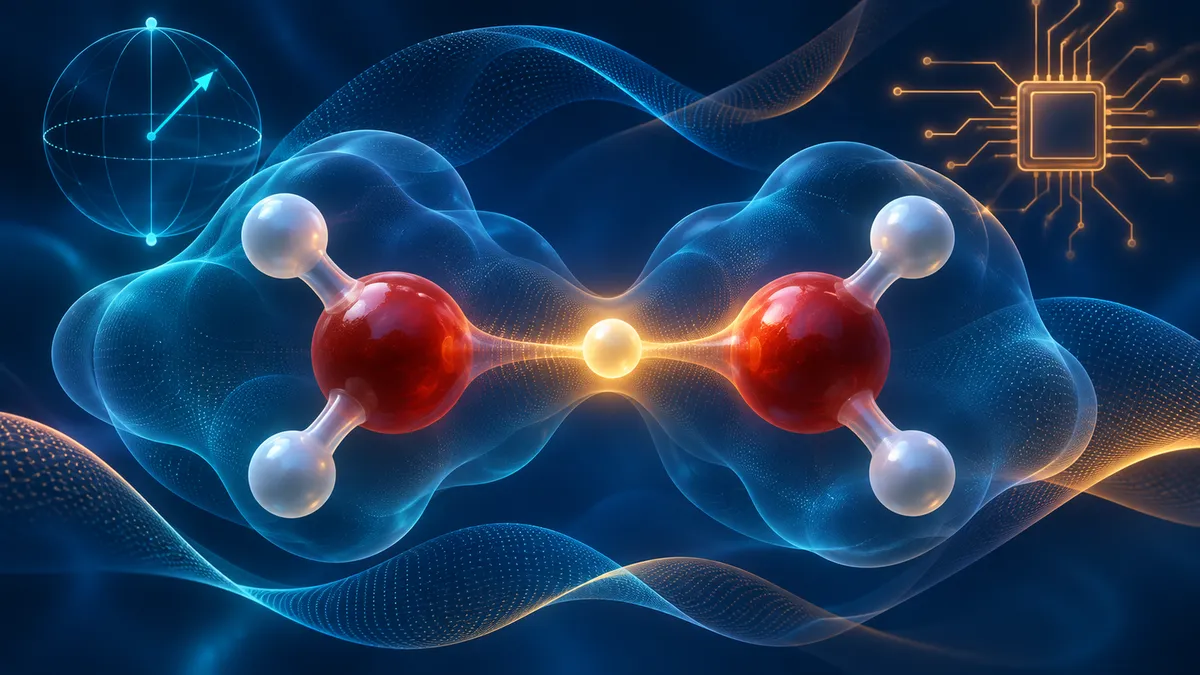
Calculating how a molecule moves means repeatedly calculating the electronic forces that move its atoms. Researchers have tested a quantum-assisted approach to that demanding task, following a proton’s journey between two water molecules and back. The demonstration combines measurements from quantum processors with substantial classical computation.
Ankit Khandelwal and colleagues at TCS Research and IBM Research describe the method, called SqDRIFT-AIMD, in a preprint submitted to arXiv on November 8, 2026. The supplied source does not establish peer review or journal publication. Its results are molecular simulations supported by quantum-hardware runs, not experimental observations of proton transfer in a physical water sample.
Dividing the calculation
The question is whether today’s quantum processors can help calculate electronic energies and forces accurately enough to sustain molecular motion, rather than merely describe a molecule at one fixed geometry.
In ab initio molecular dynamics, electronic calculations supply the forces at successive atomic arrangements. Repeating an accurate calculation at every time step makes this approach expensive.
SqDRIFT-AIMD divides the work. Quantum circuits sample possible electronic configurations. Classical computers then use those configurations to construct a smaller version of the electronic problem and solve it for an approximate lowest-energy state. Analytical energy derivatives provide nuclear forces, and a classical integration algorithm advances the atoms.
The sampling circuits use randomized approximations to electronic time evolution. They require neither repeated variational optimization nor parameters obtained from a classical coupled-cluster calculation. That electronic time evolution is a sampling tool; the nuclei themselves are propagated classically.
The team ran circuits on IBM’s Heron r3 processors, collecting 600,000 measurements per sampled geometry. Classical processing also attempted to repair configurations whose electron counts had been corrupted by hardware noise.
A proton-transfer test
The test system was the Zundel cation, H5O2+, a positively charged cluster in which two water molecules share an extra proton. The researchers used electronic active spaces containing 16 electrons in either 20 or 26 spatial orbitals, mapped onto 40 or 52 qubits. Those qubit counts describe the electronic representation, not the number of atoms.
First, they scanned the energy as the shared proton moved between the oxygen atoms while the other atoms remained fixed. Increasing the oxygen separation changed the landscape from one central energy minimum to two minima separated by a barrier.
For the largest sampled subspace in the 40-qubit model, SqDRIFT energies were below those from coupled-cluster singles and doubles, or CCSD, at every scanned geometry. Comparisons with a near-exact classical reference supported improved absolute energies. The calculation retained up to 6.25 million electronic configurations, about 0.039% of the full determinant space.
Better absolute energies did not mean exact barriers. At one oxygen separation, SqDRIFT predicted a barrier of 2.524 millihartree, compared with 1.923 millihartree from the reference. A millihartree is one-thousandth of the hartree energy unit.
The 52-qubit calculation reproduced the double-well structure but did not match CCSD’s energies: its values remained 1.3–3.4 millihartree higher. This larger model was tested through static energy scans, not a molecular-dynamics trajectory.
A short trajectory, with reused samples
The dynamics demonstration used the 40-qubit model and allowed all atoms to move. Across 177 steps spanning approximately 17 femtoseconds, the proton crossed from one oxygen’s side to the other and returned.
The proton-transfer coordinate—the difference between its distances from the two oxygens—stayed within 1.33 milliångström, or 0.00133 ångström, of a classical heat-bath configuration-interaction reference trajectory. Total energy fluctuated with a standard deviation of 0.245 millihartree, indicating stable energy conservation over this short run.
However, fresh quantum measurements were not collected at every evolving geometry. To reduce hardware use and queue delays, the researchers sampled geometries from every second step of a precomputed CCSD trajectory and reused samples for neighboring steps. Classical energy and force calculations still ran at each step. Fully on-the-fly quantum sampling remains a proposed extension.
What the demonstration leaves open
This is not a demonstration of quantum speedup. The trajectory required about 4.3 hours of reported quantum-processor time and 64 hours of classical post-processing on a machine with 64 virtual CPUs and 504 GiB of RAM. Avoiding full-space diagonalization does not establish superiority over advanced classical methods, which supplied the benchmarks here.
The results concern one small cluster, a specified electronic basis and active-space approximation, and a brief trajectory. They do not demonstrate proton transport in liquid water or a membrane. Nuclear tunneling and other nuclear quantum effects were not included. The sampling method’s theoretical convergence guarantee also assumes noiseless circuits and particular ground-state properties; it does not cover hardware noise and configuration recovery.
The demonstrated advance is narrower: quantum-assisted electronic sampling can support a closely benchmarked, short molecular trajectory in a larger active space than earlier sample-based dynamics studies.
- quantum computing
- molecular dynamics
- proton transfer
- Zundel cation
- SqDRIFT
- quantum chemistry
- hybrid quantum-classical simulation
Related reading
Automatically matched by shared topic keywords. These links do not imply that the sources agree or establish a consensus.
Quantum proposals improve a fixed-size molecular calculation
Source published
Shared keywords: quantum chemistry, quantum computing
CoMoFlow Gives Protein Shape Generation a Set of Motion Controls
Source published
Shared keywords: molecular dynamics
Tessera scales molecular AI to 30.7 million atoms across 512 GPUs
Source published
Shared keywords: molecular dynamics
A statistical correction helps VQE escape measurement plateaus
Source published
Shared keywords: quantum chemistry
Hydrogen stand-ins help transfer quantum circuit settings to larger molecules
Source published
Shared keywords: quantum chemistry