TRANSMISSION // 2611.11078v1
Webb separates the dust signals around Tc 1’s carbon cages
Source published
JWST observations reveal distinct infrared-emitting materials in the fullerene-rich nebula Tc 1. Silicon carbide is a strong candidate for part of its dust emission, while other signals remain unidentified.
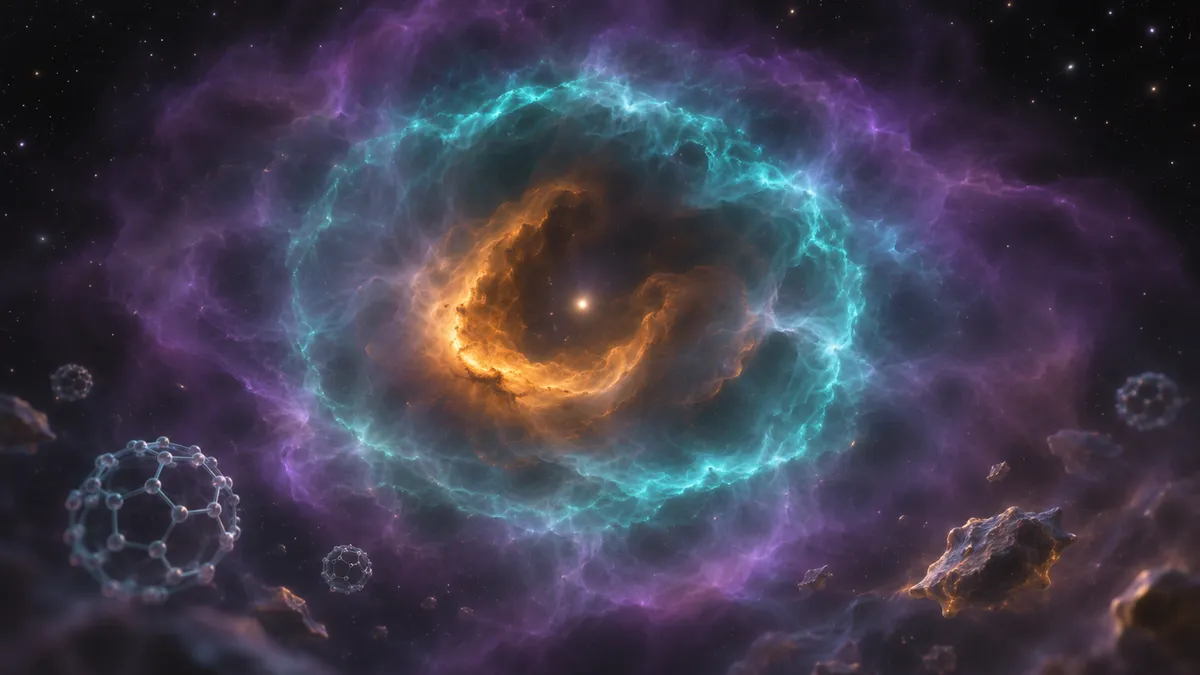
Tc 1 contains hollow carbon molecules called fullerenes, but the surrounding dust has its own unresolved chemistry. Webb’s spatially resolved spectra show that broad infrared features trace different materials—and possibly changes in the grains themselves.
What kind of dust surrounds a nebula rich in carbon cages, and does it offer clues to how those molecules form? A study of Tc 1 uses the James Webb Space Telescope to distinguish overlapping infrared signals. The results suggest a mixture of materials rather than a single explanation for the nebula’s broad dust features.
Tc 1 is a young planetary nebula: gas and dust surrounding an evolved central star. It is especially useful for studying fullerenes, hollow molecules built from carbon atoms. Its strong fullerene emission includes signals from C60, a cage containing 60 carbon atoms. Those signals peak in a thin ring roughly five arcseconds from the star. Much of the bright inner dust emission instead follows a smaller, horseshoe-shaped structure.
The supplied evidence is the version-one arXiv manuscript. It investigates this dusty environment rather than establishing a mechanism for making fullerenes. Its proposed material identifications remain provisional.
Separating overlapping signals
The researchers used observations taken on August 8, 2024, with Webb’s Mid-Infrared Instrument and its medium-resolution spectrometer. These provide a spectrum at each position across the observed region, covering approximately 4.9–27.9 micrometres. A spectrum records how brightness changes with wavelength, allowing researchers to distinguish different sources of infrared emission.
Tc 1’s spectra contain narrow atomic lines, molecular bands, broad emission features and a smooth underlying continuum. The team fitted and removed molecular features, compared spectra from small apertures, and mapped the remaining broad emission.
Two broad features receive particular attention: a plateau spanning roughly 6–9 micrometres and another spanning 9–13 micrometres. A plateau is an extended rise in emission rather than a sharply defined line.
The shorter-wavelength plateau retains essentially the same shape across the observed field, even though its brightness changes. The longer-wavelength plateau changes shape substantially. That difference points to different emitting materials or heating behaviour.
Three components, not three confirmed substances
The 9–13 micrometre plateau can be reproduced with three spectral components, peaking near 9.5, 11 and 12 micrometres. The researchers reached this conclusion both through direct profile fitting and through non-negative matrix factorization, a mathematical method that reconstructs spectra by adding positively weighted component patterns.
Three such patterns reproduce the extracted plateau spectra with a root-mean-square residual of about 5% of the average flux. But a useful mathematical component is not automatically a separate chemical substance: it can combine physical contributions, and real grain spectra can change with temperature.
The component near 11 micrometres closely resembles silicon carbide emission observed in other evolved-star environments. The 12-micrometre component resembles some laboratory silicon carbide spectra too, although that identification is less secure. Different grain shapes, sizes, aggregation states or impurities could potentially produce the two profiles.
Their changing relative strengths across Tc 1 therefore hint at dust processing. They do not establish which grain property changes or what process causes it. Titanium carbide and zirconium carbide are tentative candidates for the 9.5-micrometre component, but limited laboratory measurements and abundance constraints prevent a firm identification.
A different kind of emitter
The unchanging shape of the 6–9 micrometre plateau suggests stochastic heating: individual photons deliver brief bursts of energy to small particles or molecules, rather than maintaining a steady temperature. Its emission also extends beyond the fullerene ring more gradually than the other dust features do.
Large carbon-based molecules are promising candidates, including polycyclic aromatic hydrocarbons, known as PAHs. Yet every candidate has difficulties. Fullerene models predict additional broad emission at longer wavelengths that is not observed. Large PAHs could produce blended bands, but explaining such a strong plateau alongside Tc 1’s weak aromatic bands requires further modelling.
The continuum fits imply dust temperatures of roughly 90–140 kelvin. A simple heating model suggests that trapped hydrogen Lyman-alpha photons could explain the relatively uniform temperatures outside the inner horseshoe, where direct starlight alone does not reproduce the observed pattern.
Important uncertainties remain. Removing molecular bands and estimating the continuum can alter the extracted features. The mathematical decomposition assumes fixed component shapes, even though temperature changes can modify grain emission. Webb captures only the short-wavelength wing of the broad 30-micrometre feature, making its analysis particularly uncertain. The study sharpens the distinction between Tc 1’s emitting materials, but neither identifies them all nor shows how its carbon cages formed.
- Tc 1
- planetary nebula
- James Webb Space Telescope
- infrared spectroscopy
- fullerenes
- silicon carbide
- circumstellar dust
- stochastic heating
Related reading
Automatically matched by shared topic keywords. These links do not imply that the sources agree or establish a consensus.
Webb traces free-floating carbon cages around Tc 1
Source published
Shared keywords: infrared spectroscopy, james webb space telescope, planetary nebula
Ansky’s galaxy shows signs of black-hole activity before its 2019 brightening
Source published
Shared keywords: james webb space telescope
Webb detects a long-sought rotational signal from a key interstellar ion
Source published
Shared keywords: infrared spectroscopy
Measuring the stars behind JWST’s planet spectra
Source published
Shared keywords: infrared spectroscopy
Infrared spectra reveal contrasting gas regions in nova V5668 Sgr
Source published
Shared keywords: infrared spectroscopy