TRANSMISSION // 2611.10988v1
Circular gratings guide photons from telecom quantum dots
Source published
Researchers aligned C-band InAs/InP quantum dots with circular Bragg gratings, improving collected light and observing interference between successive photons under above-band excitation. The measured interference depends strongly on how tightly events are selected in time.
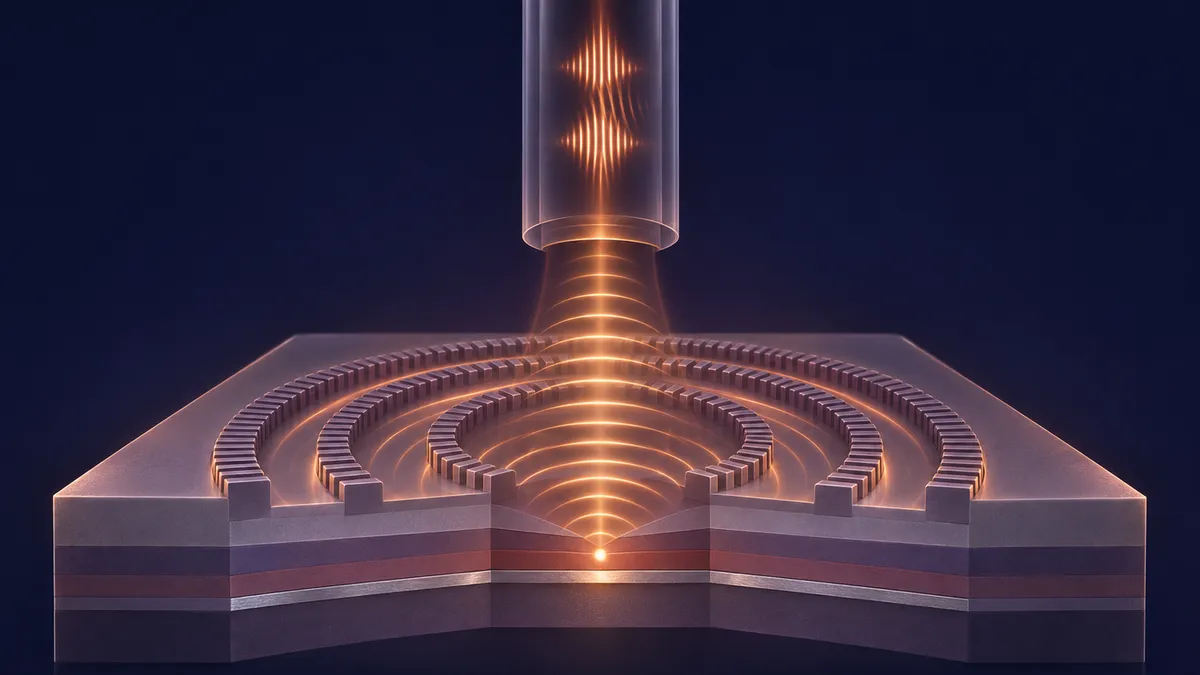
A quantum-network photon has to do two jobs: leave its semiconductor source efficiently and remain similar enough to later photons to interfere with them. Can a telecom-wavelength quantum dot meet both demands without elaborate resonant pumping or a strongly enhancing cavity? A new study tests a patterned circular grating around individual dots grown in indium phosphide.
Getting light out
Quantum dots are tiny semiconductor structures that can emit one photon after being excited. For fiber networks, emission in the telecom C-band—around 1550 nanometers—can use a low-loss region of standard optical fiber. But a dot embedded in a semiconductor does not automatically send most of its light toward a detector or a fiber. Its surroundings can also fluctuate, making photons from separate emission events less alike.
The team grew indium arsenide dots in an indium phosphide matrix using metal-organic vapor-phase epitaxy, then used low-temperature cathodoluminescence to locate dots emitting in the C-band. They wrote circular Bragg grating (CBG) patterns around selected dots with an in-situ electron-beam process. The rings and central mesa redirect emitted light into a collection cone; a reflector beneath the device helps shape the optical environment. The design emphasized collection rather than strong cavity enhancement.
Simulations predicted extraction efficiency above 80% across much of the C-band, peaking near 83% around the band center. In the measured devices, the three CBG-integrated dots were brighter than seven planar reference dots, with average integrated brightness about twice the reference average. These measurements support improved collection, but the small comparison—three patterned emitters against seven randomly selected reference dots—is not a broad population survey.
Testing single photons
The researchers studied three devices, labeled CBG1, CBG2 and CBG3. Their measurements were made at cryogenic temperatures, typically near 4 kelvin. Under pulsed, above-band excitation, a laser pulse first creates carriers in the surrounding semiconductor; those carriers can relax into the dot. This practical approach avoids resonant excitation, but the extra carriers can also be recaptured and produce additional photons or disturb the dot’s local charge environment.
For CBG2 at 3.6 K, a fit to the short-time antibunching dip gave a post-selected second-order correlation value, g²(0), of 0.03 ± 0.01. A wider integration of the central peak gave 0.17 ± 0.03. The two values answer related but different questions: the narrow fit isolates coincidences near zero delay, while the wider measurement also includes temporal broadening and correlations across the excitation period. CBG1 likewise had a lower fitted value (0.05 ± 0.02) than its integrated value (0.22 ± 0.05). Thus, a strong dip at zero delay does not mean that every pulse produces exactly one photon. The authors attribute the wider-window contribution mainly to carrier recapture after non-resonant excitation.
To see whether successive photons can interfere, the team delayed one optical path by the 12.5-nanosecond laser period and compared photons with matching polarization against a distinguishable, crossed-polarization reference. The central coincidence peak was reduced in the matching-polarization measurement: the Hong–Ou–Mandel visibility was 35 ± 2% when integrated over the full period. Restricting the analysis to a short time window raised the reported visibility to 70 ± 18%. This is a time-selected result, not the visibility across all detected events; the large uncertainty also matters when interpreting it. The difference indicates that photon similarity varies over time, consistent with the authors’ discussion of nanosecond-scale charge fluctuations.
A starting point, not a finished network source
The measured radiative lifetime was 1400 ± 50 picoseconds, and the spectral linewidth was 41.0 ± 4.0 microelectronvolts. The devices did not show significant Purcell enhancement: the cavity design prioritized efficient light collection. That choice demonstrates interference under relatively simple above-band pumping, but the observed full-window visibility remains modest compared with more selectively excited or more strongly engineered sources. The authors suggest faster radiative emission, charge stabilization and more selective excitation as routes to improving indistinguishability; these are proposed strategies, not outcomes demonstrated here.
The work combines deterministic placement, a telecom-emitting material system and measured two-photon interference. It does not demonstrate a deployed fiber network, operation at room temperature, or near-perfect photon indistinguishability. The reported findings come from a small set of devices. This arXiv manuscript reports a fabrication and measurement baseline: photons from C-band dots can be collected with patterned gratings and can interfere even when generated by above-band excitation, while temporal correlations and charge noise remain significant constraints.
- quantum dots
- single photons
- telecom C-band
- circular Bragg gratings
- photon interference
- quantum networks
Related reading
Automatically matched by shared topic keywords. These links do not imply that the sources agree or establish a consensus.