TRANSMISSION // 2611.10979v1
A close galactic encounter could bend the Large Magellanic Cloud’s bar
Source published
Seven galaxy simulations suggest that encounters with the Small Magellanic Cloud can warp its larger neighbour’s disk and bend its central bar. Comparisons with Gaia observations favour a recent close passage, but missing gas physics and limited model choices leave the encounter’s details uncertain.
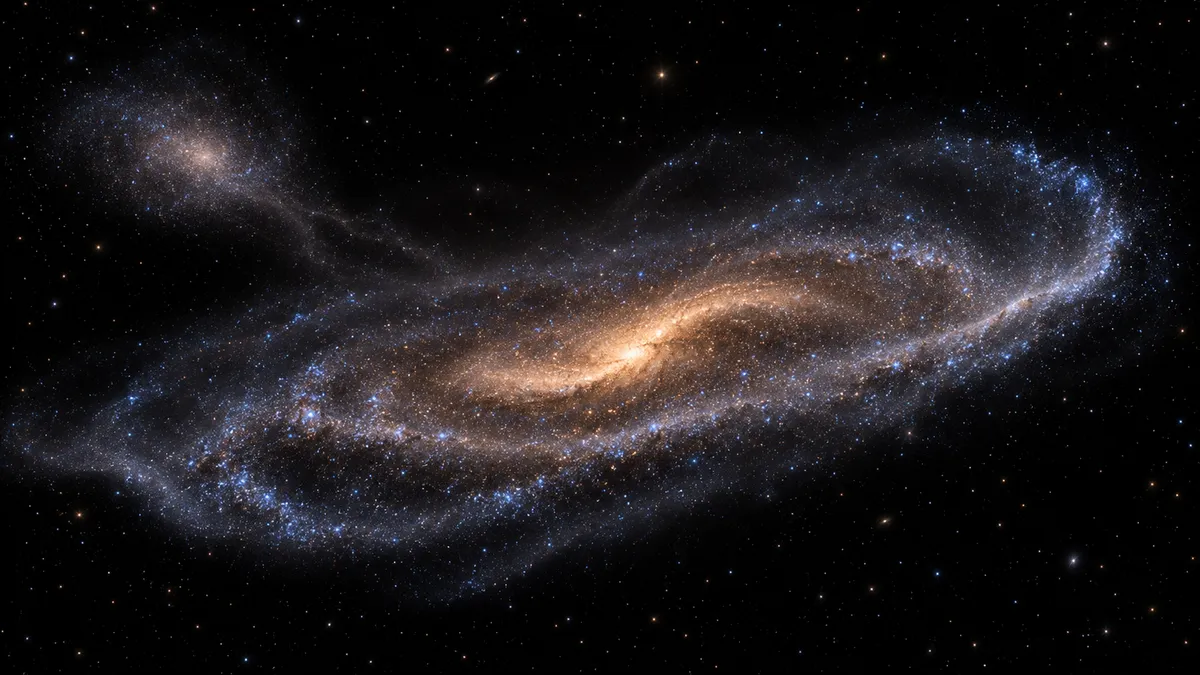
Is the Large Magellanic Cloud’s central bar tilted, or is it bent? New simulations suggest that a close encounter with its smaller companion can produce a deformed bar that looks tilted without behaving like a rigid structure.
The Large Magellanic Cloud has an uneven shape: its central bar of stars appears tilted relative to its surrounding disk, while the outer disk is warped. Could gravitational encounters with the Small Magellanic Cloud explain both features?
In a manuscript available on arXiv and accepted by Astronomy & Astrophysics, Shuyu Wang and colleagues investigate how those encounters disturb stellar positions and motions perpendicular to the larger galaxy’s disk. Their simulations support a tidal explanation, but also complicate the picture of a bar simply tipped out of alignment. The simulated bars bend and sometimes buckle rather than rotating as rigid objects.
Separating the bar from the disk
The researchers analysed seven simulations from the KRATOS suite. One followed an isolated Large Magellanic Cloud-like galaxy. Three included a Small Magellanic Cloud-like companion, and three included both that companion and a Milky Way-like galaxy. The models varied the larger galaxy’s disk mass, dark matter halo mass and initial disk stability. All seven were selected for having consistently strong bars.
These are gravitational, particle-based simulations, not full models of everything inside a galaxy. They follow stellar and dark matter components but omit gas dynamics.
To examine the bar separately from the disk, the team used a method based on persistent homology, a mathematical approach that tracks how connected structures emerge as the distance allowed between points changes. Combined with stellar velocities, it identifies a connected population of simulated bar stars. The selection favours a relatively clean bar sample rather than capturing every bar star.
After centring and aligning each galaxy, the researchers used Fourier decomposition to measure patterns in stellar heights and vertical velocities around it. A pattern labelled m = 1 captures a one-cycle variation around the galaxy, associated here with warping. An m = 2 pattern in the bar helps identify buckling, in which the bar develops an out-of-plane bend.
Close passages leave vertical disturbances
Every interacting simulation developed strong m = 1 vertical asymmetries in its bar and disk after relevant companion passages. In the isolated comparison, the bar remained vertically symmetric and the disk stayed flat. Some interacting bars also developed buckling signatures.
The encounter distance had the strongest correlation with the bar’s immediate vertical velocity disturbance: closer passages generally produced larger effects. Relative speed and the galaxies’ mass ratio showed weaker correlations within the tested models.
One particularly close encounter illustrates why a tilted appearance need not mean a rigid tilt. In model K11, the companion passed about 0.26 kiloparsecs from the larger galaxy’s centre. It added a warp to an already buckling bar, making the bar lopsided and strongly disturbing the disk.
An estimated bar angle reached 10.7 degrees roughly 150 million years later. It remained within the observationally reported range of 5–15 degrees for about 300 million years. But this angle summarises a deformed structure; it does not describe an intact, flat bar simply tipped sideways.
Comparing with Gaia
The team also analysed vertical stellar motions in Gaia’s third data release. The observed bar showed a clear m = 1 velocity asymmetry, but no clear m = 2 signature establishing that the real bar is currently buckling.
Artificial Gaia catalogues provided an important check. The researchers applied observational uncertainties and selection effects to simulated stars, then reconstructed their motions. The main asymmetries survived, suggesting that the tested measurement limitations do not manufacture the signal, although they blur some outer-disk features.
For K11, the bar’s simulated m = 1 velocity signal remained consistent with Gaia for approximately 210 million years after the direct encounter. Together with the longer-lived apparent tilt, this motivates a model-dependent upper timescale of roughly 210–300 million years since the latest close passage—not a precise measurement of when it happened.
What remains unsettled
The results suggest that a higher companion-to-primary total mass ratio, around 0.22 rather than 0.10, may help reproduce the observed bar angle. They do not establish a unique mass ratio or encounter history: the simulations cover limited initial conditions, with snapshots spaced 75 million years apart.
Gas is another substantial omission because the real Large Magellanic Cloud is gas-rich. Gaia distances also remain too uncertain to reconstruct individual stellar heights reliably, and the quoted observational error estimates mainly capture statistical uncertainty.
The study therefore offers a plausible gravitational mechanism, not a complete reconstruction: a close companion passage can warp the disk and deform the bar, producing an apparent tilt whose underlying structure is more complicated than it first appears.
- Large Magellanic Cloud
- Small Magellanic Cloud
- galactic bars
- tidal interactions
- galactic warps
- bar buckling
- Gaia DR3
- N-body simulations
Related reading
Automatically matched by shared topic keywords. These links do not imply that the sources agree or establish a consensus.
Self-interacting dark matter deepens a galactic bar puzzle in simulations
Source published
Shared keywords: galactic bars
Neutron star binaries may get their chance after a cluster’s black holes leave
Source published
Shared keywords: n body simulations
How gravitational turbulence may help galaxies settle down
Source published
Shared keywords: n body simulations
Gas disks could steer stars into growing black holes
Source published
Shared keywords: n body simulations
Stellar Accelerations and Jerks Could Help Gaia Find Hidden Black Holes
Source published
Shared keywords: gaia dr3