TRANSMISSION // 2611.10959v1
Stellar pulses point to two binaries—and spectra confirm the motion
Source published
Follow-up spectra confirm orbital motion in two hot subdwarf systems first identified through shifts in their pulsation timing. One system may have an unusually eccentric orbit, but sparse measurements and underestimated uncertainties leave that result needing further checks.
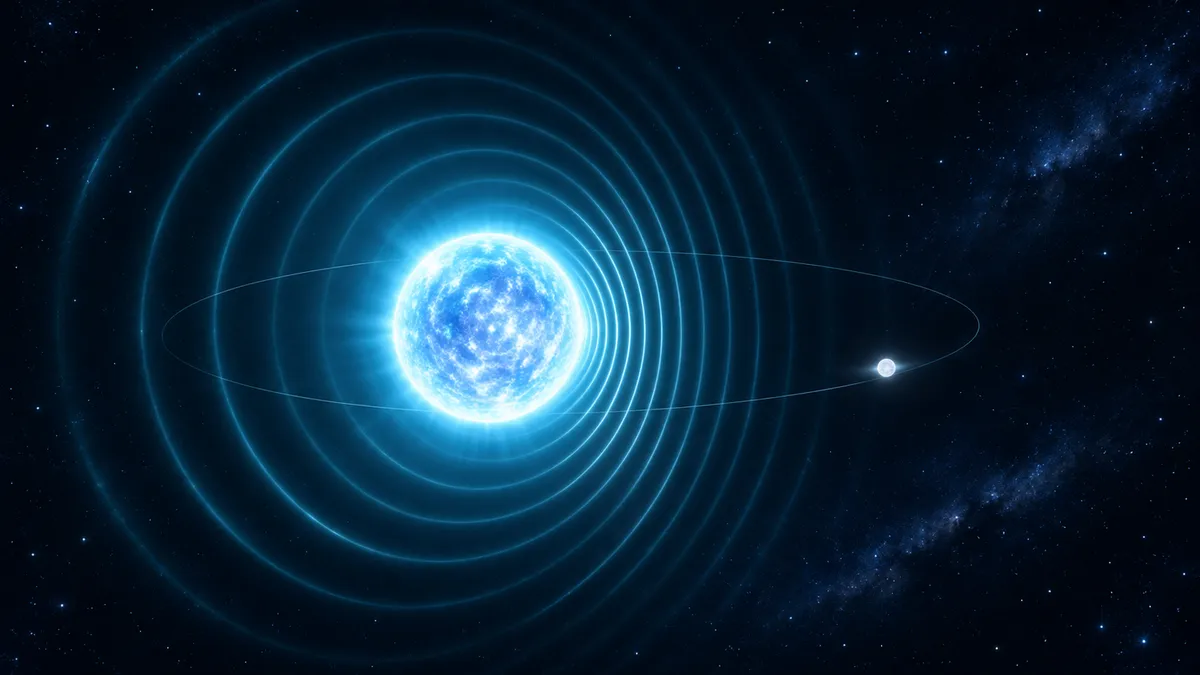
A regularly pulsating star can reveal its orbital motion through tiny changes in when its light arrives. Astronomers have now checked two such detections by measuring the stars’ motion directly, strengthening the binary interpretation while uncovering an orbital puzzle.
How can astronomers tell whether a star’s changing pulse times reveal an unseen companion rather than something happening within the star itself? For two hot subdwarfs observed by NASA’s TESS spacecraft, a new study supplies an independent check: their spectral lines shift back and forth as expected for orbiting stars.
Tomomi Otani and colleagues studied TIC 69298924 and TIC 202354658, previously identified as probable binaries through their pulsations. The new measurements confirm binary motion and support the earlier interpretation that the companions are white dwarfs. They also suggest that one orbit is unusually elongated—although that finding needs better observations.
Reading motion from arrival times
Subdwarf B stars are hot, helium-burning stars with only thin hydrogen envelopes remaining. Some pulsate with sufficiently stable periods that their brightness variations provide a timing reference.
If a pulsating star travels around a binary system’s centre of mass, its distance from Earth changes. Light takes slightly longer to arrive when the star is farther away and slightly less time when it is closer. The pulses therefore arrive periodically late and early, even if the underlying pulsation remains steady.
Earlier work found this pattern in TESS observations of both targets. A related Fourier analysis, which separates brightness variations into their component frequencies, also identified signatures consistent with orbital modulation. But frequency patterns can be ambiguous: stellar rotation can produce superficially similar structures. Measuring motion through spectroscopy provides a different test.
A second way to see the orbit
The researchers used spectra from Gemini North for TIC 69298924 and the Nordic Optical Telescope for TIC 202354658. Comparing stellar absorption lines with a template gave radial velocities: the component of each star’s motion toward or away from the observer.
Timing and velocity measure different aspects of the same orbit. Timing traces the changing light-travel distance; radial velocity measures how quickly that distance changes. Consequently, their curves should have related shapes but reach their maxima at different orbital phases.
Because the spectroscopic observations were sparse, the team fixed the orbital periods at values previously obtained from pulsation timing: about 12.84 days for TIC 69298924 and 5.54 days for TIC 202354658. They allowed the orbital eccentricity and orientation to vary, then used those results to refit the timing observations. The follow-up is therefore an independent measurement of motion, but not a wholly independent determination of every orbital parameter.
Both stars showed periodic velocity changes broadly matching the timing predictions. The fitted velocity amplitudes were about 44.7 and 46.6 kilometres per second, respectively. These were approximately 10% and 15% below the timing-based expectations. The authors suspect limited spectroscopic sampling contributes to the differences; the agreement is supportive rather than exact.
An orbit that needs another look
TIC 69298924 has a nearly circular fitted orbit, with eccentricity around 0.064. Eccentricity measures departure from a circle, for which the value is zero.
TIC 202354658 produced a more striking result: an eccentricity of 0.313, with a quoted formal uncertainty of 0.013. That would be unusually large compared with the short-period subdwarf binaries discussed in the paper.
However, the velocity measurements scatter around the fitted curves substantially more than their individual error estimates predict. The authors identify stellar pulsations and instrumental effects as possible additional sources of variation. They explicitly warn that the orbital-parameter uncertainties may be underestimated. More spectroscopy covering the full orbit is needed before treating the large eccentricity as secure.
The strongest conclusion is that both stars are binaries. The white-dwarf companion interpretation is supported, rather than established here through direct observations of the companions themselves.
The work is available as an arXiv manuscript accepted for publication in The Astronomical Journal; acceptance does not establish that journal publication has already occurred. Its practical contribution is two additional checks showing how stellar pulse timing can identify binaries worth following up, particularly at orbital periods where transits and illumination effects become less effective detection tools.
- subdwarf B stars
- binary stars
- pulsation timing
- radial velocity
- TESS
- white dwarf companions
- orbital eccentricity
Related reading
Automatically matched by shared topic keywords. These links do not imply that the sources agree or establish a consensus.
A binary star in Sagittarius’s Teapot reveals its orbit—and a distance problem
Source published
Shared keywords: binary stars
Close companions are unlikely to explain most slow-spinning stars in open clusters
Source published
Shared keywords: binary stars
A fast-spinning pulsar reveals a changing companion star
Source published
Shared keywords: binary stars
Three kinds of observations refine the orbit and masses of V819 Herculis
Source published
Shared keywords: radial velocity
A Timing Pattern in the Slow Dimming of Red Giants
Source published
Shared keywords: radial velocity