TRANSMISSION // 2611.10946v1
Reading spin entanglement in a tunneling microscope’s spectra
Source published
A preprint connects local tunneling spectra to entanglement in engineered spin systems, reconstructing stronger and weaker entangled bonds from existing nanographene-chain measurements under specific model assumptions.
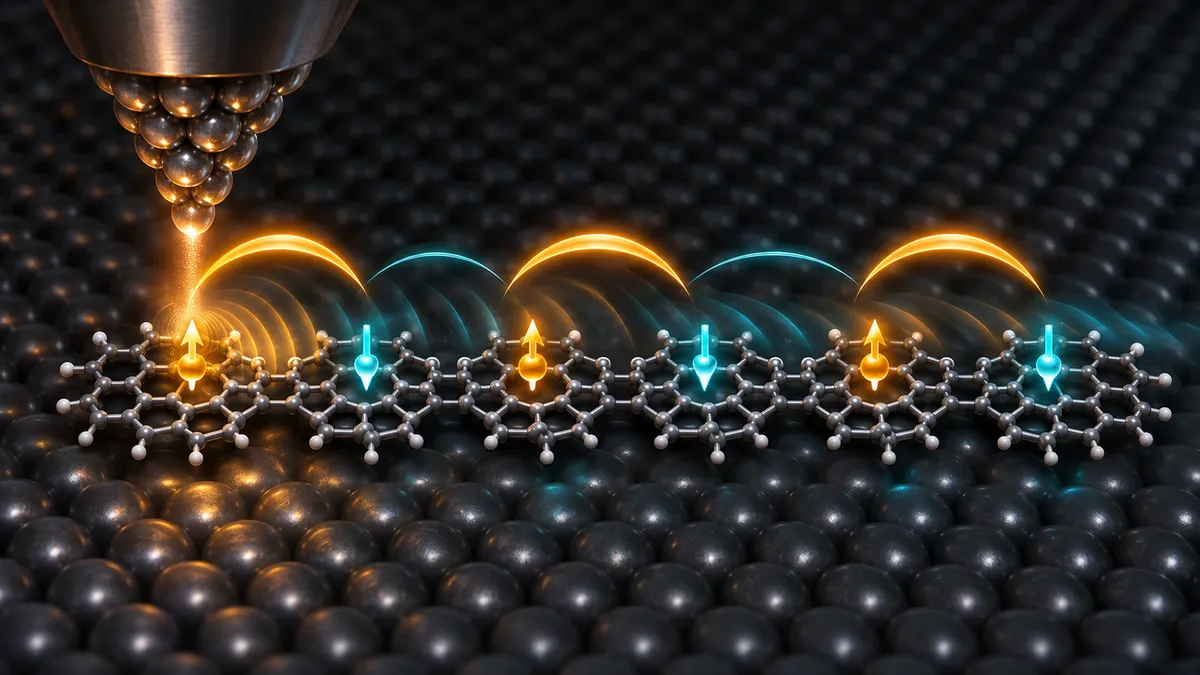
A scanning tunneling microscope probes one tiny patch of a surface at a time. Can its measurements reveal quantum entanglement shared across several spins? A new preprint explains how collective magnetic excitations can carry that information into a local electrical signal.
A local measurement with a collective response
Entanglement means that a quantum system cannot be described as independent states of its parts, or a statistical mixture of such independent states. Detecting it in surface-mounted magnetic structures is challenging: a microscope can address an individual spin, but entanglement concerns relationships between spins.
In this preprint, J. C. G. Henriques, B. Viña-Bausá, I. Brihuega and J. Fernández-Rossier develop connections between those relationships and spin inelastic electron tunneling spectroscopy, or IETS. They also apply their method to previously measured nanographene chains. The result is not a direct photograph of entanglement. It is a reconstruction from electrical spectra, supported by a model of the interacting spins.
A scanning tunneling microscope passes electrons between a sharp tip and a surface. When an electron supplies enough energy to excite the spin system, an additional tunneling channel opens. This produces a step in differential conductance: how rapidly current changes with applied voltage.
The step’s position reveals an excitation energy. Its height carries information about how strongly a local spin operation connects the system’s initial and final quantum states. Because those states belong to the interacting structure, a locally triggered transition can reveal collective properties.
Turning spectra into entanglement measures
The authors organize this information into spectral “moments.” First, they take the voltage derivative of the conductance, turning excitation steps into peaks. Integrating these peaks gives their combined weight; weighting them by voltage before integrating also accounts for their excitation energies.
The unweighted, or zeroth, moment has a particularly simple interpretation for spin-1/2 systems with a unique ground state and temperatures well below the excitation gap. After calibration, it determines the one-tangle: a measure of entanglement between one spin and everything else in a globally pure state.
That restriction matters. A spin can appear locally disordered because it is entangled with other spins, but also because the whole system is a statistical mixture. The same identification does not generally work for a mixture of degenerate ground states.
The voltage-weighted first moment provides a different route. For a Heisenberg model, it measures a weighted sum of correlations between a spin and its exchange-coupled neighbors. In an open chain with nearest-neighbor coupling, the individual bond contributions can be recovered successively, starting at an end.
If the exchange strengths are known and the state is rotationally invariant in spin space, those correlations determine pairwise concurrence, an entanglement measure for two spin-1/2 particles. Unlike the one-tangle reconstruction, this relation can also apply to thermal mixtures. It does not automatically extend to arbitrary interactions or coupling networks.
Reconstructing entangled bonds in nanographene chains
The researchers analyze existing site-resolved tunneling spectra from nanographene chains containing four, six and eight effective spin-1/2 units. They use an independently determined nearest-neighbor exchange coupling of 38 millielectronvolts.
An essential step is calibrating the tunneling strength separately at each measurement position. For these chains, the authors assume a low-temperature, nondegenerate singlet ground state and a measurement window containing all relevant spin-excitation weight. Together, these conditions supply the normalization needed to turn measured intensities into correlations.
The reconstructed bonds alternate between stronger and weaker antiferromagnetic correlations, broadly matching the model’s predictions. Agreement is closest for the four- and six-spin chains. In the eight-spin chain, the reconstructed correlations are systematically weaker, producing smaller inferred concurrences.
Even with uniform exchange coupling, open boundaries can therefore produce an uneven distribution of pairwise entanglement. Equal coupling strengths do not require equally entangled neighboring pairs.
What the signal can—and cannot—establish
The preprint also derives a simple, more limited witness. For a spin-1/2 pair, three distinct inelastic thresholds from a single occupied initial state, measured through an operator acting on only one spin, rule out a complete basis of unentangled energy eigenstates. This establishes that at least one eigenstate is entangled—not necessarily the occupied ground state. Fewer thresholds give no such conclusion.
The broader framework also connects other moments to longer-range correlations and local magnetic susceptibility, and gives a model-specific relation between three-spin excitation weights and genuine tripartite entanglement.
All these interpretations depend on the tunneling description. The calculations neglect entanglement with electrode electrons and higher-order exchange effects that can distort spectral shapes. Background signals, incomplete energy coverage and uncertain calibration can also affect inferred moments.
The preprint’s contribution is therefore a conditional but concrete bridge: familiar local spectroscopy can quantify selected nonlocal quantum relationships when the spin model, measurement regime and calibration justify the conversion.
- quantum entanglement
- scanning tunneling microscopy
- inelastic electron tunneling spectroscopy
- spin chains
- nanographene
- quantum magnetism
Related reading
Automatically matched by shared topic keywords. These links do not imply that the sources agree or establish a consensus.
EntNet learns entanglement signatures from spin correlations
Source published
Shared keywords: quantum entanglement, spin chains
Weaker end connections could improve quantum energy transfer
Source published
Shared keywords: spin chains
Quantum entanglement could build patterns that outlast it
Source published
Shared keywords: quantum entanglement
When does neutrino entanglement matter? Quantum simulations test the limits
Source published
Shared keywords: quantum entanglement
Entangled qutrits reach the quantum limit in a two-player hat game
Source published
Shared keywords: quantum entanglement