TRANSMISSION // 2611.10934v1
A black hole collision can make a massive star burn itself apart
Source published
Simulations suggest that nuclear burning can decide whether a massive star survives a direct black hole collision. How quickly the heat arrives matters more than the total energy alone, with composition and stellar structure changing the outcome.
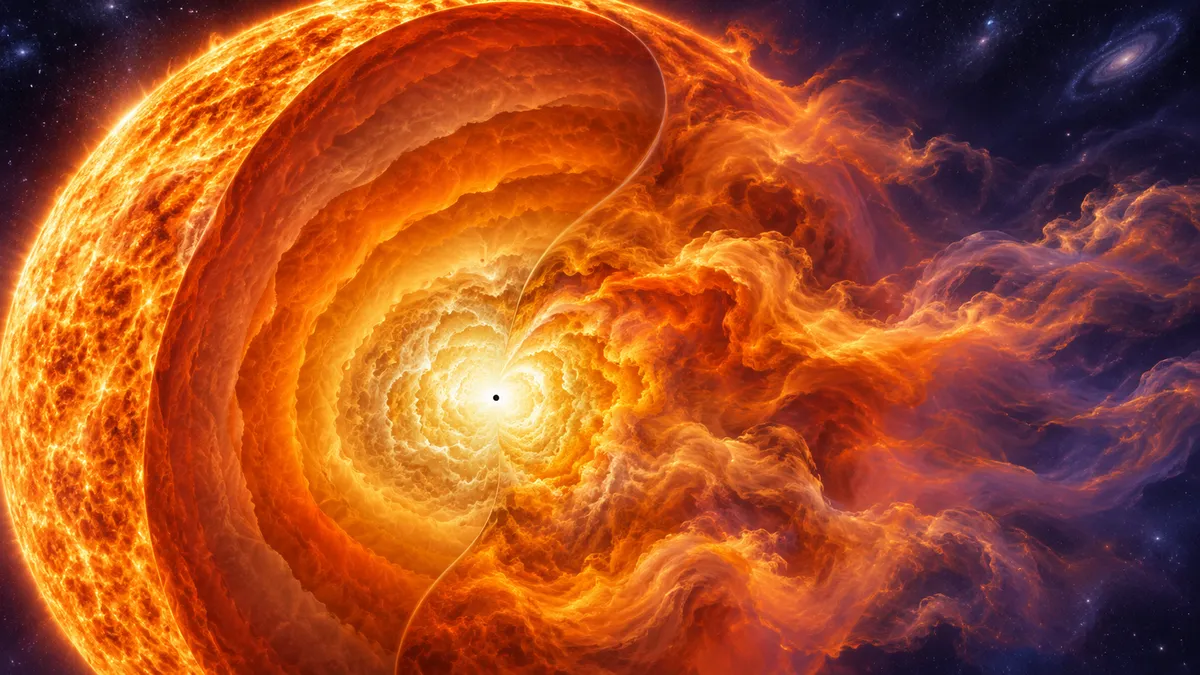
A black hole entering a massive star need not immediately destroy it. It can settle inside, surrounded by stellar gas. But new simulations suggest that the compression around this intruder can accelerate nuclear burning enough to break the star apart—or leave a violently overheated survivor.
What happens when a black hole plunges straight into a star much heavier than itself? The answer is not simply that the black hole swallows everything. Gas can slow the intruder until it settles near the stellar center, leaving a black hole embedded inside a surviving star.
A preprint by Hong-Xuan Jiang and Douglas N. C. Lin investigates a complication: the gas is nuclear fuel, not an inert fluid. Their simulations suggest that compression around the captured black hole can accelerate hydrogen burning enough to destroy some stars that would otherwise survive. The decisive difference is often how quickly that energy arrives.
Adding nuclear reactions to the collision
The researchers used the AthenaK hydrodynamics code to simulate head-on encounters involving stars of 100 or 500 times the Sun’s mass. Black holes weighed either one-tenth or one-fifth of their target star. The stellar models included a solar-like chemical mixture, a mixture poor in elements heavier than helium, and helium-enriched compositions.
The calculations followed gas motion, gravity and nuclear heating. Comparison runs calculated nuclear reactions without depositing their released heat into the gas, helping isolate the effect of that feedback.
These are direct collisions, not cases in which a distant black hole tears a star apart through tides. Here, the lighter black hole penetrates the star and loses orbital energy through drag. That heats the gas, but the captured black hole also strengthens the gravity holding it together. In the tested encounters, drag without nuclear heating did not destroy the star.
Nuclear reactions supplied an additional energy source.
Compression changes the burning
Gas gathering around the black hole reached temperatures above roughly 200 million kelvin. Under these conditions, hydrogen burns rapidly through the CNO cycle, which uses carbon, nitrogen and oxygen nuclei as catalysts.
The reaction rate eventually encounters a bottleneck set by radioactive decay lifetimes. That ceiling matters: the authors do not find a nuclear detonation. Instead, sustained heating expands the compressed gas and can push the star toward disruption.
The expansion also limits its own power source. As gas spreads out, less remains in the conditions needed for enhanced burning. In disrupted models, the accumulated nuclear energy flattened near the energy initially required to unbind the star. This did not mean the hydrogen supply had run out; the star’s response had weakened the burning.
Similar energy, different outcomes
One revealing comparison involved two 100-solar-mass stars, each struck by a 20-solar-mass black hole. The solar-composition star was disrupted, while the metal-poor star retained a substantial stellar remnant around its captured black hole.
Their total nuclear energy releases were remarkably similar, differing by about 9%. But the metal-poor star, with fewer CNO catalysts, released its energy more slowly. It had time to expand and adjust rather than lose its self-gravitating structure.
Across the tested models, disrupted stars received more than half their initial binding energy as nuclear heat during the defined encounter interval. Survivors received less than a quarter. Those values describe this simulation set, not an established universal boundary.
Helium-enriched and very massive models were especially vulnerable because they were more weakly bound relative to their internal pressure support. The lower black-hole mass ratio left both the solar-composition 100- and 500-solar-mass stars intact.
“Disrupted” does not necessarily mean that all gas escapes the black hole. In the solar-composition 100-solar-mass case, about 72% of the original stellar mass remained bound to the combined black hole and gas system at the simulation’s end, although the star’s self-bound structure was breaking down. Its eventual fallback was not followed.
Survivors are not settled stars
The surviving objects retained 86–97% of their original stellar gas within the combined system. They were still burning intensely and remained far from thermal equilibrium. Their long-term survival is therefore unresolved.
The study is an arXiv preprint, not an observational detection or a peer-reviewed result. Its largest modeling uncertainty concerns gas closest to the black hole: accretion and its radiative feedback were omitted, and gravity was numerically smoothed near the center. Burning there was switched off. Changing that smoothing scale substantially changed the released energy, although the tested survival classifications stayed the same.
Oblique collisions, radiation transport and longer-term evolution remain unexplored. Within those limits, the calculations identify a consequential distinction: a star’s fate depends not just on how much nuclear heat a collision unlocks, but on whether the star can respond before that heat overwhelms it.
- black hole–star collisions
- massive stars
- thermonuclear feedback
- CNO cycle
- stellar disruption
- hydrodynamical simulations