TRANSMISSION // 2611.10910v1
Gas stripping leaves galaxy discs’ stellar spin largely intact
Source published
A GASP survey analysis finds that selected disc galaxies in clusters and quieter environments follow similar mass–rotation and stellar angular-momentum relations. Stripped galaxies show a modest gas-related offset, but its interpretation depends strongly on how gas mass is inferred from star formation.
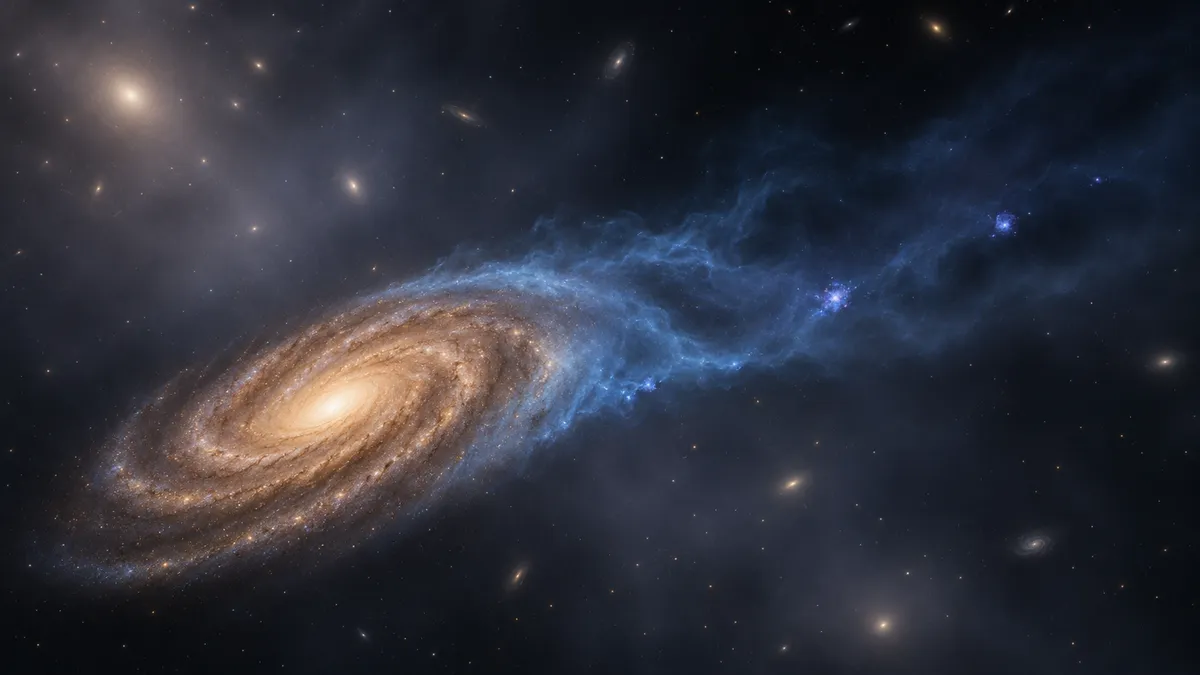
Can a galaxy lose gas without noticeably changing its stellar disc’s rotation? A study of galaxies at different stages of environmental stripping finds similar stellar scaling relations across environments, alongside a more complicated signature in their gas.
When a galaxy travels through the hot gas filling a galaxy cluster, the resulting pressure can strip away its own gas. Some affected galaxies develop trailing structures, earning them the name jellyfish galaxies. But does losing fuel also change the relationship between a galaxy’s mass and its rotation?
C. Bacchini and colleagues investigate that question using the GAs Stripping Phenomena in galaxies survey, or GASP. Their analysis, available as an arXiv manuscript posted on November 7, 2026, finds no significant environmental shift in several basic relationships describing stellar discs. Gas does show a difference, although interpreting it requires care: most gas masses in this study are estimated indirectly.
Two ways to measure a rotating disc
The researchers examine two kinds of scaling relation: patterns connecting properties across many galaxies. The Tully–Fisher relation connects stellar mass, or the combined mass of stars and gas, with circular speed. Circular speed describes the motion required for a circular orbit in the galaxy’s gravitational field.
The second relation connects mass with specific angular momentum: angular momentum per unit mass. This quantity depends on both rotation speed and how far material lies from the centre. Gas orbiting in a galaxy’s outskirts can therefore contribute substantially even when it represents relatively little mass.
That makes stripping an interesting test. Removing outer gas should change the gas’s angular momentum, while stars need not respond directly to pressure from the surrounding medium. Gravitational encounters, by contrast, can disturb both components.
Mapping stars and gas separately
The team uses observations from MUSE, an instrument that records spectra across a galaxy’s image. These spectra reveal stellar motions and emission from ionised gas. The galaxies mostly lie at a redshift of about 0.05 and inhabit clusters, groups or the field.
Starting with 118 galaxies, the researchers retain 81 for the mass–speed analysis after excluding unsuitable viewing angles and unreliable kinematics. Different measurements require different subsets: the stellar, gas and combined angular-momentum analyses contain 73, 49 and 71 galaxies respectively.
They model the discs as concentric rotating rings, estimate stellar mass distributions from the spectra, and correct rotation speeds for support supplied by random motions. For most galaxies, they infer cold gas content from hydrogen emission tracing recent star formation, using the empirical Schmidt–Kennicutt relationship between star formation and gas density. Available atomic and molecular-gas observations provide additional constraints for a small subset.
Similar stellar relations, a gas offset
Cluster galaxies and galaxies in lower-density environments follow statistically compatible Tully–Fisher relations. The fitted mass–speed exponents are approximately 3.6 for stars and 3.5 for stars plus gas. Even strongly stripped galaxies do not show a clear systematic displacement.
The stellar and combined angular-momentum relations likewise show no significant environmental dependence. Their exponents are close to 0.68, consistent with the approximate two-thirds scaling associated with tidal-torque models of angular-momentum acquisition. Agreement does not reconstruct individual galaxies’ histories, but it supports the authors’ interpretation that the measured stellar discs have largely retained their angular momentum.
Gas provides the exception. Stripped galaxies sit about 0.16 dex below the control relation at comparable inferred gas mass—roughly 31% lower in specific angular momentum. The reported offset uncertainty is 0.06 dex. The deficit does not increase significantly with stripping severity.
Crucially, this is not straightforward evidence that stripping slowed the gas. The authors’ simplified model instead attributes much of the displacement to enhanced star formation, which raises the gas mass inferred through their conversion method, alongside a more compact emitting disc. A related offset persists when analysing hydrogen emission directly, so the conversion alone does not create the entire signal.
What remains outside the picture
The observations do not capture every component of every galaxy. Hydrogen emission traces the inner star-forming disc and can miss extended neutral gas carrying substantial angular momentum. The analysis probes at most roughly six disc scale lengths, and some rotation curves never clearly flatten. Including galaxies whose gas angular-momentum profiles have not converged weakens the stripped–control offset to about 0.10 ± 0.06 dex.
GASP is also a targeted survey, not a complete census. Galaxies excluded for reasons other than viewing geometry are mostly mergers, limiting conclusions about disruptive histories. No detected environmental shift therefore does not mean that clusters never alter galaxy rotation.
Ten passive S0 or transitional S0/a galaxies also follow the stellar-disc relations. That is consistent with spirals fading after losing or exhausting their gas, rather than necessarily requiring disruptive mergers. The broader result is similarly bounded: gas loss and the shutdown of star formation can accompany little detectable change in the surviving stellar disc.
- disc galaxies
- GASP survey
- ram pressure stripping
- Tully–Fisher relation
- specific angular momentum
- galaxy clusters
- MUSE
- galaxy evolution
Related reading
Automatically matched by shared topic keywords. These links do not imply that the sources agree or establish a consensus.
Early disk galaxies show a different mass–speed pattern
Source published
Shared keywords: galaxy evolution, tully fisher relation
How Earth's sky can distort a galaxy's stellar history
Source published
Shared keywords: galaxy evolution
Cluster galaxies show a subtle nitrogen–oxygen abundance offset
Source published
Shared keywords: galaxy clusters, galaxy evolution
JWST probes the chemistry of tiny early galaxies—and a nitrogen puzzle
Source published
Shared keywords: galaxy evolution
Simulated galaxy clusters match X-ray outskirts—but their cores look too faint
Source published
Shared keywords: galaxy clusters