TRANSMISSION // 2611.10829v1
Why twisted neutrons can hide their spin effects
Source published
A theoretical preprint predicts that distinctive spin effects in twisted-neutron capture are concentrated near the beam’s vortex axis. Averaging over a large helium-3 target can make them far too small for a recent experiment to detect.
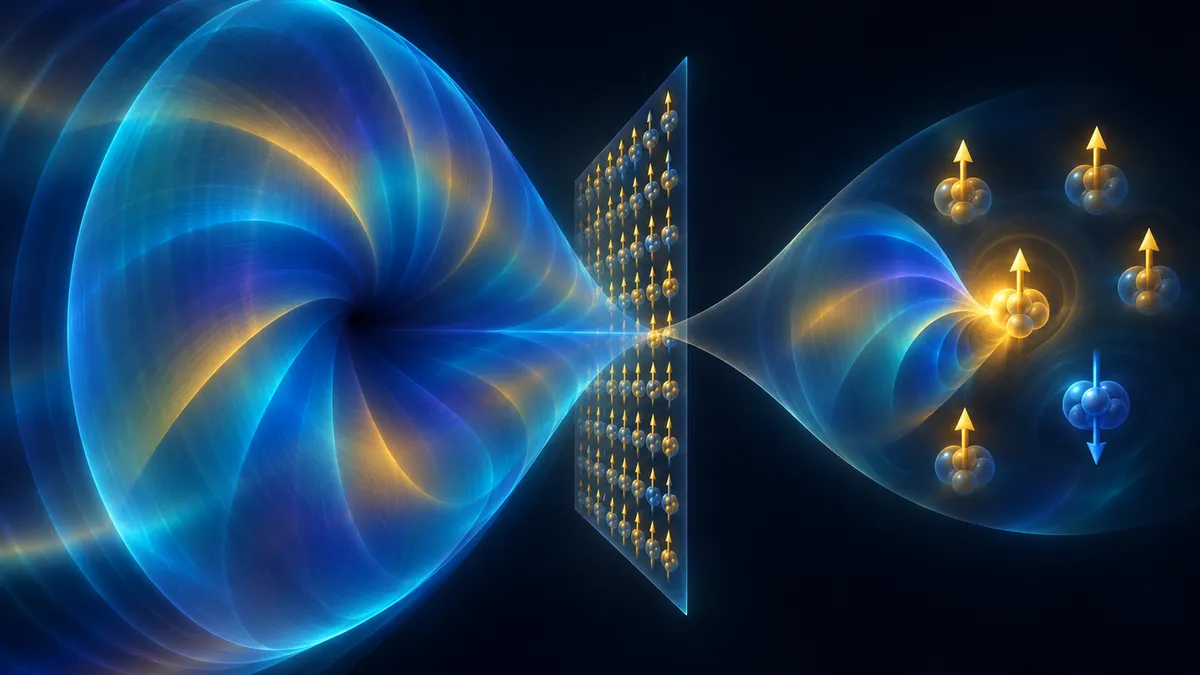
A neutron wave can carry a twist, but detecting that twist through a nuclear reaction may depend on positioning the target within roughly a neutron wavelength of the beam’s central axis.
Why did an experiment looking for a distinctive signature of twisted neutrons find none? A new theoretical preprint by Rakhee Roy, Carl E. Carlson and Andrei Afanasev offers a quantitative explanation: the strongest changes in nuclear capture occur very close to the beam’s vortex axis, while a large target averages over mostly less revealing encounters.
The study examines thermal neutrons captured by polarized helium-3 nuclei. It predicts substantial local changes in spin-dependent capture, but an extremely small signal for the broad-beam, bulk-target conditions considered in its comparison with a recent experiment. These are theoretical results, not a new experimental detection; the supplied manuscript is an arXiv preprint.
What makes a neutron wave twisted?
Neutrons have intrinsic angular momentum, called spin. Their waves can also carry orbital angular momentum associated with a phase that winds around the beam’s propagation axis. This does not mean that each neutron follows a little corkscrew trajectory: the twist describes the quantum wave.
At the central vortex line, that winding phase is undefined. The authors ask how a helium-3 nucleus’s distance from this line changes the angular-momentum combinations available during capture.
For ordinary thermal neutrons, the reaction proceeds through an excited helium-4 compound nucleus with zero spin and positive parity. Opposite neutron and helium-3 spin orientations provide the familiar capture channel. Twisted waves introduce additional orbital angular momentum, making the accounting depend on both polarization and target position.
There is an important restriction. In the authors’ formalism, twisting the incoming wave does not make a final total-angular-momentum state accessible if its corresponding ordinary-wave transition amplitude is forbidden. The distinctive effects involve position-dependent angular-momentum projection rules, not a wholesale removal of nuclear selection rules.
Calculating capture near and far from the axis
The researchers represent the incoming neutrons using idealized Bessel waves, constructed by combining momentum components arranged on a cone. The cone’s opening, or pitch angle, describes their spread around the propagation direction.
They calculate capture amplitudes for two polarization preparations: neutrons with a fixed spin projection along the beam axis, and neutrons with fixed helicity, meaning spin projection along each component’s direction of motion. Those preparations produce different quantitative predictions, although the central spatial conclusion is similar.
The team then compares capture rates after reversing either the beam polarization or the target polarization. Such a normalized rate difference is a spin asymmetry.
For their illustrative beam, the neutron wavelength is 1.2 nanometres and the pitch angle is extremely small, chosen so that the Bessel beam’s first intensity maximum lies one millimetre from the axis. For the configurations highlighted in the paper, a nucleus exactly on the vortex axis can show a reversal of the usual asymmetry. Moving away by distances comparable to the neutron wavelength brings the prediction most of the way back toward the ordinary-beam result.
Not every polarization combination shows that reversal. Some retain the ordinary result even near the axis.
Why a large target hides the difference
An experiment generally contains many target nuclei at different distances from the vortex. To model this, the authors distribute nuclei uniformly across a disc, average the individual capture rates over its area, and only then form the asymmetry.
They also calculate the specific comparison used to test whether reversing the neutron’s orbital angular momentum changes the spin-dependent signal. Contributions from different target positions largely cancel in this observable.
Under the experimental conditions considered, the predicted orbital-angular-momentum signal is of order 10⁻¹³, compared with experimental accuracy of about 1%. The calculation therefore explains why a null measurement need not imply that twisted neutrons lack distinctive local capture effects.
A demanding route to a larger signal
The proposed routes forward are spatially demanding: restrict the target to roughly a wavelength-sized region near the vortex, or focus the twisted beam to a spot only a few wavelengths across. For larger pitch angles of 0.1 and 0.3 radians, the authors estimate corrections of roughly 1% and 10%, respectively.
These estimates do not demonstrate that such an experiment is practical. They depend on the modeled beam and target geometry. The study’s main contribution is to identify the scale that matters: a millimetre-wide beam can carry a twist while its most distinctive capture signature remains concentrated on a nanometre scale.
- twisted neutrons
- orbital angular momentum
- helium-3
- spin asymmetry
- nuclear capture
- quantum vortex
Related reading
Automatically matched by shared topic keywords. These links do not imply that the sources agree or establish a consensus.