TRANSMISSION // 2611.10796v1
When quantum errors cluster, familiar decoders can lose their edge
Source published
Simulations show that clustering errors can sharply worsen quantum error correction even when each error mechanism keeps the same average probability. Giving decoders otherwise unavailable information about the noise recovers much of the lost performance.
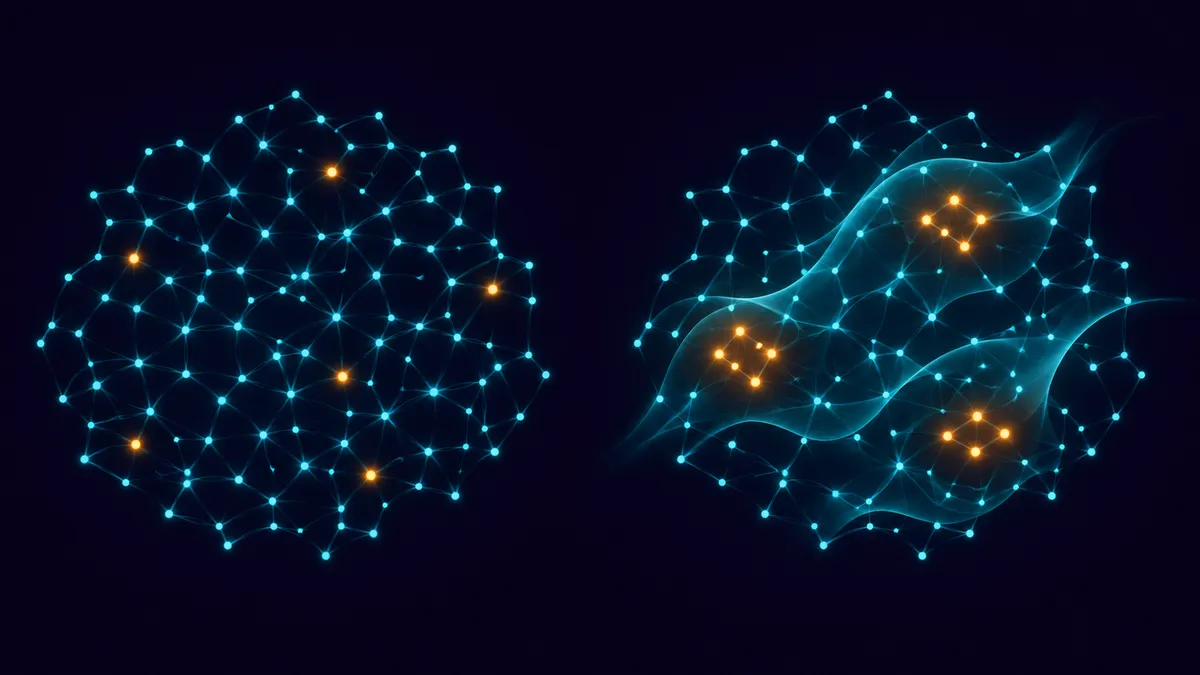
How often errors happen is not the whole story. A quantum error-correction decoder may also need to know where errors are likely to happen together.
Quantum error correction depends on software that interprets error-check measurements and chooses a correction. But what happens when that software knows the average probability of each fault while assuming incorrectly that faults occur independently?
In a November 7 arXiv preprint, Abhinav Dangi and Avhishek Chatterjee investigate that mismatch. Their simulations show that spatially correlated errors can sharply increase decoding failures, weaken the advantage of a larger code and sometimes reverse which decoder performs best. The results are computational findings, not a demonstration on quantum hardware.
Changing the pattern, not the average
The researchers studied quantum low-density parity-check codes, or qLDPC codes, which protect quantum information using checks involving relatively few physical qubits. They also included a surface-code comparison.
Their main targets were Relay-BP and beam search, two decoding approaches built around belief propagation. Belief propagation passes probability estimates through a network connecting possible errors with their detectable consequences. Relay-BP perturbs that process to escape unsuccessful configurations; beam search explores several competing possibilities. The study compared both with BP-OSD, which adds ordered-statistics post-processing.
To generate correlated faults, the authors used a hidden Gaussian random field: a simulated pattern that makes nearby error mechanisms more or less likely to fire together. They could adjust correlation strength and range while preserving each mechanism’s average error probability exactly.
That distinction matters. The correlated simulations did not simply turn up every fault probability. They changed which faults occurred together, although this also changed the distribution of the total number of faults in an individual trial.
Failures rise—and rankings depend on the circuit
For a code using 144 physical qubits to encode 12 logical qubits, one strong-correlation setting increased the reported logical error rate by roughly 240 times for Relay-BP, 160 times for beam search and 90 times for BP-OSD relative to each pipeline’s independent-noise baseline.
Those figures compare published pipelines using different circuits, so they do not isolate the decoding algorithms. The authors therefore also made all three decoders process identical simulated trials from each of two circuits.
On one circuit, strong, relatively short-range correlations made Relay-BP fail about 2.5 times as often as BP-OSD and beam search about 3.7 times as often. On the other circuit, Relay-BP remained best at every tested setting. There was no universal ranking reversal.
Correlations also narrowed the protection advantage of a larger code. In one Relay-BP comparison, increasing from 144 to 288 physical qubits provided almost no measured advantage at the strongest tested correlation. This finite-size result does not establish that increasing code distance stops helping in general.
Error arrangement matters
Could the failures simply reflect occasional trials containing too many faults? The researchers compared failures within matched error-count ranges.
Correlated errors remained harder to decode. For beam search in one range containing fewer than 45 injected error mechanisms, the failure probability was about 12 times higher under correlated sampling. Arrangement mattered alongside quantity.
The team also reduced failed trials to smaller configurations that still defeated a decoder. Some clustered configurations resisted all tested escape strategies. Increasing search effort helped, but did not restore independent-noise performance in the examined comparisons. The detailed failure mechanisms differed between circuits.
Better information helps—but is not yet a solution
A final experiment supplied each decoder with error probabilities conditioned on the hidden field for that particular trial. This hypothetical “oracle” revealed the changing risk pattern, not which errors had actually occurred.
Performance improved dramatically. At one setting, all three decoders recorded zero failures in 5,000 trials. Zero observed failures does not mean the underlying failure probability was zero. On the other circuit, residual failures remained despite the extra information.
The experiment identifies inaccurate noise assumptions as a major contributor, but supplies no practical method for obtaining the oracle’s knowledge.
The limitations are substantial: the field follows an abstract qubit ordering rather than a particular hardware layout, different measurement rounds have independent fields, and the oracle tests cover one code family and one measurement basis. As a preprint, the work should be treated as provisional. Its central lesson is narrower than a verdict against these decoders: independent-noise benchmarks alone may miss important vulnerabilities to structured errors.
- quantum error correction
- qLDPC codes
- correlated noise
- belief propagation
- Relay-BP
- beam search
- prior mismatch
Related reading
Automatically matched by shared topic keywords. These links do not imply that the sources agree or establish a consensus.
Small changes to a decoder’s assumptions improve quantum error correction in simulations
Source published
Shared keywords: belief propagation, quantum error correction
For silicon quantum memory, the route can matter as much as the circuit
Source published
Shared keywords: qldpc codes, quantum error correction
Shared conductors could produce long-range, direction-dependent qubit noise
Source published
Shared keywords: quantum error correction
How the shape of a quantum-code region determines what it reveals
Source published
Shared keywords: quantum error correction
GARI++ splits quantum error correction into a fast first pass and a smaller cleanup
Source published
Shared keywords: quantum error correction