TRANSMISSION // 2611.10769v1
When should a robot look ahead before moving?
Source published
In a simulated pushing task, searching possible moves improved a frozen controller’s success rate from 0% to 18%. A selective search rule cut runtime roughly threefold compared with full search in the reported comparisons, but physical robots remain untested.
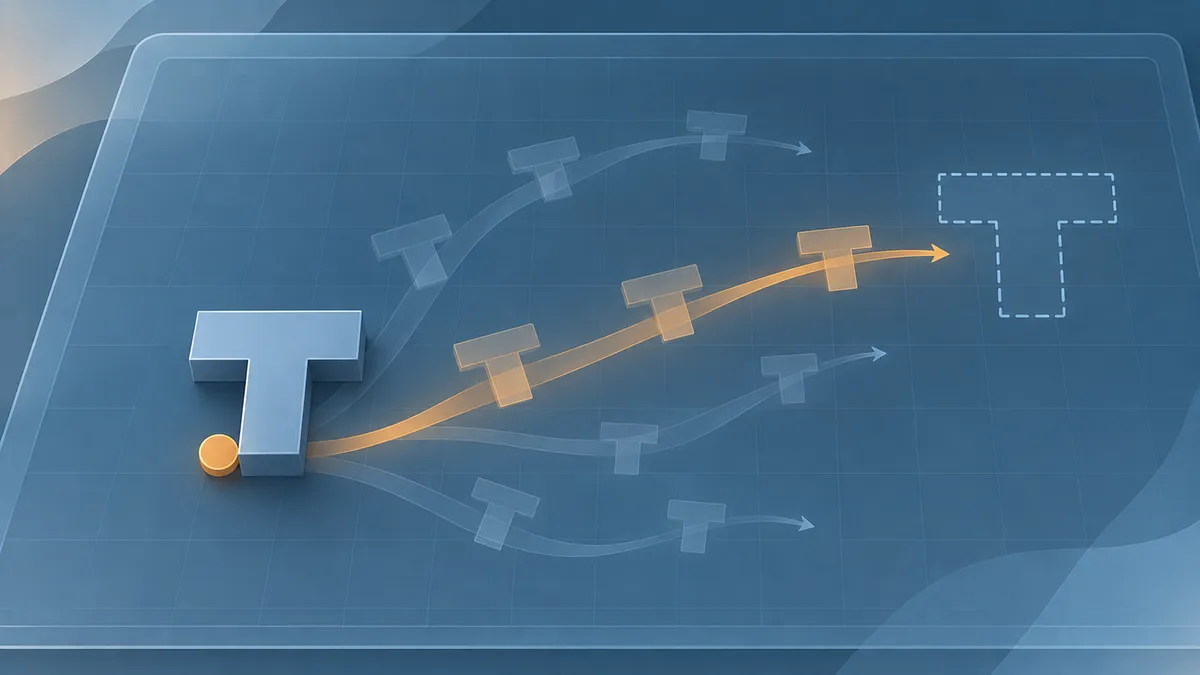
A robotic controller can propose a plausible movement without knowing whether it will help. A new preprint asks whether simulating possible consequences—and searching alternatives only when trouble is predicted—can improve action selection without retraining the controller.
Trying a movement before committing
Imagine pushing a T-shaped object until it overlaps a matching target. A movement that looks reasonable might rotate the object the wrong way or undo earlier progress. Could a controller avoid some mistakes by testing possible moves in simulation first?
In the preprint Look Ahead: Search-Driven Reasoning in Embodied AI, Ahmed Zeer and colleagues investigate that question in PushT, a simulated manipulation task. Their central concern is not simply whether looking ahead helps, but when its computational cost is worthwhile.
The experiments use a pretrained Action Chunking with Transformers controller, or ACT. Its parameters remain frozen: the researchers change how actions are selected, not what the underlying model has learned. Although the work is motivated by vision–language–action models, this ACT controller uses images and agent position, not language instructions.
Searching over short sequences
ACT predicts an action chunk: a short sequence of target positions for the simulated pushing agent. The researchers keep that original prediction and generate alternatives by adding small perturbations, constrained to remain within the workspace.
Each candidate sequence is tried from a restored copy of the relevant simulator state. This lets the planner compare hypothetical outcomes without those trial movements changing the actual episode.
The search ranks outcomes using coverage—the overlap between the movable T and its target. Beam search retains a limited set of promising possibilities at each level, then explores their continuations. After choosing a sequence, the controller executes only its first portion before observing the environment and planning again.
Success requires at least 95% overlap. An episode ends when that threshold is reached or after 300 environment steps.
Better results, but far from reliable
Each configuration was evaluated over 50 episodes. The direct ACT baseline achieved no successful episodes. A beam-search configuration with depth four, eight candidates per expanded node and beam width four reached 18% success.
Its average cumulative reward rose from 39.44 to 103.2. This is an accumulated episode score, not a coverage percentage, and should not be read as a percentage improvement in alignment.
Looking ahead was expensive. The table’s reported runtime increased from 2 seconds for the baseline to 47 seconds for that search configuration. These timings describe the experimental setup; they do not establish real-time performance on physical robots.
More computation also did not consistently produce better choices. Doubling that configuration’s beam width from four to eight increased runtime to 87 seconds while success fell to 10%. Increasing search depth alone yielded little benefit in another comparison. More frequent replanning generally improved cumulative reward, highlighting the value of checking progress rather than committing to long movements without feedback.
A gate for extra computation
The authors’ One Step Ahead method, or OSA, asks a narrower question before launching full search: would the controller’s original sequence make coverage noticeably worse?
It first simulates that sequence. If final predicted coverage is more than 0.05 below current coverage—a drop exceeding five percentage points—it triggers beam search. Otherwise, it uses the original prediction directly. “One step” therefore means one simulated action chunk, not one individual movement.
In the reported comparisons, OSA reduced runtime roughly threefold relative to full beam search while preserving or improving success. Cumulative reward sometimes decreased, however. Reaching the success threshold and accumulating progress throughout an episode are different measurements; improving one does not guarantee improving the other.
What the shortcut can miss
OSA detects predicted regression, not every kind of failure. A sequence that makes no progress can pass its check. Looking only at final coverage can also miss harmful intermediate movements. It is a computation-allocation heuristic, not a safety guarantee.
The broader evidence is limited to one checkpoint and one simulated task family, with no confidence intervals or reported variation across independent seed sets. Small success-rate differences therefore warrant caution, and 18% success remains low.
The planner also enjoys access unavailable directly on a physical robot: restorable simulator states and an exact task-specific coverage measure. Real deployment would require reliable predictions of motion and estimates of progress from observations. Neither that transfer nor performance with language-conditioned controllers was demonstrated. The supported conclusion is narrower: selective look-ahead can improve this simulated controller’s decisions while avoiding some of full search’s expense.
- embodied AI
- robotic control
- beam search
- action chunking
- selective planning
- PushT
- simulation
Related reading
Automatically matched by shared topic keywords. These links do not imply that the sources agree or establish a consensus.
A robotic laboratory links experiment planning with hands-on chemistry
Source published
Shared keywords: embodied ai
AI coding agents build a robotics simulation benchmark
Source published
Shared keywords: embodied ai
When shorter instructions trip up embodied AI agents
Source published
Shared keywords: embodied ai
A lab AI benchmark finds a gap between seeing a procedure and locating where to act
Source published
Shared keywords: embodied ai
When a Robot Experiment Becomes Scientific Evidence
Source published
Shared keywords: embodied ai