TRANSMISSION // 2611.10703v1
Could a hidden pulsar power the LHAASO Peanut?
Source published
A modeling study explores whether one unseen central accelerator could produce the LHAASO Peanut’s elongated gamma-ray emission and two bright regions. The proposed arrangement reproduces broad features, but the distant bright region remains too weak relative to the other components, especially at higher energies.
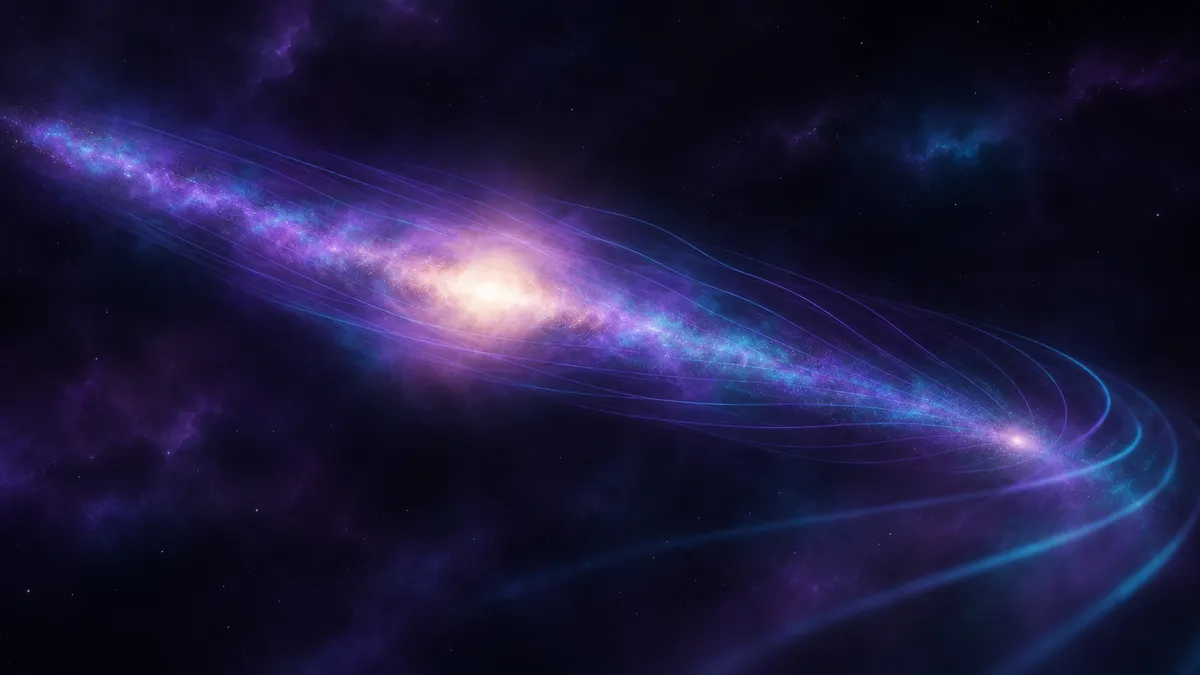
The LHAASO Peanut combines a long, narrow strip of ultra-high-energy gamma rays with two compact bright regions. In an arXiv preprint, Agnibha De Sarkar investigates whether electrons supplied by a hidden central pulsar could account for all three features through direction-dependent transport and a prescribed change in magnetic-field geometry.
A structure in need of an explanation
The Large High Altitude Air Shower Observatory, or LHAASO, has detected an unusually elongated gamma-ray structure away from the Milky Way’s plane. Nicknamed the Peanut, it contains a straight diffuse strip, a bright region near its center and another near one end. The strip contributes approximately 70% of the observed emission. Both compact regions remain visible at energies of several hundred teraelectronvolts, or TeV.
De Sarkar’s study asks whether these features could share a single central source. It is available as an arXiv preprint; the supplied record does not establish journal publication.
The proposed source is an unidentified pulsar and its surrounding pulsar wind nebula, a region supplied by particles from the rotating neutron star. The study does not report detecting this object.
Why consider an unseen source?
A known millisecond pulsar, PSR J0218+4232, lies near the Peanut’s far bright region. The paper examines whether it, or a compact nebula associated with its motion, could power the structure.
Under an electron-based interpretation, the highest-energy gamma rays require electrons with energies of order a petaelectronvolt, or PeV. Such electrons lose energy rapidly through radiation. The pulsar moves too little during their cooling time to produce the Peanut’s extent as a direct trail. Simple estimates also identify demanding acceleration, confinement and escape requirements for its possible nebula. These arguments motivate investigating a more powerful source near the central excess rather than establishing that one exists.
Modeling electrons and magnetic geometry
In the proposed model, the hidden source continuously injects energetic electrons. These produce gamma rays through inverse-Compton scattering: electrons transfer energy to photons of the cosmic microwave background.
The calculation includes radiative energy losses and anisotropic diffusion, meaning that particles spread more rapidly along an ordered magnetic field than across it. The field’s angle to the observer determines how this extended electron distribution appears on the sky. This baseline model supplies the diffuse strip and central concentration.
Producing the far excess requires an additional prescription. The study assumes a local field reorientation toward the observer and redistributes the electrons beyond that location into an emitting column aligned with the line of sight. Particle numbers are conserved separately at each electron energy, and their original emission contribution is removed to avoid counting it twice.
This is a phenomenological construction: an assumed arrangement used to test plausibility, not a self-consistent calculation of a three-dimensional magnetic-field deformation.
The exploration covers source ages of 10,000, 20,000 and 30,000 years, two ambient magnetic-field strengths and two parallel diffusion coefficients, giving twelve configurations. Injection parameters are adjusted to reproduce the broad observed spectrum.
Partial agreement, with a persistent mismatch
Representative configurations remain compatible with the Peanut’s overall spectral shape. Faster transport along the magnetic field strengthens the far component while retaining a dominant diffuse strip.
In the representative 20,000-year configuration, the fitted strip contributes approximately 75–77% of the emission across the two energy bands examined. The central component contributes approximately 13–15%, and the far component approximately 10%. These are outputs of fitting spatial templates to simulated brightness maps, not new observational measurements.
Some configurations bring the two compact components to comparable fitted brightness between 25 and 100 TeV. Above 100 TeV, however, the far component remains weaker than the central component. The explored model therefore does not fully reproduce the observed division of emission.
What remains unresolved
The component analysis uses model maps rather than LHAASO event, exposure and background data, so it does not reproduce the observational likelihood analysis. The source’s distance is unknown, and the representative age is not a measured age. The diffusion approximation may also have limited accuracy near the assumed field reorientation.
Separate estimates indicate that the proposed compact accelerator could supply PeV electrons, but only with unusually efficient acceleration and substantial magnetization. Those conditions are possibilities, not measured properties.
Deep radio and X-ray observations of the central region, better energy-resolved measurements of the compact components and constraints on local magnetic geometry could test the interpretation. For now, the study offers a conditional explanation rather than an identification of the Peanut’s source.
- LHAASO Peanut
- gamma rays
- pulsars
- anisotropic diffusion
- inverse-Compton scattering
- magnetic fields
Related reading
Automatically matched by shared topic keywords. These links do not imply that the sources agree or establish a consensus.
Two gamma-ray-producing regions emerge in black hole simulations
Source published
Shared keywords: gamma rays, inverse compton scattering
An extended gamma-ray source hints at a pulsar-powered particle accelerator
Source published
Shared keywords: inverse compton scattering
Pandora’s Cluster reveals hot gas and a weak merger shock
Source published
Shared keywords: inverse compton scattering
Galactic Center Gamma Rays Stay Extreme, but IceCube Finds No Neutrino Counterpart
Source published
Shared keywords: gamma rays
A nova’s fading visible light could guide the search for gamma rays
Source published
Shared keywords: gamma rays