TRANSMISSION // 2611.10685v1
How photon-pair graphs make NOON states
Source published
A new analysis turns machine-discovered optical graphs into recipes for generating NOON states at arbitrary photon number. It identifies how pair-emission alternatives cancel unwanted mixtures, gives path-identity and Gaussian implementations, and derives a lower bound on heralding photons.
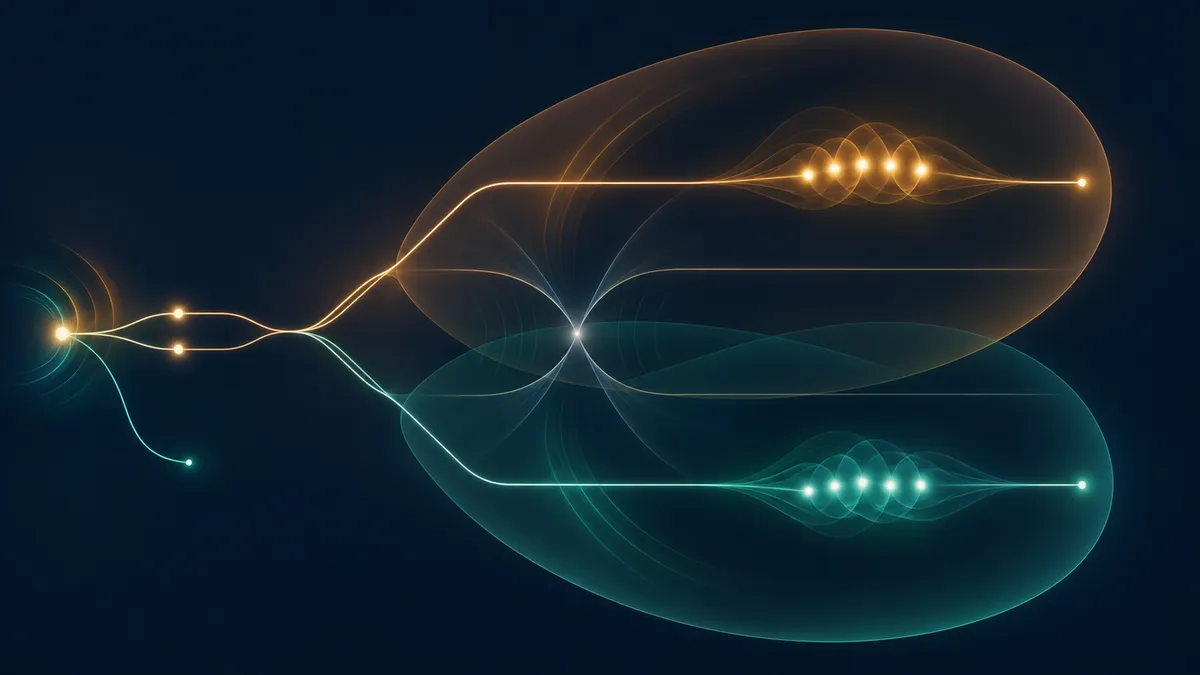
How can an optical experiment arrange for every detected photon to occupy one of two paths, while canceling all the ways photons could be split between them? NOON states—superpositions of all N photons in one mode and all N in another—are useful in quantum metrology, but constructing them becomes harder as N grows. Ozra Mahmoudi, Fatemeh Ahmadi and Rahman Nouroozi analyze graph-based proposals for these states and derive families of optical recipes rather than searching separately for every photon number.
Turning a graph into interference
The researchers start from PyTheus graphs, a way to represent optical pair sources. Each graph edge specifies a possible photon-pair creation process and has a complex weight; self-loops represent pairs created in one mode. The desired event is heralded: detectors register a specified photon pattern in auxiliary modes, while the experiment also selects exactly N photons in two output modes. The remaining output state should be a coherent superposition in which all N photons take one path or all take the other.
The key is not simply to produce the two desired outcomes, but to make every mixed occupation cancel. For odd N, the authors factor the polynomial describing the target state into linear and quadratic pieces. They use those factors to set output-pair weights, then count the different combinations of pair emissions that contribute to each heralded event. Matching those multiplicities gives analytic conditions on the remaining graph weights. The three-photon example shows the idea: alternatives that produce the same mixed output occupation have opposite amplitudes, while the two all-in-one-path terms remain. The construction extends to odd photon numbers with additional heralding-pair blocks.
For even N, the graph is arranged so that each heralding pair can be produced either directly, adding no output photons, or through two output–herald pairs, adding two photons to one output. Carefully chosen weights cancel selected photon-number contributions on each branch. The cancellation removes every mixed N-photon occupation, leaving the two NOON components with equal magnitudes; their relative sign depends on N and can be adjusted by a phase shift.
Two ways to implement the recipes
One implementation uses path identity. Pair sources are pumped coherently and their optical paths are aligned so that alternatives from different sources become indistinguishable. A Hong–Ou–Mandel interferometer supplies bunched photon pairs, while other sources provide output–herald or herald–herald pairs. The required relative source amplitudes and phases realize the graph weights. In the low-gain regime, the selected event comes from the specified number of pair emissions, and the unwanted output combinations cancel by interference. This is a proposal derived from the graph construction, not a report of a new experiment.
A second route uses a mathematical factorization called the Takagi decomposition. It expresses the symmetric pair-amplitude matrix in terms of single-mode squeezing strengths and a passive interferometer, giving an exact Gaussian-state implementation of the weighted graph. Here “Gaussian” describes the optical states produced by squeezing and linear mode mixing; heralding and photon-number selection then isolate the desired component.
The analysis also proves a resource bound under stated assumptions: any pure Gaussian scheme with zero displacement and photon-number-resolved heralding needs at least N−2 detected herald photons to produce an exact two-mode NOON state in the selected N-photon sector. Both proposed families reach the bound, with one photon detected in each herald mode. The proof uses the polynomial structure of the conditional output: with fewer herald photons, a repeated quadratic factor would remain, whereas the NOON polynomial has distinct linear factors.
Ideal selection and practical sensitivity
The two implementations differ away from the idealized limit. In the Takagi construction, every accepted N-photon amplitude has the same gain-dependent factor, so the selected state retains unit fidelity to the target at finite gain, given the prescribed ideal weights and selection. This does not mean every run succeeds: the probability of producing the accepted event can rise and then fall as gain increases and extra pairs become more likely. In path identity, later sources can be stimulated by photons produced earlier, changing relative amplitudes; with fixed source settings, the cancellation is then imperfect and selected-state fidelity decreases. The authors therefore note that path-identity settings should be optimized for a desired fidelity. Errors in graph weights also disturb cancellation.
These results explain how a set of machine-discovered graphs can be generalized through analytic cancellation rules, and connect the recipes to earlier conditional NOON projections and squeezed-state filtering. The bound applies specifically to pure, zero-displacement Gaussian schemes with photon-number-resolved heralding; it is not a limit on all possible ways to make NOON states. The paper gives theoretical constructions and probability and fidelity analyses, not an experimental demonstration. Its preprint reports the constructions for arbitrary N, while finite-gain behavior and robustness remain important practical considerations.
- NOON states
- quantum optics
- photon-pair sources
- quantum interference
- Gaussian states
- heralding
Related reading
Automatically matched by shared topic keywords. These links do not imply that the sources agree or establish a consensus.