TRANSMISSION // 2611.10662v1
A dark-star model links a mass ceiling to gravitational-wave signatures
Source published
A theoretical preprint explores how attraction and repulsion between hypothetical dark particles could produce self-bound stars. Within a specified family of models, the calculations yield a maximum mass and tidal responses that could help test the idea with gravitational waves.
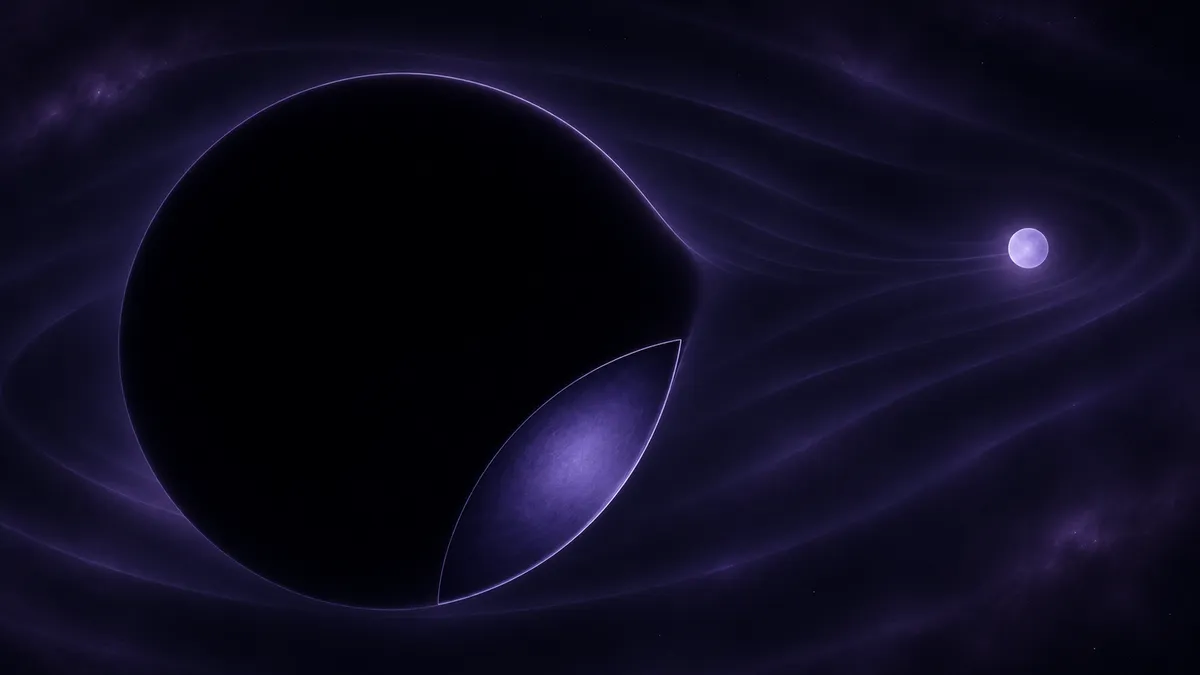
Could dark matter form compact stars held together partly by its own interactions, rather than gravity alone? Ilídio Lopes investigates that possibility in a model where two competing forces give dark matter a preferred density—and connect its microscopic properties to potentially observable stellar behavior.
Matter that holds itself together
The study considers hypothetical dark fermions: particles with the same broad quantum classification as electrons and neutrons, but not identified with either. They interact through two mediator fields. A scalar mediator supplies attraction, while a vector mediator supplies repulsion between particles carrying like dark charges.
The question is how that competition changes the stars such matter could support. In the calculations, attraction becomes less effective as the matter becomes relativistic, whereas the source of vector repulsion does not weaken in the same way. For suitable interaction strengths, the energy per particle reaches a minimum at a nonzero density.
This is called saturation. If that minimum lies below the energy of separated particles, the material is self-bound: its interactions can hold it together without gravity providing all the confinement. The mechanism resembles nuclear saturation, although the model lacks features of ordinary nuclear matter, including electric charge and the distinction between protons and neutrons.
The work is an arXiv preprint submitted on 7 November 2026. Its listing says it was submitted for publication; the supplied record does not establish peer review. These are theoretical predictions, not detections of dark stars.
Building the model stars
Lopes first calculates an equation of state—the relationship between pressure and energy density—for cold dark matter. The calculation uses a mean-field approximation, replacing detailed particle interactions with average fields. Most results concern one dominant particle species with specified interaction choices.
He then integrates the general-relativistic equations describing spherical stars in hydrostatic equilibrium, following sequences with different central densities. Additional perturbation equations calculate how each star responds to an external tidal field. Internal checks include recovering the established maximum mass for a noninteracting fermion star and verifying thermodynamic consistency.
Self-bound configurations have a distinctive boundary: pressure reaches zero while the material still has finite density. Their surfaces therefore appear sharp on stellar scales, rather than tapering through a broad atmosphere.
A ceiling with specific conditions
The main mass result comes from a restricted model family. Lopes fixes the saturation density in particle-mass units, sets two scalar self-interaction parameters to zero, and varies vector repulsion while readjusting scalar attraction to preserve that density.
Across this sequence, the maximum stellar mass rises roughly eightfold. Eventually, repulsion becomes too strong for the prescribed saturation condition to be satisfied. This ends the sequence and supplies a ceiling across the allowed interaction choices.
For a dark fermion mass of 1 gigaelectronvolt, the reported ceiling is about 3.9 times the Sun’s mass. The reference model itself reaches about 3.25 solar masses, not 3.9.
That distinction matters: the larger number is not a universal limit for all dark stars. It applies to the specified saturation-density and self-interaction choices. Physical masses also scale inversely with the square of the assumed particle mass.
Other interaction choices produce two disconnected equilibrium families: a dilute, gravitationally bound branch and a dense branch with a finite-density surface. For these cases, the dense material is only metastable relative to free particles; mechanical stability does not automatically establish global binding.
Testing the tidal response
A companion’s gravity deforms a star during a binary inspiral. The dimensionless tidal deformability describes that response and can influence the gravitational-wave signal.
For the reference parameters and a 1-gigaelectronvolt particle, a 1.4-solar-mass star has a calculated radius of 13.3 kilometers and tidal deformability near 1,600. The paper contrasts this with a neutron-star estimate of 190, with substantial uncertainty, inferred from GW170817. Its scalar-only comparison gives a deformability near 65.
These differences could distinguish specified hypotheses, but not exclude the entire dark-star framework with one observation. Changing particle mass or interaction strengths can move predictions into the neutron-star range. Distinguishing the most massive model stars from black holes would be especially demanding because their remaining tidal responses are small.
What remains uncertain
The paper does not calculate how these objects form or how abundant they might be. Corrections beyond the mean-field treatment may also matter at the strong interactions considered.
A quantum-pressure correction mainly affects a microscopic surface layer. Its estimated contribution to the reference maximum-mass star is below one part in 10²¹. Surface properties and the smallest dark nuggets are less secure: the gradient approximation is near its validity limit, and omitted mediator-field gradients can contribute comparable surface energy.
The result is a conditional bridge from hypothetical particle interactions to stellar observables—not evidence that nature builds these stars.
- dark matter
- fermion stars
- self-bound matter
- gravitational waves
- tidal deformability
- general relativity
Related reading
Automatically matched by shared topic keywords. These links do not imply that the sources agree or establish a consensus.
Neutron Star Tides Could Complicate Tests of Einstein’s Gravity
Source published
Shared keywords: general relativity, gravitational waves, tidal deformability
Using a black hole’s ringdown to examine nonlinear gravity
Source published
Shared keywords: general relativity, gravitational waves
Can a simpler star simulation recover tides in gravitational waves?
Source published
Shared keywords: general relativity, gravitational waves
A single stellar vibration captures much of neutron stars’ tidal response
Source published
Shared keywords: general relativity, gravitational waves
Simulated detector network sharpens the search for neutron stars’ faint internal vibrations
Source published
Shared keywords: gravitational waves