TRANSMISSION // 2611.10608v1
A Tomato-Health Chatbot Shows Promise—but Not Proven Diagnostic Accuracy
Source published
A research prototype combines language models, a small tomato-health reference library and illustrative images. Five test questions show differences in response relevance and speed, but do not establish reliable diagnosis or safe treatment advice.
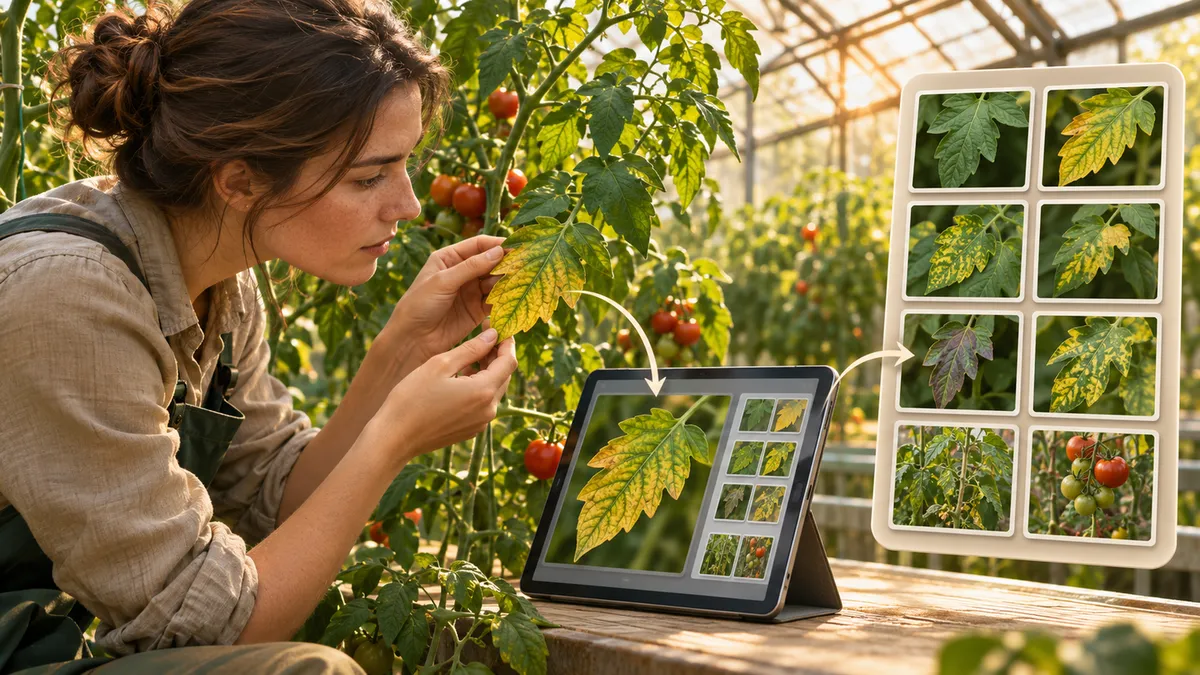
A grower types that tomato leaves are yellowing and curling. A chatbot suggests possible causes, explains them and displays photographs of related conditions. That is the idea behind a prototype described by Ngoc-Son Le, Khanh-Nghi Phan and Ngoc Hong Tran. Its small evaluation demonstrates a conversational workflow, not a field-tested replacement for plant-health expertise.
Looking up information before answering
The system uses retrieval-augmented generation, or RAG. Instead of asking a language model to answer entirely from its existing training, the software first searches a prepared reference collection and supplies relevant material alongside the grower’s question.
The researchers assembled 45 entries covering tomato diseases, pests and physiological disorders. Each includes descriptions, symptoms, treatment information and a label connecting it to reference images. The collection therefore extends beyond infectious diseases to problems such as nutrient deficiencies and water stress.
An embedding model, MXBAI-Embed-Large, converts the question and reference documents into numerical representations that allow matching by meaning rather than exact wording. ChromaDB retrieves the closest documents. A language model—Mistral or Llama 3.2—then uses the retrieved information to generate an explanation and suggested response.
LangChain coordinates these steps, Streamlit provides the interface, and Ollama runs the models. Conversations are saved locally in JSON files so users can revisit previous exchanges.
What the pictures actually do
The image collection contains five representative pictures in each of 45 labeled folders. According to the paper, these were gathered from agricultural extension resources and research datasets.
After generating an answer, the system looks for recognized condition labels and displays corresponding pictures. The implementation also describes a similarity-search fallback when keyword matching is insufficient.
This matters when interpreting the word “multimodal” in the title. Although the introduction mentions optional image inputs, the detailed workflow and reported tests center on typed symptoms followed by retrieved illustrations. They do not establish that the chatbot can accurately diagnose an uploaded photograph. Showing an example image associated with an answer is different from independently examining a grower’s plant.
What five questions revealed
The comparison used five symptom descriptions: yellowing and curling leaves, white spots with webbing, fruit rotting at the bottom, holes with visible insects, and wilting despite watering.
The researchers measured response time, approximate output length, grammatical quality, memory change and semantic relevance. Relevance was calculated using SentenceBERT to compare each answer’s meaning with a short reference answer.
Llama 3.2 scored higher on this similarity measure for all five questions: 0.60–0.68, compared with Mistral’s 0.37–0.64. These are similarity scores, not percentages of correctly diagnosed plants. An answer can resemble a reference without proving that its diagnosis or treatment recommendation is correct.
Neither model was consistently faster. Mistral took 7.19–14.46 seconds; Llama 3.2 took 4.65–18.95 seconds. Llama was faster on three questions, while Mistral was faster on two. For the wilting question, Mistral took 7.19 seconds versus Llama’s 10.74 seconds. For spots and webbing, Llama took 4.65 seconds versus Mistral’s 8.55 seconds.
Llama produced longer answers in every case. Both models received grammar scores of 0.99 or 1.00. Fluent writing, however, does not demonstrate sound agricultural reasoning. Likewise, the reported memory figures measure changes during inference, not the total hardware required to run the system.
Important gaps remain
Five questions are too few to establish performance across varied growing conditions or ambiguous symptoms. The paper does not report repeated trials, statistical uncertainty, expert assessment of treatment safety, or field validation against confirmed diagnoses. Nor does the comparison isolate whether retrieval improves answers relative to using the models alone.
The offline claim also needs qualification. The architecture is described as locally runnable, but a separate implementation section places model execution on Google Colab, accessed through an ngrok public address. That configuration needs connectivity. Offline operation depends on running the necessary components locally; it should not be assumed for the cloud-backed setup.
A prototype, not a validated consultant
The supplied source is the first arXiv version, posted November 7, 2026. The evidence does not establish peer-reviewed publication. This account draws on extracted paper text; figures were unavailable for inspection, and extraction can distort equations and layout.
The demonstrated contribution is a conversational way to access a small tomato-health library with supporting pictures. The results favor Llama 3.2 on answer similarity within this narrow comparison, with mixed speed results. Whether either model can reliably guide real crop-management decisions remains untested by the reported evaluation.
- artificial intelligence
- tomato plant health
- retrieval-augmented generation
- agricultural chatbots
- language models
- preprint
Related reading
Automatically matched by shared topic keywords. These links do not imply that the sources agree or establish a consensus.
AI Memory Needs More Than a Relevance Check, Preprint Argues
Source published
Shared keywords: artificial intelligence, language models, retrieval augmented generation
A medical AI system that searches for help after identifying a gap
Source published
Shared keywords: language models, retrieval augmented generation
Pairing predictive AI with a medical reference chatbot to explain diabetes classifications
Source published
Shared keywords: retrieval augmented generation
An AI co-pilot for physics experiments combines alarm diagnosis with institutional memory
Source published
Shared keywords: artificial intelligence, retrieval augmented generation
AI claims-analysis preprint tests policy citations and privacy safeguards on synthetic data
Source published
Shared keywords: retrieval augmented generation