TRANSMISSION // 2611.10572v1
Radio and optical rhythms hint at changes in a blazar’s jet
Source published
A preprint reports roughly 280-day radio brightness oscillations and a shorter optical rhythm in the blazar PKS 0754+100. The observations suggest a possible connection between changing jet activity across wavelengths, but a proposed shift to a longer radio period remains unconfirmed.
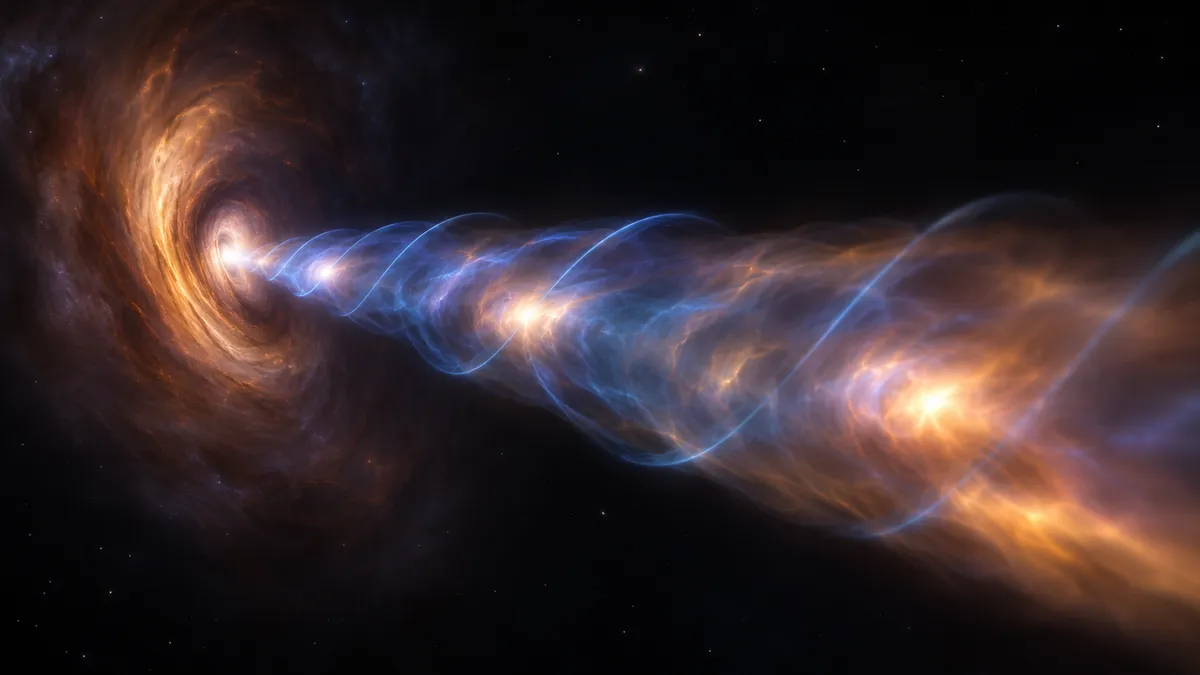
A blazar’s brightness usually changes irregularly. In PKS 0754+100, astronomers have found evidence for approximately repeating radio variations, alongside a brief optical rhythm during a transition to stronger radio fluctuations. The question is whether these signals reflect connected disturbances within the jet—or patterns that noisy, limited observations can only partly establish.
PKS 0754+100 is a blazar: an active galactic nucleus whose fast-moving jet points close to our line of sight. Motion toward us boosts the jet’s apparent brightness and variability. It belongs to the BL Lac class, in which jet emission dominates and spectral emission lines are weak or absent.
In a preprint submitted to The Astrophysical Journal, Ashutosh Tripathi and colleagues investigate whether its changing brightness contains quasi-periodic oscillations, or QPOs. These are approximately repeating variations rather than perfectly regular cycles. Establishing them is difficult because irregular blazar activity can also produce apparently recurring peaks.
Combining radio, optical and X-ray observations
The team used observations from the SMMAN monitoring program at the Nanshan 26-m radio telescope, measuring emission at 4.8 and 23.6 gigahertz. They supplemented these with archival 15-gigahertz measurements and images from the Very Long Baseline Array, optical observations from the Transiting Exoplanet Survey Satellite, or TESS, and hard X-ray monitoring from Swift.
Their light curves—measurements of brightness over time—were examined using two complementary techniques. A generalized Lomb–Scargle periodogram searches for repeating timescales. A weighted wavelet analysis also tracks how strongly a timescale appears at different points during the observations. Long-term trends were removed from the radio data, while the TESS data were processed with a pipeline designed to preserve active-galaxy variability.
To assess whether random fluctuations could mimic the signals, the researchers generated 100,000 simulated light curves for the significance calculations. These represented the statistical and noise properties of the observations, including red noise: irregular variability with more power on longer timescales.
Evidence for a radio rhythm
At 4.8 gigahertz, the analysis identified a period near 278 days across roughly ten cycles. During the lower-variability portion of the 23.6-gigahertz observations, it found a similar timescale, approximately 280–290 days, spanning about six cycles. A separate correlation analysis also supported recurrence on comparable timescales.
The distinction between local and global statistical significance matters here. A local significance evaluates a peak at a particular frequency. A global assessment accounts for the extra opportunities to find an apparently interesting peak when searching multiple frequencies and sources.
After those corrections, the authors report significances of 2.98 standard deviations at 4.8 gigahertz and 3.50 at 23.6 gigahertz. These support the proposed oscillations but do not eliminate the possibility that noise or trends contributed. The independent 15-gigahertz measurements suggest a similar period, but cover fewer than three cycles—too few for the authors to establish a QPO from those data alone.
A changing variability state
Around October 2021, fluctuations became stronger at 15 and 23.6 gigahertz. At 23.6 gigahertz, the measured scatter increased by almost a factor of three. Later observations hint at longer periods near 400 days, but the authors explicitly say that too few cycles have been observed to confirm a period change.
TESS recorded a possible 1.4-day optical oscillation over a ten-day interval, giving about seven cycles. The main analysis reports a global significance of 2.87 standard deviations. However, the supplied manuscript gives inconsistent local significance values in its text and figure caption, so the optical evidence should not be presented as an unambiguous detection.
A Swift X-ray flare occurred roughly 100 days before the radio transition. Radio images also showed differences in jet structure: a distinct secondary bright knot was absent in a selected low-variability image, while higher-variability images showed additional structure. Sparse imaging prevents a firm determination of the cause.
A possible connection, not a demonstrated mechanism
The authors propose that a disturbance originating near the black hole could travel outward through the jet. A shock interacting with magnetic fields, or a kink in a helical jet structure, might connect the X-ray, optical and radio changes. Changes in jet orientation offer another possible explanation for the earlier radio oscillations.
These remain interpretations, not directly observed causal sequences. The X-ray data are too noisy for a useful periodicity analysis, the imaging is sparse, and the longer radio rhythm needs additional cycles. Continued monitoring will be necessary to test whether the apparent period shift persists and whether one physical process can explain the different signals.
- astrophysics
- PKS 0754+100
- blazars
- BL Lac objects
- relativistic jets
- quasi-periodic oscillations
- radio variability
- TESS
- SMMAN
Related reading
Automatically matched by shared topic keywords. These links do not imply that the sources agree or establish a consensus.
What millimeter waves reveal about gamma-ray blazars
Source published
Shared keywords: relativistic jets
A shared explanation for web-like patterns in black-hole X-ray variability
Source published
Shared keywords: quasi periodic oscillations
A narrow black-hole jet could explain a seven-hour gamma-ray burst
Source published
Shared keywords: relativistic jets
Why black hole flickers form crosses, webs and diagonal ridges
Source published
Shared keywords: quasi periodic oscillations
Falling merger debris could fuel—and frustrate—a second cosmic jet
Source published
Shared keywords: relativistic jets