TRANSMISSION // 2611.10548v1
A billion-star search maps the Milky Way’s nested structures
Source published
Researchers applied hierarchical clustering to more than a billion Gaia stars, identifying 7,410 statistically significant groups. The preprint recovers many known systems and flags candidate structures, but catalogue gaps and measurement limitations complicate their interpretation.
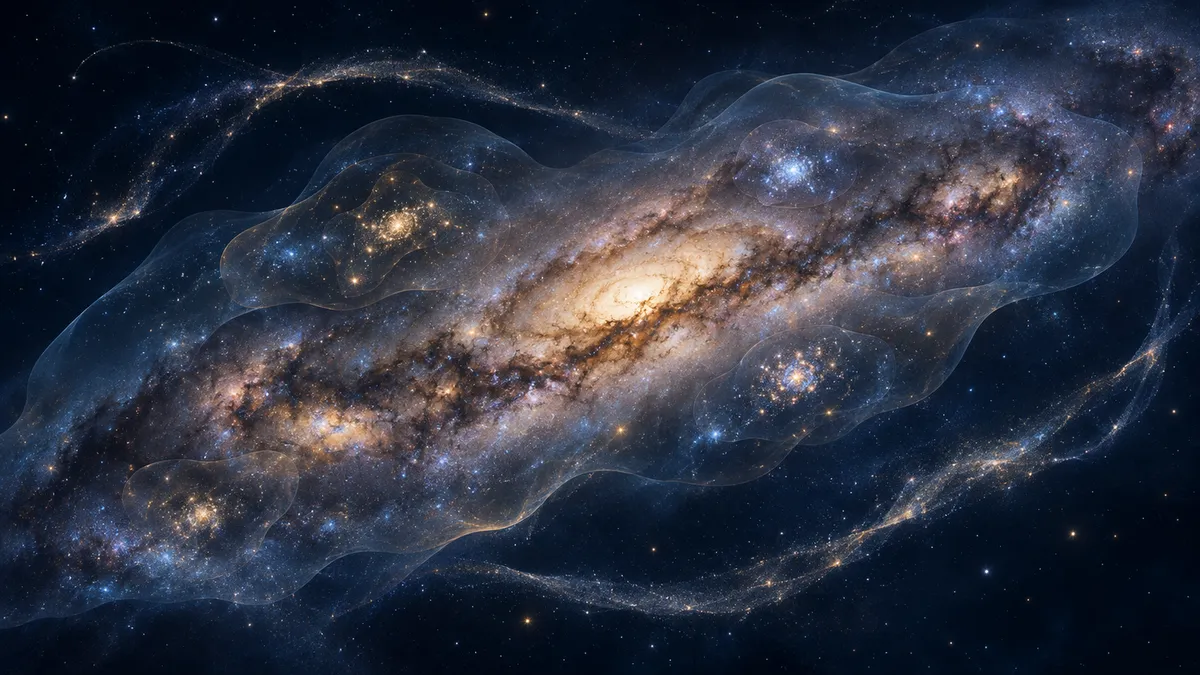
The Milky Way contains stellar structures within structures: compact clusters, sprawling streams and smaller galaxies. A new preprint asks whether one method can identify this variety across more than a billion stars, without prescribing each group’s shape in advance.
Finding groups within groups
The Milky Way’s stellar distribution reflects both its accumulation of smaller systems and its internal evolution. Understanding that history requires finding structures at different scales, rather than treating every stellar group as a separate, self-contained object.
In a preprint, William H. Oliver and Tobias Buck apply the AstroLink clustering algorithm to more than a billion stars from Gaia Data Release 3. Their question is whether a single, model-agnostic approach can recover the Galaxy’s nested structure and relate it consistently to existing catalogues. The supplied source does not establish peer-reviewed publication.
Here, “model-agnostic” means the method does not prescribe a particular shape for the groups it seeks. It still requires choices about data preparation, measurement scaling and statistical significance.
Preparing a billion-star sample
The researchers selected approximately 1.03 billion stars with five-dimensional information: two coordinates on the sky, two components of proper motion and a distance estimate. Proper motion describes a star’s apparent movement across the sky. The distances came from estimates combining Gaia measurements with information about stellar brightness.
The sample excludes sources failing the authors’ astrometric quality requirements. Rather than applying one brightness limit everywhere, they used a limit that varies across the sky, retaining more stars while accounting for differences in crowding and Gaia’s observations.
Selection nevertheless changes the apparent distribution of stars. The team estimated the probability that stars would enter their sample and weighted the density calculation inversely by that probability, aiming to reduce artificial patterns introduced by uneven sampling.
They also transformed distances so that uncertain estimates for distant stars contributed less strongly to the clustering. Positions and motion-related coordinates were rescaled to balance their influence. These operations help reveal patterns, but also affect which patterns the method identifies.
What AstroLink found
AstroLink searches for overdensities: collections of points more concentrated than their surroundings in the chosen data space. It connects these into a hierarchy, allowing smaller groups to sit inside larger ones. A statistical noise model helps distinguish prominent overdensities from random fluctuations.
At the authors’ chosen significance threshold of 3.8 sigma, the algorithm identified 7,410 groups. That threshold refers to AstroLink’s assessment of density structure; it does not independently establish that every group is a distinct physical stellar system.
About 42.3 million stars, or 4.1% of the selected sample, belonged to identified groups. The hierarchy extended through six levels. The authors report that the clustering calculation took approximately 80 minutes on 48 CPU cores.
Comparing maps with different boundaries
The team compared its hierarchy with catalogues of open clusters, globular clusters, dwarf galaxies and stellar streams. Their “availability-aware” comparisons account for the fact that different searches may not include the same stars. Where the original search samples were unknown, they calculated bounds on the comparison scores.
They also asked whether each association was reciprocal: did both the AstroLink group and the catalogue object identify the other as their best match? Other relationships indicate fragmentation, where one catalogue system corresponds to several detected groups, or merging, where one detected group encompasses several catalogue systems.
Compact, high-contrast systems often produced reciprocal matches. Some globular clusters also showed nested substructure. Extended systems were more often split or recovered only in their denser regions. A substantial population had no counterpart in the comparison catalogues, making these groups candidates for investigation—not confirmed discoveries.
What remains uncertain
The analysis lacks radial velocities, which measure motion toward or away from the observer, so it cannot capture the Galaxy’s full dynamical structure. Residual selection effects and the adopted transformations also influence the results; distance contraction can combine distant stars into composite groups.
Catalogue comparisons introduce further ambiguity. Stream tracks describe expected locations and motions rather than securely established membership lists, so unrelated compact groups can overlap their footprints. Low coverage also weakens interpretations of dwarf-galaxy substructure.
The study therefore offers a scalable framework for locating and comparing stellar patterns, not a definitive physical classification. Establishing what unmatched groups represent—and whether apparent fragmentation is physical—requires additional checks.
- Milky Way
- Gaia DR3
- AstroLink
- hierarchical clustering
- stellar clusters
- stellar streams
- galactic structure
Related reading
Automatically matched by shared topic keywords. These links do not imply that the sources agree or establish a consensus.
A Proposed Infrared Instrument Could Trace the Milky Way’s History
Source published
Shared keywords: milky way, stellar streams
Colours of 5,377 Star Clusters Trace the Milky Way’s Patchy Dust
Source published
Shared keywords: gaia dr3
A close galactic encounter could bend the Large Magellanic Cloud’s bar
Source published
Shared keywords: gaia dr3
Simulated stars put Milky Way mass measurements to the test
Source published
Shared keywords: milky way
Close companions are unlikely to explain most slow-spinning stars in open clusters
Source published
Shared keywords: gaia dr3