TRANSMISSION // 2611.10544v1
Can a Tiny Quantum Gate Help Recognize Signers the Model Has Never Seen?
Source published
An eight-qubit circuit makes a compact attention gate for static sign-language images, but matched tests find no measurable accuracy gain over classical alternatives.
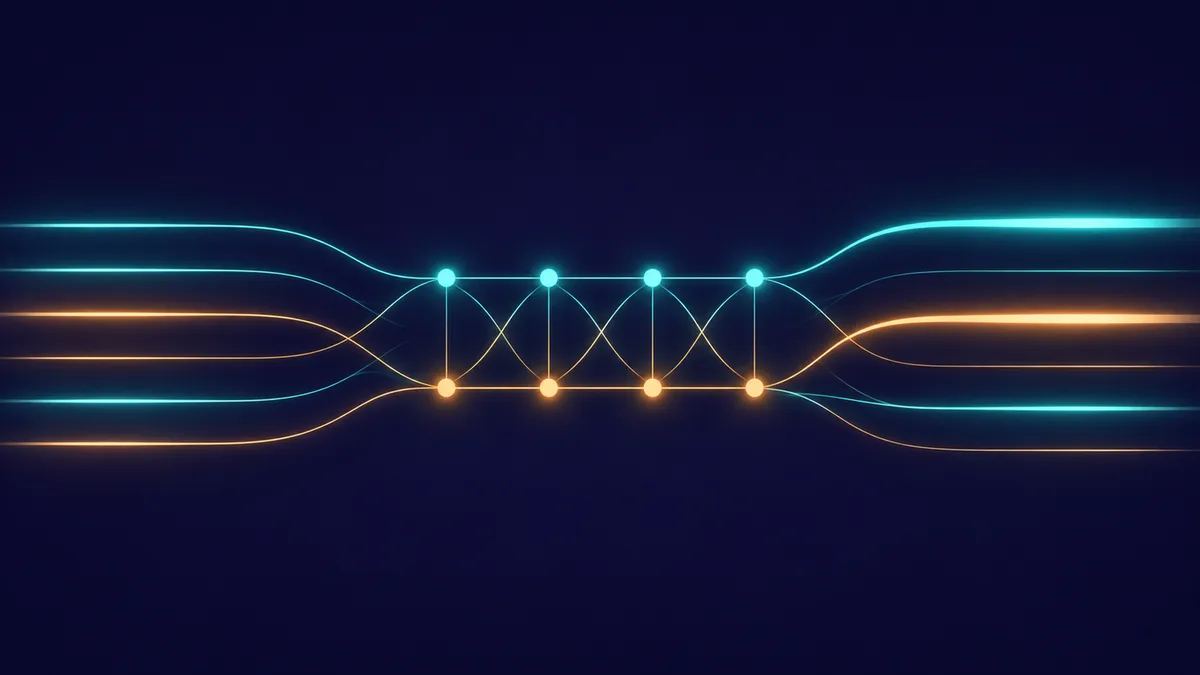
A sign-language image classifier can score well when training and test images are drawn from the same collection. But how does it perform when the test signer is entirely new—and does a quantum circuit help? This study puts a small circuit inside an image model, then compares it with similarly sized and larger classical attention gates.
A harder test than a random image split
The paper studies static American Sign Language fingerspelling: one image of a handshape is classified as one of 26 letters. The researchers focus on a practical weakness in image benchmarks. High scores on a random split do not show whether a model generalizes to people absent from training. They therefore test whether a model trained on four people can classify images from a fifth, unseen signer. This is a still-image task, not recognition or translation of continuous signing.
Their proposed QCA-DenseNet starts with DenseNet121, a convolutional image network initialized with ImageNet weights. It converts each 224-by-224 color image into 1,024 pooled features. A compact quantum channel-attention gate turns those features into weights: a classical layer compresses them to eight angles, an eight-qubit variational circuit processes the angles, and another classical layer expands the circuit's eight outputs into 1,024 values between zero and one. Multiplying each feature by its weight can reduce a channel's contribution, but cannot amplify it. A linear classifier then predicts the letter.
The circuit has two entangling layers and is simulated exactly with PennyLane's default.qubit simulator; it is not run on quantum hardware. The gate contains 17,464 trainable parameters, compared with 131,072 in the study's squeeze-and-excitation (SE) attention block. Most QCA parameters are in its two classical projections, not the circuit: only 48 are circuit angles. To isolate what the circuit contributes, the authors also replace its eight-unit core with a similarly sized classical multilayer perceptron (MLP), and test a model with no attention.
Testing on new people
The main evaluation uses 1,815 images of the letters A through Z from the MU HandImages dataset, contributed by five signers. In each of five rounds, one signer is held out for testing while the other four provide training and validation images. All model layers, including DenseNet121, are fine-tuned. Each fold uses one training seed, so the signer results represent only that run. The paper also reports an ablation on the Kaggle ASL Alphabet dataset, where the image backbone is frozen and only the classifier head is trained with 1%, 5%, or 10% of the training data.
On the held-out signers, QCA-DenseNet averages 94.50% accuracy across people. That is higher than SE's 93.72%, but lower than the matched MLP's 94.55% and the no-attention model's 94.78%. Paired tests across the five signers found no statistically significant differences between QCA and any of these alternatives. The small number of signer pairs also means that a non-significant result does not establish that the methods are equivalent. The study's result is therefore a compact gate with comparable observed accuracy—not evidence that the circuit improves recognition.
How the score is averaged matters. QCA has 94.99% accuracy when all test images are pooled, but the largest signer groups then carry more weight. The equal-signer average, which gives each held-out person equal weight, does not put QCA in front. The fifth signer is also consistently hardest: model accuracy on that fold ranges from about 84.6% to 87.7%, while the other folds are roughly 94.8% to 98.5%. Differences between people matter more here than the choice among attention modules.
What the comparison can—and cannot—show
The matched MLP performs almost identically to QCA, and removing attention does not reduce the measured signer-mean accuracy. The paper consequently attributes the high scores primarily to the fine-tuned DenseNet features, rather than a distinct contribution from the circuit. QCA saves 113,608 attention parameters relative to SE, but that is about 1.6% of the full model; the authors did not compare wall-clock time. In the frozen-backbone Kaggle tests, the larger SE head performs best at each data fraction, so the smaller gate is not uniformly more accurate when training data are limited.
These findings are bounded by five test signers, a single training seed for the main folds, and one particular dataset and architecture. The paper notes that five paired observations give low power, and it does not test noisy circuits or quantum hardware. Its preprint results support a narrower conclusion: this simulated quantum gate is a parameter-efficient alternative in this experiment, but the controlled comparisons show no detectable quantum advantage.
- quantum machine learning
- sign language recognition
- variational quantum circuits
- channel attention
- DenseNet
Related reading
Automatically matched by shared topic keywords. These links do not imply that the sources agree or establish a consensus.