TRANSMISSION // 2611.10525v1
Magnetic disturbances could reshape polarized light around black holes
Source published
A simplified model shows how localized magnetic restructuring near a black hole could change polarization patterns, with different field directions producing distinct signatures.
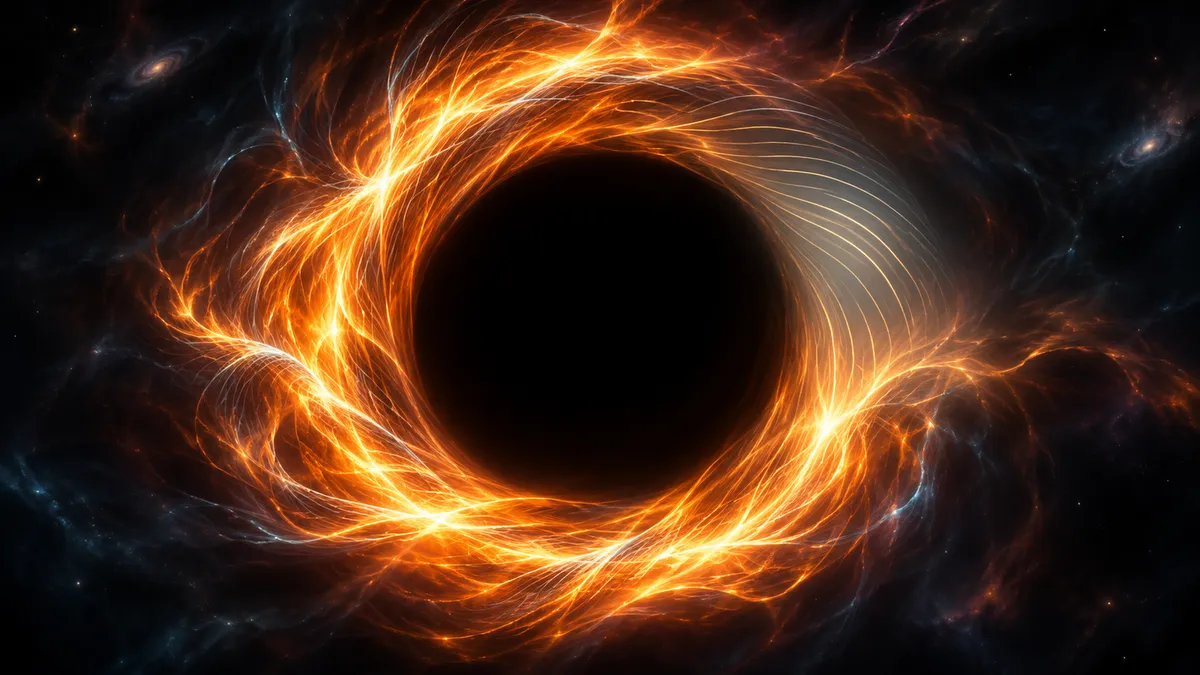
The polarized glow around a black hole can change as nearby magnetic fields evolve. A new theoretical study explores how a localized magnetic reconnection event could alter that glow—without requiring the entire surrounding flow to change.
Reading a changing magnetic environment
Event Horizon Telescope observations reveal ring-like emission around supermassive black holes, including M87*. Polarization—the orientation of light’s electric field—provides information about the magnetic environment of the emitting plasma. As the study describes, observations across multiple years show changes in both polarized brightness and polarization direction.
Yu-Xiang Huang and En-Wei Liang of Guangxi University investigate whether localized magnetic reconnection could produce such changes. Reconnection reorganizes magnetic fields and releases magnetic energy. Their question is not whether they can reconstruct a particular observed event, but how different kinds of magnetic restructuring would appear in polarized images.
The work is available as an arXiv manuscript submitted on November 7, 2026. Its supplied metadata also lists a journal reference in Physical Review D, so it should not be described as an unpublished preprint alone.
A deliberately simplified magnetic bubble
The researchers start with a model of synchrotron emission from plasma in an equatorial layer around a nonrotating black hole. Synchrotron radiation is emitted by charged particles moving in a magnetic field. General relativistic ray tracing follows the light through curved spacetime and calculates how its polarization reaches a distant observer.
Into this otherwise steady model, they introduce a temporary, localized magnetic “bubble.” This is a mathematical representation of a reconnection-disturbed region, not a directly observed object or a self-consistent simulation of reconnection itself.
Inside the disturbance, the ordered magnetic field weakens and changes direction. The bubble moves around the black hole, broadens spatially and gradually fades. A separate “magnetic-memory” prescription gives the field geometry a finite response and relaxation time rather than forcing it to reset immediately.
The model also allows a modest local change in plasma velocity tied to the prescribed depletion of ordered magnetic energy. This matters because motion changes the observed emission through relativistic effects, alongside changes in magnetic strength and orientation.
By varying these ingredients while holding the underlying spacetime and other background assumptions fixed, the researchers isolate their contributions to polarization variability.
Different directions leave different signatures
The calculations compare disturbances dominated by three magnetic directions: radial, pointing toward or away from the center; azimuthal, running around the ring; and vertical, perpendicular to the emitting plane.
In the examples studied, radial-dominated restructuring produces a moderate local decrease in polarized intensity and an inward displacement of the electric-vector position angle, or EVPA. EVPA describes the orientation of linear polarization on the image.
Azimuthal-dominated restructuring instead produces an outward EVPA displacement, together with milder suppression of polarized intensity. Vertical-dominated restructuring produces the strongest polarized-intensity suppression of the three examples, but a comparatively small polarization-angle change.
These are model-dependent trends, not universal rules for every black-hole environment. The distinctions also appear in the evolution of Stokes Q and U, two quantities used to describe linear polarization.
The parameter exploration shows how stronger initial magnetic depletion deepens the field-strength decrease, while a longer bubble lifetime slows recovery. Faster spatial broadening spreads the disturbance more quickly. A longer memory timescale extends the magnetic response rather than merely multiplying its strength.
Connecting local changes to the whole ring
For illustrative M87*-like images, the team adopts a low viewing inclination and an image orientation aligned with the galaxy’s large-scale jet. An azimuthally dominated disturbance in a western sector produces an outward EVPA shift; a radial-dominated disturbance in a northeastern sector produces an inward shift.
They also track the phase of a polarization coefficient called beta-two, which characterizes the ring’s overall polarization twist. Its different evolution in the two examples shows that a localized disturbance can affect this global measure. Both the disturbance’s position and its magnetic orientation matter.
What the model cannot establish
The examples are explicitly not reconstructions of particular EHT observing epochs. Their parameters are representative choices, not uniquely calibrated outputs from detailed plasma simulations.
The model assumes an optically thin emitting layer and neglects synchrotron self-absorption, Faraday rotation and conversion. It does not independently evolve electron temperatures or particle distributions, nor fully track how released magnetic energy is divided among heating, particle acceleration, turbulence and bulk motion. Black-hole spin and a finite-thickness emission region also remain outside the present framework.
The result is a controlled way to explore possible polarization signatures—not evidence that reconnection caused a specific observed change. Its value lies in identifying combinations of brightness, polarization angle and global twist that future observations and more complete models can investigate.
- black holes
- magnetic reconnection
- polarization
- Event Horizon Telescope
- M87*
- general relativistic ray tracing
Related reading
Automatically matched by shared topic keywords. These links do not imply that the sources agree or establish a consensus.
Webb maps gas and stars moving differently around faint active black holes
Source published
Shared keywords: black holes
Two gamma-ray-producing regions emerge in black hole simulations
Source published
Shared keywords: magnetic reconnection
Late solar radio bursts point to particle acceleration after a flare’s peak
Source published
Shared keywords: magnetic reconnection
Magnetic field geometry changes the pace of simulated reconnection
Source published
Shared keywords: magnetic reconnection
Small magnetic patches can bring a simulated solar eruption forward
Source published
Shared keywords: magnetic reconnection