TRANSMISSION // 2611.10507v1
Reading two-dimensional quantum topology from a one-dimensional pump
Source published
A theoretical preprint maps the Haldane model onto a periodically driven chain, showing how quantized transport could reveal its topology. Calculations test both a filled band and a localized bosonic wave packet, with an important factor-of-two calibration.
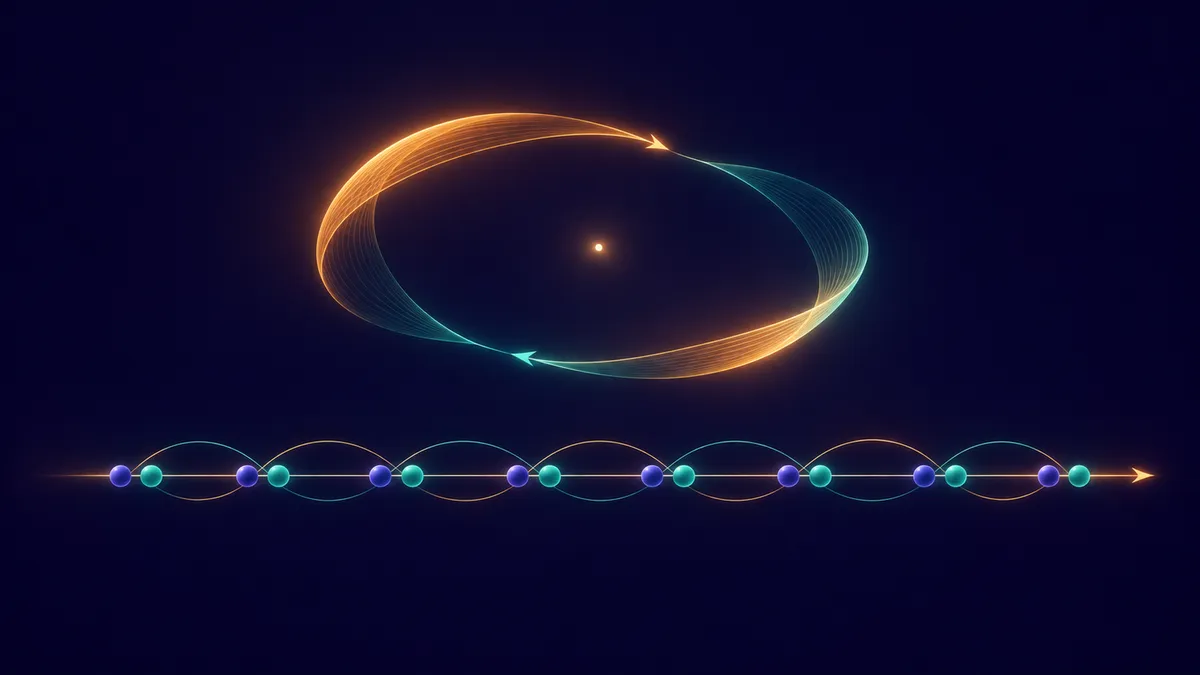
Can motion along a chain reveal a property usually associated with a two-dimensional lattice? A new theoretical study shows how carefully timed changes to a one-dimensional system could make that possible.
A second dimension supplied by time
A quantum particle moving through a repeating lattice has allowed energy bands. Those bands also have geometry: their quantum states change as the particle’s quasimomentum, the momentum-like quantity used in a periodic structure, changes. In two dimensions, an integer called the Chern number characterizes an aspect of this geometry and determines a quantized Hall response.
A one-dimensional chain can encode related information if its properties change periodically. Quasimomentum supplies one coordinate; the position within the driving cycle supplies another. Together, they form a synthetic two-dimensional parameter space—not an additional physical direction.
In an arXiv preprint, Zhen Dong, Xin-Lei Zhao and Yi Zheng develop this connection for an extended Su–Schrieffer–Heeger, or SSH, chain. Their work combines analytical mappings with numerical quantum dynamics. It does not report a new laboratory experiment.
Designing a cycle that transports particles
The SSH chain contains repeating cells with two sites each. Particles hop between neighboring sites with alternating coupling strengths. The extension adds hopping between next-nearest neighbors, with independently adjustable strengths on the two types of site.
The researchers periodically vary the difference between the alternating nearest-neighbor couplings and the difference between the next-nearest-neighbor couplings. Their pumping path circles a point in parameter space where the two bands would touch, while keeping the bands separated along the path itself.
To visualize this construction, they represent the two-band Hamiltonian using a three-component Bloch vector. As quasimomentum changes, the vector traces a loop in an abstract space. During the pump, that loop moves. Its motion around the origin provides a graphical way to understand the cycle’s topology. The origin represents a band degeneracy, not a physical object inside the chain.
For the illustrated cycle, the occupied band has Chern number one. With the lower band uniformly filled by spinless fermions, the calculated current integrates to one unit of pumped particle number per cycle in the adiabatic regime. Adiabatic means that the parameters change slowly enough for particles to remain in their band. The instantaneous current can oscillate even when the accumulated transport approaches the topological value.
A wave packet instead of a filled band
Uniform band occupation is a demanding starting condition for a bosonic wave packet, which may occupy only a narrow range of quasimomenta. The authors therefore also examine an established alternative: adding a weak potential gradient.
The gradient drives Bloch oscillations, sweeping the packet through quasimomentum while the pumping parameters change. This can replace averaging over a filled band with sampling through time.
For a gradient-induced oscillation frequency equal to six-fifths of the pumping frequency, the two motions share a common period of five pump cycles. In the reported simulation, the packet’s center shifts by five unit cells after five cycles and ten after ten, despite substantial oscillatory motion between those times.
This readout is conditional, not an exact consequence of any rational frequency ratio. The argument assumes adiabatic single-band evolution and sufficiently uniform sampling of the relevant band geometry; the paper expresses the wave-packet transport relation as an approximation.
Mapping the Haldane model—and counting twice
The researchers then construct a more specific drive corresponding to the Haldane model, a two-dimensional honeycomb-lattice model with topological bands despite zero net magnetic flux. They replace one momentum coordinate with pumping time and prescribe the chain’s hopping strengths and additional site energies accordingly.
A crucial calibration follows: one full driving cycle covers the Haldane model’s momentum domain twice. Consequently, a filled band pumps twice the Haldane Chern number, rather than once. Their example with Chern number one transports two units per cycle. In the wave-packet calculation, a four-thirds frequency ratio produces shifts of six and twelve unit cells after three and six cycles, respectively, consistent with that doubled count.
The result is a theoretical route to reading two-dimensional topology through one-dimensional transport. Cold atoms and photonic lattices are proposed platforms, not demonstrated implementations here. Realizing the prescribed couplings, maintaining slow single-band evolution and obtaining adequate momentum sampling remain essential conditions. Extensions to interactions or disorder are possibilities raised by the authors, not results established in this study.
- Thouless pumping
- Haldane model
- SSH chain
- Chern number
- Bloch oscillations
- synthetic dimensions