TRANSMISSION // 2611.10454v1
Drone swarms can repair formations by letting old claims fade
Source published
A simulation preprint finds that expiring position claims help decentralised drone swarms recover from silent failures. But a simpler, equally tuned allocator often matches the proposed swarm-intelligence controller and repairs formations faster.
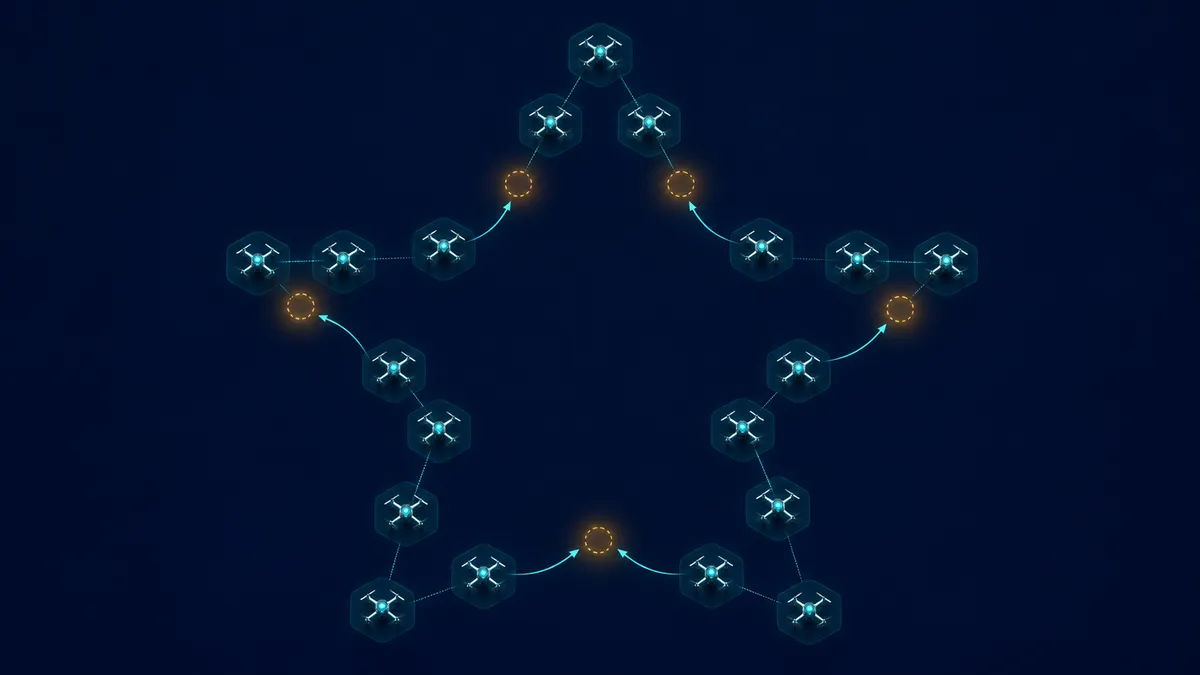
How can a drone swarm redraw a picture when half its members disappear without warning? A new preprint explores a practical answer: let every drone’s claim to a position expire unless it keeps renewing it.
A drone that fails cannot reliably announce its departure. For a swarm forming a picture without a central coordinator, that creates a problem: surviving drones may keep treating an empty position as occupied. Md. Abu Horaira’s preprint studies how local, fading records of ownership could let a swarm reorganise despite silent failures, unreliable radio and noisy movement.
The results come entirely from simulation, not aircraft. Their most informative finding is also a qualification: the proposed controller works well in many tested conditions, but its more elaborate ant-colony and particle-swarm ingredients are not consistently responsible for that performance.
Claims that expire
The target picture consists of discrete positions, or slots. These are ordered by repeatedly choosing a point far from those already selected. Filling the highest-priority slots therefore spreads a smaller surviving swarm across the picture rather than leaving a random fragment intact.
Each drone keeps a table of slot claims and exchanges it with nearby radio neighbours. A drone strengthens and refreshes its own claim while holding a slot. Copies retain their original timestamps, so passing an old claim around cannot keep it alive indefinitely.
The paper calls these records digital pheromone, borrowing from ant colony optimisation, or ACO. Unlike a trail that attracts ants, a strong claim discourages another drone from choosing an occupied slot. Unassigned drones select slots probabilistically using claim strength, distance and priority. Drones can also exchange assignments or move into more important vacancies.
When a drone disappears, its claim fades. The paper proves that its records expire within a bounded number of simulation steps, regardless of how messages circulate. This is not an infallible diagnosis of death: prolonged radio silence from a living drone can also weaken its claim. Faster expiry speeds repair but increases that ambiguity.
A separate motion controller combines momentum, attraction towards the assigned slot and particle-swarm optimisation, or PSO, terms based on previously good positions and neighbours. An independent geometric filter restricts movements to buffered safety regions. PSO is also used offline to tune the controller’s 17 parameters.
What the experiments show
The typical experiment used 34 drones and 34 slots. Four difficulty levels changed radio range, packet loss, motion noise and access to the target map. The hardest combined 50% message loss, short-range communication, triple the base noise and partial map knowledge.
Formation counted as successful when drones occupied at least 95% of the available target positions within the time limit. Across two test-seed sets, the proposed reference configuration succeeded in about 95% of the hardest runs; a configuration selected for its validation performance reached about 99%.
After half the drones were silently removed at normal difficulty, the reference controller restored at least 90% of the smaller swarm’s high-priority picture within 400 steps in 96% of runs. Median recovery took 186 steps. This means redrawing the shape at lower resolution, not replacing the missing aircraft.
The strongest comparison used the same fading claims but chose the highest-scoring slot deterministically and omitted assignment swaps. This CBBA-style baseline was tuned with the same search budget. It matched or exceeded formation reliability and repaired the half-swarm loss faster: a median of 128 steps for its reference configuration.
The proposed controller nevertheless transferred better to eight previously unused shapes under the hardest conditions, succeeding in 98% of runs versus 88–89% for the tuned baseline. It also formed pictures with 300 simulated drones. A centralised comparison with immediate global knowledge remained faster in formation.
Safety and the limits of the evidence
The safety proof is conditional: drones must start safely separated, motion noise must remain bounded, nearby positions must be sensed exactly, and the filter must return feasible movements within its displacement bound. Dense jams can violate the filter condition.
Across 21,088 runs of the proposed controller with different parameter settings, five contained brief simulated overlaps. These were shallow, but they demonstrate why the theorem is not an unconditional collision guarantee.
Component-removal experiments found no measurable benefit from PSO’s personal-best and social terms, including in a 150-drone congestion test. Deterministic slot selection was at least as reliable under heavy loss. Tuning mattered substantially, although tuning on a narrow set of conditions sometimes produced severe failures elsewhere.
This is preprint evidence with important boundaries. The simulator uses two-dimensional motion, synchronised updates and exact local sensing; it omits real quadrotor dynamics, wind and battery constraints. One design revision followed inspection of the first test set, although a second set remained uninvolved. Communication bandwidth was not limited, despite growing claim tables. The demonstrated lesson is therefore about simulated coordination: renewable, expiring claims and broad tuning appear more important than the full swarm-intelligence machinery.
- drone swarms
- decentralised coordination
- silent failures
- ant colony optimisation
- particle swarm optimisation
- collision avoidance
- simulation