TRANSMISSION // 2611.10431v1
Small white dwarf explosions could resemble the faintest Type Iax supernovae
Source published
Simulations suggest that double detonations in low-mass white dwarfs can produce faint, strongly asymmetric explosions resembling some Type Iax supernovae. Their apparent brightness depends sharply on viewing direction, but uncertainties in nuclear burning and light modelling prevent a firm identification.
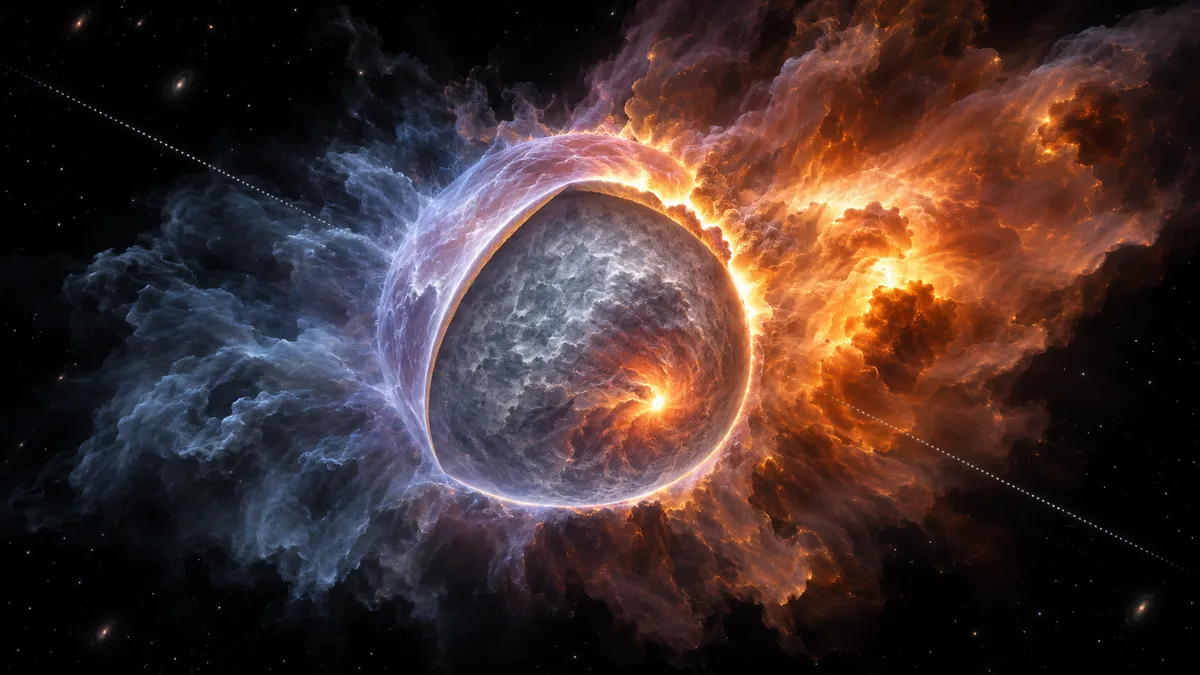
Could relatively common, low-mass white dwarfs produce some of the faintest supernova-like explosions? A new preprint follows simulated blasts from ignition to escaping light and finds promising similarities to two observed events—alongside important mismatches and modelling limits.
A white dwarf’s explosion need not look equally bright from every direction. In simulations by Samuel J. Boos and Lars Bildsten, low-mass white dwarfs produce lopsided distributions of radioactive material, making the same explosion appear substantially different depending on where an observer sits. The results suggest a possible origin for some faint Type Iax supernovae, not a confirmed explanation. The study is presented as an arXiv preprint, with no journal publication listed in the supplied record.
The question concerns double detonation: an explosive burning wave in a white dwarf’s helium shell sends shocks into its carbon-and-oxygen core, triggering a second detonation. Earlier models with white dwarfs around 0.9–1.1 times the Sun’s mass have reproduced properties of normal Type Ia supernovae. But lower-mass white dwarfs are much more common, motivating the authors to ask what their explosions would look like.
Following the blast into light
The researchers modelled white dwarfs with masses of 0.50 and 0.60 times the Sun’s mass. Both had thin helium layers inherited from their stellar evolution, rather than thick shells assembled through substantial additional accumulation. They ran two-dimensional simulations with FLASH, a code that follows fluid motion and nuclear burning, using a finest grid spacing of four kilometres.
Each simulation began with an artificially imposed hot region in the helium–carbon transition layer. The shell detonation then travelled around the star. Its inward-moving shocks converged on the opposite side and ignited the core without a second artificial ignition. Thus, the calculations follow what happens after shell ignition; they do not independently demonstrate how a real binary system starts that first explosion.
The authors then used Sedona, a radiation-transport code, to calculate light curves—brightness changing with time—and spectra, which separate the escaping light by wavelength. They calculated observables along 15 viewing directions for each model.
Incomplete burning, uneven illumination
Unlike detonations in more massive white dwarfs, the core-burning waves failed before crossing the entire star. In the 0.50-solar-mass models, failure occurred near the centre; in the 0.60-solar-mass model, the wave travelled somewhat farther. Considerable carbon and oxygen therefore escaped without burning.
The explosions produced little radioactive nickel-56, whose decay helps power the emerging light. Crucially, that nickel was concentrated mainly in one hemisphere. This uneven heating produced strongly direction-dependent brightness, spectral shapes and inferred expansion velocities.
For a single explosion, peak bolometric brightness—the brightness accounting for radiation across wavelengths—varied by up to nearly two magnitudes between viewing directions. Across all models and directions, peak absolute bolometric magnitudes ranged from −12.4 to −15.8; more negative values indicate brighter objects. These simulated events were much dimmer than normal Type Ia supernovae.
The spectra contained numerous relatively narrow absorption features. The authors attribute these to slower-moving ejecta, which spread spectral lines less through Doppler shifts, and cooler, less ionized material. Both the light curves and spectra changed markedly with viewing direction.
How closely do observations match?
Some viewing directions of the 0.50-solar-mass models reproduced aspects of the measured brightness and light-curve shapes of the faint Type Iax supernovae SN 2008ha and SN 2024vjm. Spectral agreement was less convincing, although some individual features aligned. The 0.60-solar-mass model lacked a close light-curve comparison for most directions and was dimmer than observed intermediate-luminosity events with similar inferred expansion velocities.
Several uncertainties prevent a stronger conclusion. Two versions of the nuclear-burning software produced about 0.0052 and 0.0018 solar masses of nickel-56 from the same 0.50-solar-mass progenitor. The authors regard the newer-version result as more faithful, but retain both to illustrate uncertainties in this poorly explored regime.
The light calculations also assumed local thermodynamic equilibrium, an approximation tying the material’s excitation and ionization to local thermal conditions. The authors say calculations relaxing that assumption are needed for more confident predictions.
Finally, the explosion simulations excluded a companion star. Although all material was unbound under the exploding star’s gravity alone, a crude subsequent calculation suggested that a companion could retain up to 0.1 solar masses of ejecta in the lower-mass cases. Proper binary simulations are needed to test that estimate. The study therefore establishes a plausible resemblance to some faint Type Iax events, while leaving their actual origin and the frequency of these explosions unresolved.
- white dwarfs
- double detonation
- Type Iax supernovae
- thermonuclear explosions
- nickel-56
- radiative transfer
- astrophysical simulations
Related reading
Automatically matched by shared topic keywords. These links do not imply that the sources agree or establish a consensus.
A nearby supernova may reveal how quickly white dwarfs can explode
Source published
Shared keywords: white dwarfs
Dust and oxygen complicate the story of SN 1987A’s fading light
Source published
Shared keywords: radiative transfer
Did two stars become one? Clues from the heaviest white dwarfs
Source published
Shared keywords: white dwarfs
Layered cloud model traces hydrogen’s transition toward star-forming gas
Source published
Shared keywords: radiative transfer
Reading starlight without flattening the star
Source published
Shared keywords: radiative transfer