TRANSMISSION // 2611.10428v1
Two gamma-ray-producing regions emerge in black hole simulations
Source published
A preprint models how polar spark gaps and an equatorial current sheet sustain electrical currents around a rotating black hole. Radiation cooling changes the polar region’s variability more strongly, while simulated emission depends on viewing angle. Applying the results to real galaxies remains uncertain.
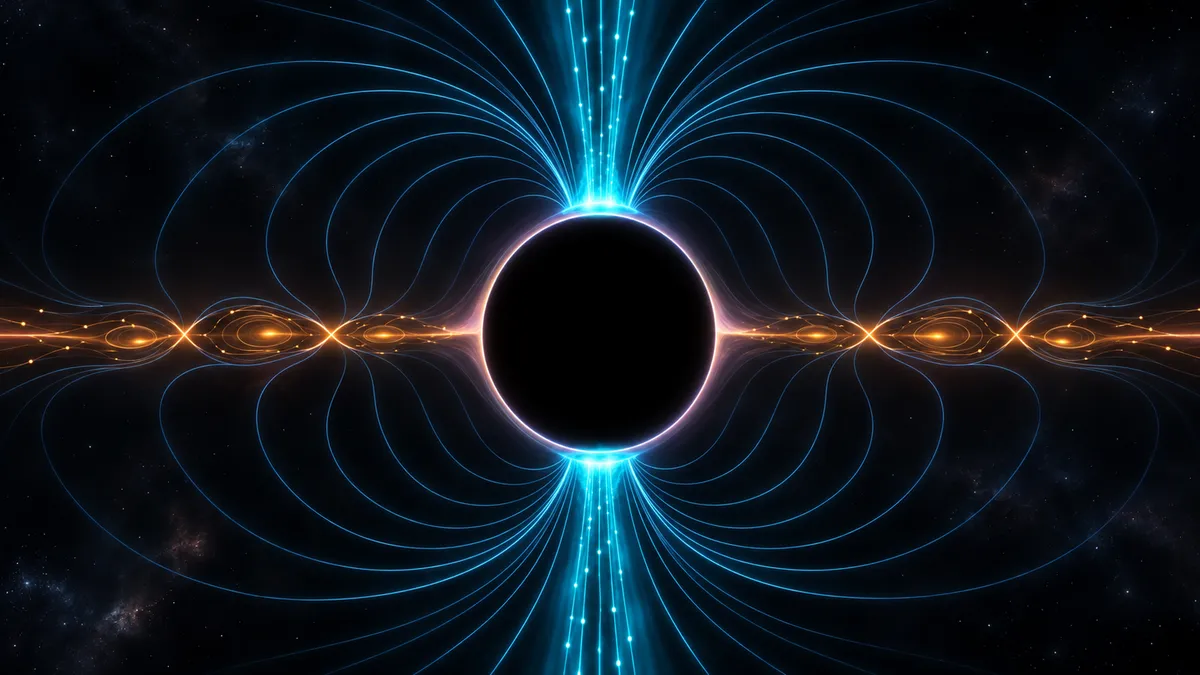
How do the electrical currents around a rotating black hole sustain themselves, and what radiation do they produce? New simulations examine two particle-accelerating regions together, finding that they support the same global current system without showing significantly correlated short-term fluctuations.
A rotating black hole surrounded by magnetic fields can transfer rotational energy into an outward electromagnetic flow through the Blandford–Znajek mechanism, a leading explanation for powerful astrophysical jets. But the surrounding magnetosphere—the magnetically dominated region containing charged particles—must have enough particles to carry its electrical currents. Where that supply falls short, electric fields can accelerate particles and generate high-energy radiation.
A preprint by Koki Kin and colleagues, submitted to arXiv on November 7, 2026, investigates how two such acceleration regions operate together. One is a polar “spark gap,” where insufficient charge allows an electric field along the magnetic field to persist. The other is an equatorial current sheet, a narrow region where opposing magnetic fields can reconnect, rearranging their connections and releasing magnetic energy. The supplied record lists submission to APS, not a published journal article.
Following particles and radiation
The researchers used two-dimensional, axisymmetric general relativistic particle-in-cell simulations. This method follows simulated charged particles and evolving electromagnetic fields while accounting for the gravity of a rotating black hole. Axisymmetry means the model does not represent variations around the rotation axis.
The plasma consisted of electrons and positrons, their positively charged counterparts. Particles could transfer energy to background photons through inverse-Compton scattering. Sufficiently energetic photons could then collide with background photons to create additional electron–positron pairs, replenishing the plasma.
The team compared a model without synchrotron-curvature cooling against one with it enabled. This radiation arises as charged particles’ trajectories bend in electromagnetic fields; emitting it removes particle energy. The cooling model was restarted from the other simulation, allowing the researchers to examine the response to switching this energy loss on.
Both runs began with a vertical magnetic-field configuration. The background photon field was simplified to be uniform, static, directionally isotropic and composed of photons with a single energy. The surrounding accretion flow was not dynamically simulated.
Shared currents, different fluctuations
Both models developed a polar gap and a variable equatorial current sheet. Together with a return-current layer, these regions sustained a global current system: current flowed inward near the poles and returned through the equatorial regions. The overall electromagnetic structure remained broadly similar with and without the added cooling.
The polar gap nevertheless changed substantially. With synchrotron-curvature cooling enabled, its electric field repeatedly grew and became screened by newly supplied charges. Cooling increased the population of particles at energies that efficiently produced pair-generating inverse-Compton photons. Those photons supplied charges closer to their originating magnetic field lines, helping suppress the gap’s electric field and producing oscillations.
In the equatorial region, time-dependent electric fields drove magnetic flux inward, rearranging the magnetic field before reconnection occurred. Cooling strongly reduced the highest-energy particle population there, but its effect on the sheet’s overall dynamics was more modest for the parameters tested.
The researchers also compared the timing of fluctuations in the polar and equatorial regions. Their cross-correlation analysis found no relationship reaching 95% significance under a circular time-shift test. That suggests weak or absent direct dynamical coupling in the simulated inner magnetosphere, rather than proving that the regions are universally independent. Their currents could balance on average without their short-term fluctuations matching.
What a distant observer might see
After the simulations, the team traced photon paths to calculate synthetic radiation signals. Luminosity integrated over the modeled photon energies reached roughly 1% of the reference Blandford–Znajek power for synchrotron-curvature emission and 0.1% for inverse-Compton emission. These are model-dependent values, not observed efficiencies.
Viewing direction mattered. Near the poles, accelerated particles moved preferentially along magnetic field lines. Around the equatorial sheet, their directions were more broadly distributed. The inverse-Compton contribution relative to synchrotron-curvature emission was consequently greater for observers looking closer to the rotation axis.
Separate energetic estimates suggest that polar spark gaps could produce photons in the sub-TeV range. That extrapolation is not a direct simulation of a particular galaxy or an identification of an observed gamma-ray source.
Limits on the interpretation
The simulations did not reproduce the large brightness increases seen in some prominent very-high-energy flares. The authors suggest that stronger external changes, such as variations in accretion and its photon field, may be needed.
Their numerical rescaling of magnetic and cooling parameters also limits direct application to real systems. The adopted photon density and cooling-energy hierarchy may differ substantially from those around M87. Three-dimensional particle motions absent from axisymmetry could change acceleration efficiency. Broader parameter surveys and models including external plasma supply are therefore needed to establish how robust these predicted behaviors and radiation signatures are.
- black hole magnetospheres
- gamma rays
- particle-in-cell simulations
- spark gaps
- magnetic reconnection
- inverse-Compton scattering
- synchrotron-curvature radiation
- Blandford–Znajek mechanism
Related reading
Automatically matched by shared topic keywords. These links do not imply that the sources agree or establish a consensus.
Could a hidden pulsar power the LHAASO Peanut?
Source published
Shared keywords: gamma rays, inverse compton scattering
An extended gamma-ray source hints at a pulsar-powered particle accelerator
Source published
Shared keywords: inverse compton scattering
Galactic Center Gamma Rays Stay Extreme, but IceCube Finds No Neutrino Counterpart
Source published
Shared keywords: gamma rays
Magnetic disturbances could reshape polarized light around black holes
Source published
Shared keywords: magnetic reconnection
Magnetic field geometry changes the pace of simulated reconnection
Source published
Shared keywords: magnetic reconnection