TRANSMISSION // 2611.10419v1
An information-based method tracks light echoes around active black holes
Source published
A preprint tests mutual information as a way to measure delays between brightness changes in four active galaxies. It broadly recovers ultraviolet and optical delays, but X-ray results are less consistent, and the study does not establish superiority over existing methods.
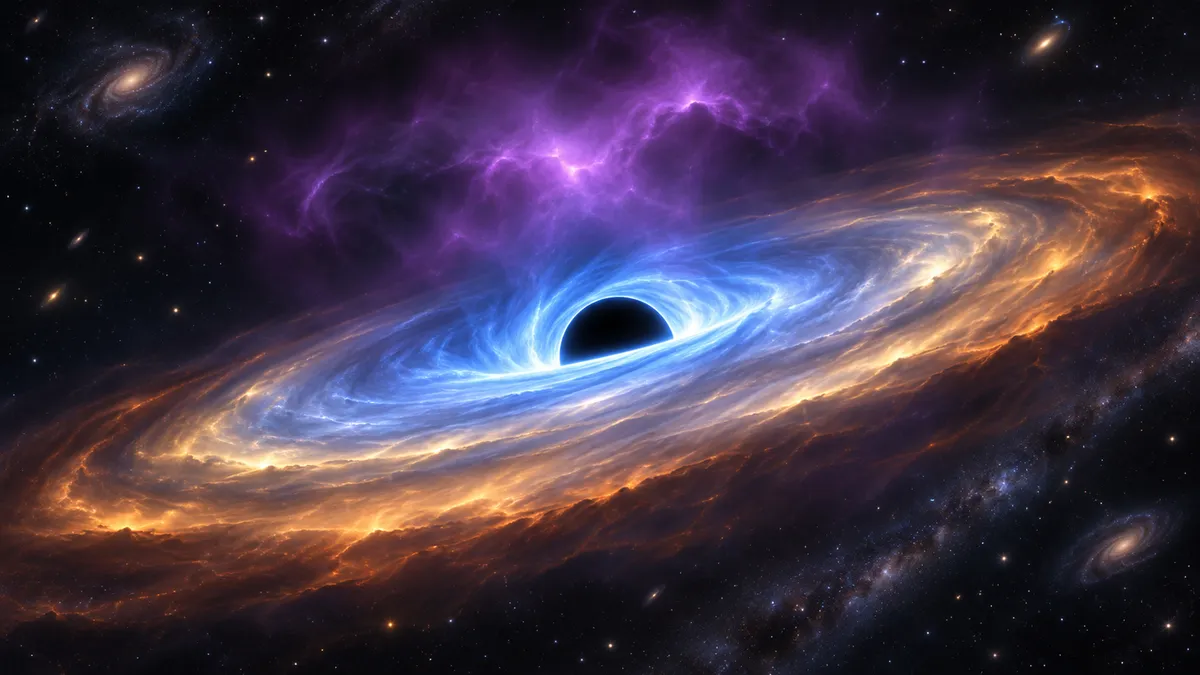
Light emitted near a supermassive black hole can be absorbed and re-emitted by surrounding material, producing delayed echoes at other wavelengths. A new study asks whether a statistical tool that captures nonlinear relationships can help astronomers measure those delays.
Measuring echoes, not images
Active galactic nuclei are bright central regions of galaxies powered by matter falling toward supermassive black holes. Their brightness fluctuates across the electromagnetic spectrum. Comparing the timing of those fluctuations can reveal information about structures too small to image directly.
The technique, called reverberation mapping, measures delays between signals at different wavelengths. In the disc-reprocessing picture, surrounding material absorbs radiation and emits a delayed response. Those delays help constrain light-travel distances and the arrangement of emitting regions.
In an arXiv preprint, R. A. A. Souza and colleagues test whether mutual information can recover these delays in observations of four Seyfert galaxies, a class of active galaxies. The supplied source does not establish journal publication or completed peer review.
Looking beyond linear correlation
A standard approach, the interpolated cross-correlation function, or ICCF, compares brightness records after shifting one relative to the other. It measures linear correspondence: how closely increases and decreases in one record track those in another.
Mutual information measures statistical dependence more broadly, including nonlinear relationships. In accessible terms, it asks how much knowing one signal reduces uncertainty about the other. The researchers calculate it repeatedly at different trial shifts, looking for the delay where the two records share the most information.
That flexibility does not guarantee a reliable physical delay. The observations still need to contain a sufficiently clear relationship between the signals.
Four galaxies, eight observing bands
The team analysed Swift observations of Mrk 509, NGC 5548, NGC 4151 and NGC 4593. Each was monitored in eight bands: six ultraviolet or optical bands and two X-ray bands. The shortest-wavelength ultraviolet band, W2, served as the reference.
The researchers standardised the brightness records, called light curves, and used linear interpolation to place observations on common time grids. They estimated mutual information with the Kraskov–Stoegbauer–Grassberger nearest-neighbour method, using five neighbours to characterise local patterns in paired brightness measurements.
To estimate uncertainty, they repeated the analysis 150 times, independently selecting 80% of the observations from each light curve without replacement. The spread of recovered delays provided uncertainty intervals. They compared the results with previously published ICCF estimates and ultraviolet/optical estimates from JAVELIN, which models variability statistically.
Clearer ultraviolet echoes, difficult X-rays
The method broadly reproduced the established ultraviolet and optical lag pattern, with particularly close agreement in the nearby ultraviolet bands M2 and W1. Results were not equally strong everywhere. Performance generally weakened toward the optical, where lower variability amplitudes could leave less distinct mutual-information peaks.
NGC 5548 nevertheless provided a strong optical example: its B-band delay was about 1.08 days using mutual information, compared with about 1.11 days using ICCF. Conversely, Mrk 509 showed appreciably shorter mutual-information delays than ICCF in its U, B and V bands.
The authors suggest that some differences reflect what the estimators measure. ICCF uses a centroid that averages across a correlation peak, whereas this mutual-information implementation seeks a peak. An extended delayed response from diffuse emission could shift those summaries differently. This is an interpretation, not a direct demonstration that one estimate is physically correct.
X-ray recovery was substantially less consistent. Broad or multiple peaks and wide uncertainty distributions often prevented a well-constrained delay. NGC 4593 was the exception: both X-ray estimates agreed with ICCF within the reported mutual-information uncertainties. The authors relate the broader difficulty to previously reported weak X-ray/ultraviolet coupling, rather than treating statistical flexibility as sufficient to uncover an echo.
Promise with important qualifications
Across 20 ultraviolet/optical comparisons, mutual-information estimates were closer to JAVELIN in 14 cases. Their mean and median differences were smaller than ICCF's, but their root-mean-square difference was larger. A paired statistical test did not establish a significant advantage. Agreement with JAVELIN therefore does not demonstrate superior accuracy.
The authors also compare performance with earlier measurements of multifractality: how differently small and large fluctuations behave across timescales. Its spectral width, Δα, is proposed as a candidate diagnostic, particularly for ultraviolet/optical data. High values did not reliably predict X-ray success, and a direct statistical test is left for future work.
Finally, interpolation can introduce artificial structure when observations are irregular. The relatively homogeneous dataset supports this initial test, but broader sampling conditions remain to be examined. The study supports mutual information as a promising complementary tool, not a universal replacement for existing reverberation methods.
- active galactic nuclei
- reverberation mapping
- mutual information
- Seyfert galaxies
- Swift
- accretion discs
- time delays
- multifractality
Related reading
Automatically matched by shared topic keywords. These links do not imply that the sources agree or establish a consensus.
Stellar Motions Put NGC 3227’s Black Hole at About 12 Million Suns
Source published
Shared keywords: reverberation mapping, seyfert galaxies
Untangling the changing light signals of NGC 5548
Source published
Shared keywords: reverberation mapping
When gravity changes the effect of neutrino flavour near a black hole
Source published
Shared keywords: accretion discs
Two telescopes tracked fourfold quasars to measure light and gravity
Source published
Shared keywords: time delays
Measuring the cosmic web’s statistical memory—and the limits of the measurement
Source published
Shared keywords: mutual information