TRANSMISSION // 2611.10342v1
Planetary phase changes forecasts for detecting exoplanet atmospheres
Source published
An EXOSIMS simulation study connects atmospheric detection requirements to planetary phase. Under the tested assumptions, it predicts more successful water-vapor and oxygen detections than fixed-threshold controls, with the highest success fractions at intermediate phases.
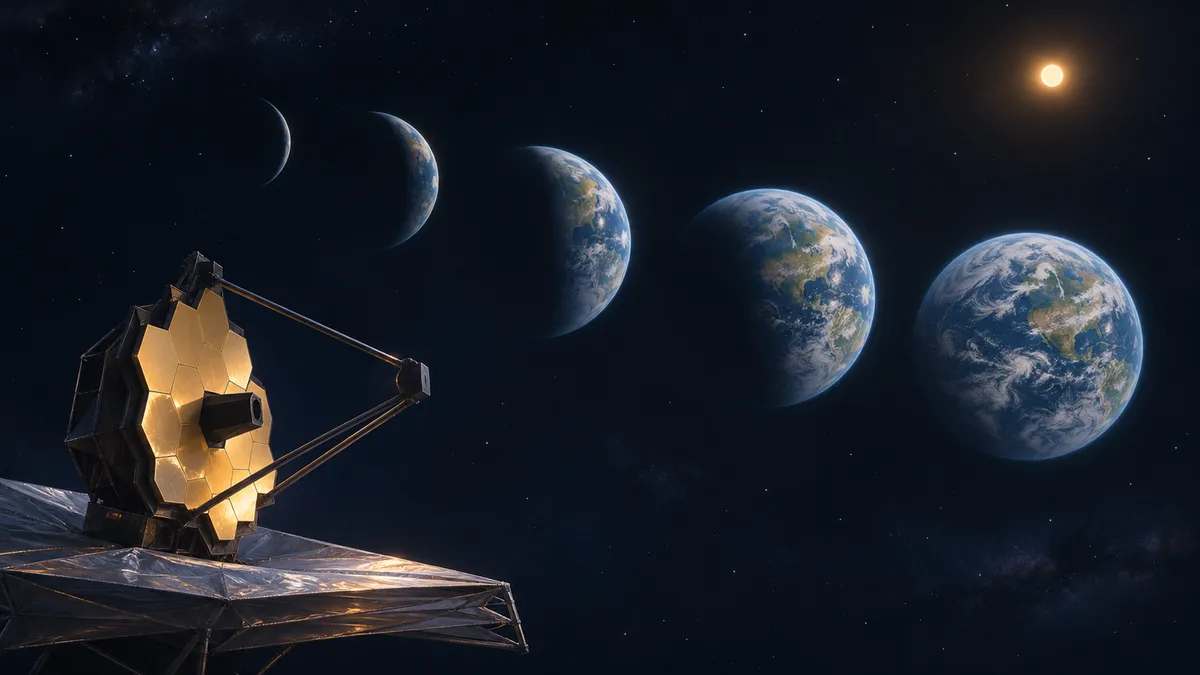
Finding an Earth-like planet and identifying molecules in its atmosphere are different observing challenges. A new preprint by Searra Foote and colleagues connects them by accounting for how a planet’s viewing geometry changes both its molecular signatures and its accessibility to a telescope.
From finding planets to identifying molecules
NASA’s planned Habitable Worlds Observatory aims to detect Earth-like planets around Sun-like stars and characterize their atmospheres. Predicting its scientific return requires more than counting planets: simulations must also estimate whether observations can identify particular atmospheric molecules.
In a preprint submitted to arXiv on November 7, 2026, Searra Foote and colleagues extend the Exoplanet Open-Source Mission Simulator, EXOSIMS, to address that distinction. Their study considers water vapor, H2O, and molecular oxygen, O2. It reports simulated molecular detections, not observations of actual exoplanet atmospheres. The supplied metadata lists no journal publication.
The central question is how planetary phase affects atmospheric characterization. Phase angle describes the star–planet–observer geometry: zero degrees corresponds to full phase, 90 degrees to a half-illuminated appearance, and larger angles to increasingly crescent phases. This geometry changes both the planet’s apparent brightness and the molecular information in its reflected light.
Calculating a phase-specific requirement
The researchers used the atmospheric modeling and retrieval tool rfast to generate spectra for a modern-Earth analog orbiting a Sun-like star. Their adopted atmosphere included clouds covering half the planet. They modeled water vapor over wavelengths of 0.8–1.0 micrometers and oxygen over 0.6–0.8 micrometers.
At nine phase angles, they compared paired spectra with the target molecule present or effectively removed, holding other parameters fixed. These differences provided estimates of the signal-to-noise ratio, or SNR, needed to identify each molecule. SNR measures the strength of a signal relative to noise.
The calculation targeted a five-sigma molecular detection across the wavelength interval. That criterion is distinct from the spectral SNR required to achieve it; the latter is not the detection significance of a single spectral element.
For both molecules, the required spectral SNR declined toward crescent phases. At 90 degrees, the requirements were 3.10 for water and 6.72 for oxygen. At 150 degrees, they fell to 1.59 and 2.59, respectively. Atmospheric retrieval tests at 90 degrees supported the approximate requirements at that geometry.
Putting the atmosphere into mission scheduling
The team incorporated these requirements into EXOSIMS using lookup tables interpolated according to each simulated planet’s phase. The resulting SNR target feeds into the existing calculation of characterization exposure time. The underlying count-rate and noise model remains unchanged, as do the criteria for initially detecting a planet.
This is not simply a new label applied after a simulated mission finishes. Changing an exposure-time requirement can change the schedule and the observing opportunities available later.
The researchers ran separate ensembles of 1,000 five-year missions for water and oxygen, assuming a six-meter telescope and a specified coronagraph configuration. A coronagraph enables direct imaging near a star, but its inner working angle limits how close to the star a planet can appear and remain accessible. Control simulations retained the same observing configuration while using constant SNR requirements of 5 for water and 8.5 for oxygen.
Intermediate phases produced the most success
Although crescent phases required lower spectral SNR, they did not produce the highest molecular detection success. Both species had their highest successful-detection fractions near phase angles of 60–70 degrees, even after accounting for unequal numbers of characterization attempts at different phases.
The paper attributes this behavior to competing effects. Relative molecular absorption features strengthen toward crescent phases, but the available reflected light decreases and the planet’s apparent separation from its star changes. Zero-SNR failures became increasingly associated with planets falling inside the coronagraph’s inner working angle at larger phase angles.
Mean water detections increased from about 7.3 per simulated mission in the fixed-threshold control to 12.9 with phase-dependent requirements, a reported increase of 76.8 percent. Oxygen detections increased from about 9.7 to 12.6, or 29.7 percent.
What the forecasts establish
These yields depend on the adopted atmosphere, instrument, and mission assumptions. The large simulation ensembles reduce sampling noise but do not remove those underlying uncertainties. Retrieval validation was performed at 90 degrees, and EXOSIMS uses the precomputed requirements rather than running a fresh atmospheric retrieval for every observation.
The authors propose extending the framework to other atmospheric states and molecules. For now, the study demonstrates how species-specific atmospheric requirements can change mission forecasts when propagated through exposure calculations and scheduling, rather than considered separately from observing geometry.
- exoplanets
- Habitable Worlds Observatory
- EXOSIMS
- atmospheric characterization
- planetary phase
- water vapor
- molecular oxygen
Related reading
Automatically matched by shared topic keywords. These links do not imply that the sources agree or establish a consensus.