TRANSMISSION // 2611.10302v1
When better holograms stop saving laser power
Source published
A theoretical and numerical preprint estimates how brightly phase-only holograms can illuminate their weakest optical trap. In the modeled arrays, optimized patterns approach those limits, while changing illumination or splitting traps between two planes offers further power savings.
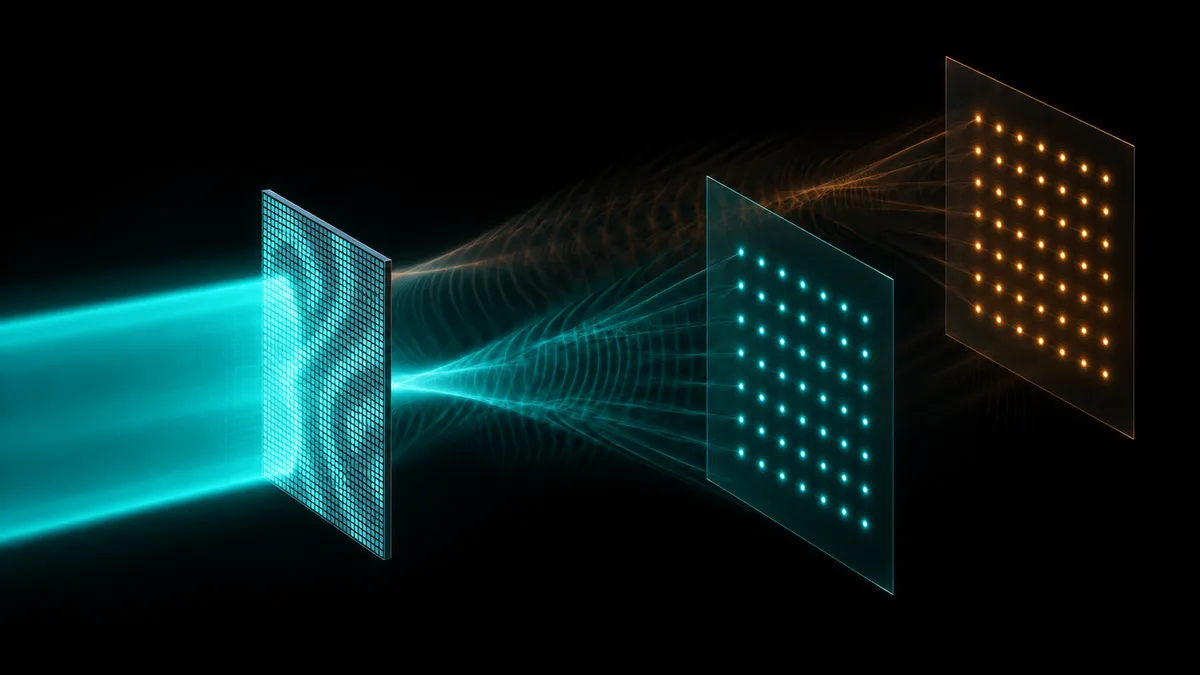
How many optical tweezers can one laser support? The answer depends not just on total power, but on how much light reaches the weakest trap—and whether a better hologram can still improve it.
Optical tweezers use tightly focused laser light to hold and manipulate small particles. To produce many traps at once, researchers can send a beam through a spatial light modulator: a grid of pixels that adjusts the phase, or timing, of the light wave. Interference then concentrates light at chosen positions.
But every trap must receive enough light. If one site is too dim, increasing the laser power to strengthen it also increases the power supplied to the whole array. That makes the weakest trap a crucial design constraint.
In a November 2026 preprint, Anzhou Wen and colleagues derive limits on the minimum intensity that a phase-only hologram can deliver across an array. Their calculations and numerical optimizations distinguish improvements available from a better phase pattern from those requiring changes to illumination, pixel sampling or trap geometry.
A ceiling independent of the phase pattern
The researchers’ central mathematical step is to group positions across the illuminated modulator that contribute the same relative phase at every site of a target lattice. Contributions within each group can reinforce one another throughout that lattice.
Combining these contributions produces an effective aperture—a mathematical representation of the light available to form the array. From this, the team derives an upper bound on the weakest-target intensity multiplied by the number of targets. The bound depends on illumination and lattice geometry, but not on the chosen phase pattern.
This quantity is not the fraction of laser power captured by the traps. It is a scaled measure of intensity at the target coordinates. Its practical value is that, for a fixed required intensity at every target, increasing it reduces the necessary incident power.
Real modulators impose another constraint. Each pixel applies one phase across its finite area. Light can partially cancel within that area when directed toward an off-axis target, reducing the pixel’s response. Changing the pixel’s overall phase cannot undo that internal cancellation. Outer targets can therefore become increasingly costly as an array spreads sideways.
The authors incorporate these pixel effects into a second bound. Comparing an optimized hologram with that ceiling gives a limit on how much additional input-power saving phase optimization could achieve.
Little room left in the tested patterns
For modeled planar arrays on a 1,024-by-1,024-pixel modulator, optimized holograms reached 95.93%–98.47% of their pixel-constrained bounds. The numerical sweep covered 63 to 20,163 targets.
At the largest count, the bound left room for no more than 2.27% further input-power saving through phase optimization on the existing pixels. Removing pixelation while retaining the same illumination allowed a larger theoretical saving, capped at 26.12% relative to that hologram. The distinction matters: the latter is not an improvement available simply by finding a better pattern for the existing device.
The paper also establishes conditions under which growing arrays can approach the theoretical ceiling as pixel counts grow alongside them. These are conditional results, requiring suitable illumination, sampling and target placement—not a guarantee for arbitrary layouts.
Moving traps into depth
Another option is to divide the targets between two planes. Each plane then needs less transverse area, potentially reducing pixel-diffraction losses. The difficulty is that one phase pattern must supply both depths without leaving either plane underilluminated.
The team derives a two-plane limit and tests optimized holograms using a vector model that accounts for polarization effects in tight focusing. The numerical setup uses a 2,160-by-2,160-pixel modulator, 852-nanometre light, 14.20-micrometre lateral spacing and 47.33-micrometre plane separation. The tested patterns include eight-bit phase quantization.
At the seven largest sampled counts, beginning with 7,938 targets, the two-plane patterns outperform an upper bound for the specified equal-count planar family. At 20,402 targets, the comparison establishes at least 19.68% lower required input power for the same minimum target intensity.
That advantage is restricted to the stated comparison: planar layouts on the same fixed-pitch, pixel-aligned lattice within the modeled sampling window. It does not establish that two planes beat every possible planar design.
Bright spots are not the whole test
High intensity at a requested coordinate does not automatically establish confinement. The authors separately examine whether nearby intensity falls in every spatial direction. Numerical checks for the two-plane examples find a local three-dimensional maximum near every target, with target intensity at least 99% of its nearby peak.
These are theoretical and numerical findings reported in a preprint, not a laboratory demonstration of trapping performance. Their immediate contribution is a benchmark: when a hologram already approaches its bound, changing the optical arrangement may offer more than further phase optimization.
- optical tweezers
- holography
- spatial light modulators
- laser power
- diffraction
- three-dimensional trap arrays