TRANSMISSION // 2611.10295v1
A quieter route to tunable light–matter interactions
Source published
A doctoral thesis shows how superconducting microwave cavities can gain fast magnetic control without giving up the long photon lifetimes that make them useful for quantum information.
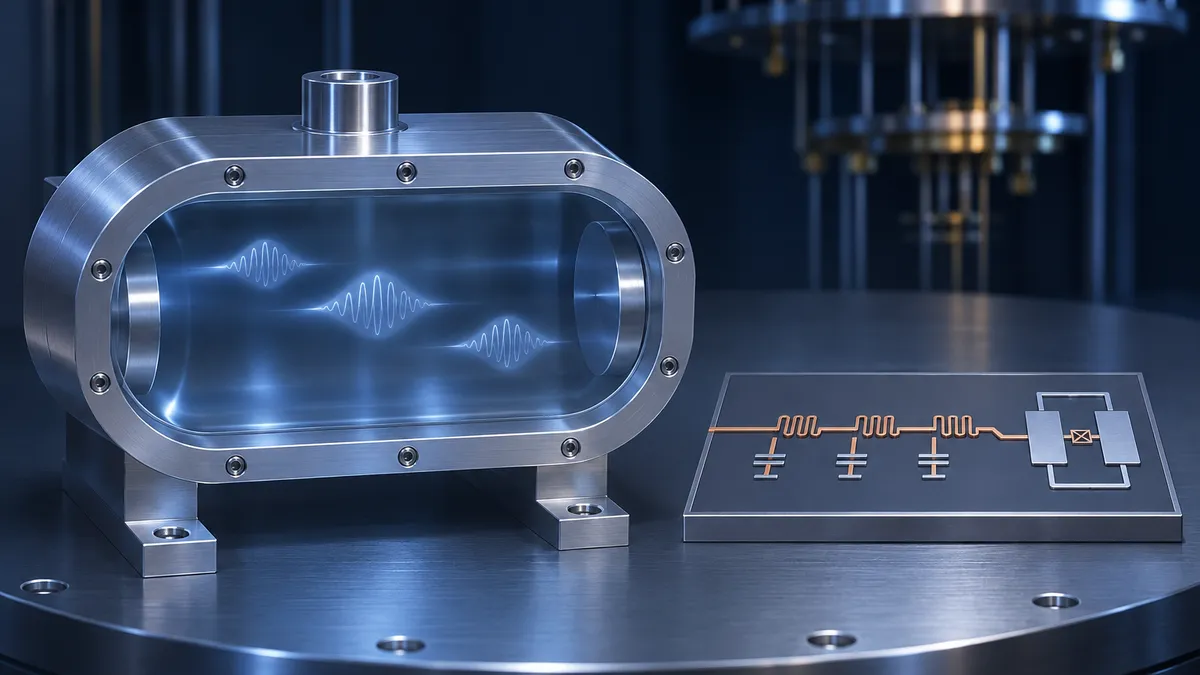
How can a microwave cavity be made easy to steer without making its stored photons vanish? Flux control lets an artificial atom tune its interaction with cavity light, but the extra wiring can also open a path for energy loss. Fernando Valadares’s thesis tackles that hardware trade-off and uses two protected circuit designs to move between different kinds of light–matter interaction.
A microwave cavity can hold photons for a long time, making it a useful place to store quantum information. A nearby superconducting circuit called a transmon can add the nonlinearity needed to prepare and manipulate complicated cavity states. But making the transmon tunable creates a practical conflict: the magnetic-flux wiring used to change its frequency can also let cavity energy leak away.
Fernando Valadares’s doctoral thesis, submitted at the National University of Singapore, investigates how to keep that control while protecting the cavity. In circuit quantum electrodynamics, a transmon plays the role of an artificial atom and the cavity stores microwave photons. Their interaction depends on both the frequency difference between them (the detuning) and their coupling strength. If those parameters can be changed quickly, the same device can access distinct operating regimes instead of being locked into one design-time compromise.
The first solution, called Somerset, carries magnetic flux from a remote coil through a magnetic hose: a layered structure combining superconducting aluminum and high-permeability metal. Its superconducting output also filters microwave fields that would otherwise escape along the control route. After adjusting the geometry and addressing heating in the flux wiring, the team measured a cavity single-photon lifetime of 244 ± 4 microseconds. The fast flux pulses changed the transmon frequency in less than the experiment’s 16-nanosecond time resolution.
That tunability let the researchers briefly bring the transmon and cavity into resonance, where they exchanged an excitation coherently. By interrupting this exchange at selected times, they prepared one- and two-photon Fock states in the cavity. They characterized cavity states with both Wigner-function measurements and a characteristic-function method, which use different interaction regimes. They also showed that moving the transmon farther in frequency from the cavity reduced unwanted nonlinear phase shifts: for a coherent state with an average amplitude near 6.25, distortion was strong at 67 megahertz detuning and substantially smaller at 200 megahertz. This is a way to suppress an unwanted interaction during storage, not to eliminate all sources of photon loss or error.
Somerset established the idea but had drawbacks, including substantial heating and a manually assembled magnetic hose. The thesis’s second device, Lakeside, instead uses a lithographically patterned on-chip flux line with multiple filtering stages in a hybrid two- and three-dimensional circuit. The filters are designed to block microwave leakage while allowing the control signals through. The measured cavity lifetime reached 590 ± 40 microseconds, and the experiments reported no detectable heating from the flux pulses.
Lakeside also demonstrated that periodic flux modulation can create adjustable frequency sidebands. A sideband can bridge the frequency gap between transmon and cavity, enabling resonant exchange even while their unmodulated frequencies differ. In one experiment, the effective coupling varied continuously from zero to 6.57 megahertz as the pump amplitude changed. The team further used resonant, number-selective transitions to prepare cavity states across as many as eight levels and demonstrated rotations between selected photon-number states. These results show control operations in a larger cavity state space; they do not establish a scalable quantum processor or fault-tolerant computation.
The work is a thesis describing laboratory demonstrations, not a claim that the engineering challenges are finished. The cavity lifetime remains finite, and the reported qudit rotations were limited by the transmon’s coherence time. Lakeside’s cavity lifetime was also below the millisecond-scale values of comparable fixed-frequency cavities discussed in the thesis. Further gains depend on improving losses such as package-seam losses and on refining coherence and control. The central result is more specific: careful design of magnetic-flux delivery can make a superconducting cavity both more protected and dynamically controllable, opening experimental options for quantum-information operations and engineered light–matter systems.
- superconducting circuits
- circuit quantum electrodynamics
- microwave cavities
- quantum information
- light–matter interaction
- transmon qubits
Related reading
Automatically matched by shared topic keywords. These links do not imply that the sources agree or establish a consensus.
When a quantum sensing limit depends on the model
Source published
Shared keywords: light matter interaction
A superconducting resonator routes strong microwaves without a bias
Source published
Shared keywords: superconducting circuits
Why finite quantum circuits cannot reproduce the quantum switch
Source published
Shared keywords: quantum information
Waiting to measure can unlock an unbounded quantum communication advantage
Source published
Shared keywords: quantum information
How one local change can leave many readable records in a quantum chain
Source published
Shared keywords: quantum information