TRANSMISSION // 2611.10289v1
How to read a noisy atom interferometer’s ellipse
Source published
When two atom interferometers share environmental noise, their paired readings trace an ellipse that encodes a phase difference. Fowler and colleagues compare ways to fit it, finding tradeoffs among bias, precision, speed and the accuracy of other fitted parameters.
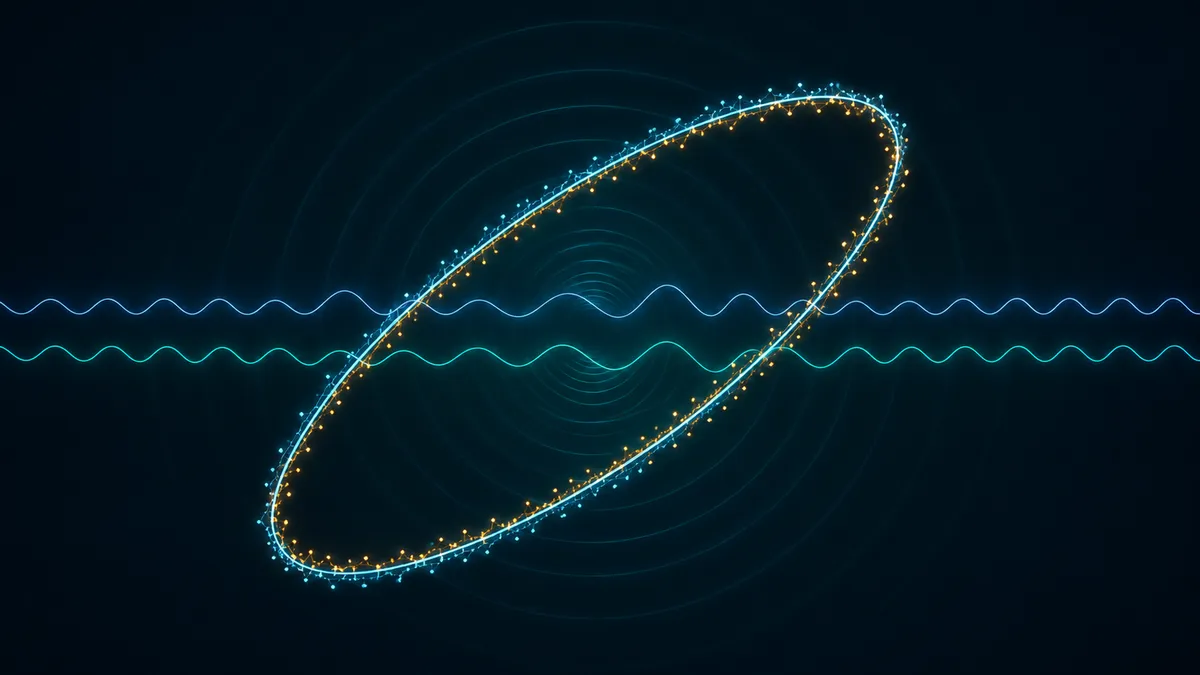
Two noisy sensors can sometimes reveal a signal that neither can measure cleanly alone. In atom interferometry, the trick is to compare two interferometers exposed to much of the same disturbance. But how can their shared noise be separated from the phase difference we want?
Turning shared noise into a curve
An atom interferometer splits an atomic wave into two paths, lets the paths accumulate different phases, then recombines them. The resulting atom populations depend on that phase. Vibrations or other disturbances can scramble the reading; if the phase wanders by more than a full turn, one interferometer’s output can become effectively random.
A differential measurement uses two interferometers at once. If both experience a changing common phase but respond differently to the quantity of interest, plotting one output against the other produces an ellipse. Its shape and orientation carry the difference between their phases. The challenge is to estimate that phase from a finite cloud of noisy points.
Fowler, Reinhardt, Meister and Sackett compare statistical, algebraic, geometric and Bayesian fitting approaches. Their study is computational: they generate synthetic data from a model, add either measurement-offset noise or phase noise, and measure how far each method’s phase estimates stray from the known input and how much those estimates fluctuate. They also examine fitted offsets and amplitudes. The authors report having used the methods on experimental data in earlier work, but the comparisons in this paper come from simulations.
No fit is best for every job
The basic statistical method uses averages, variances and correlation between the two signal streams rather than optimizing a curve fit. It is quick and simple, but its phase estimates generally fluctuate more than those from the other methods. A Bookstein algebraic fit is also fast and usually reduces that fluctuation. Near phases where the ellipse collapses toward a line, however, an unmodified Bookstein fit can return a hyperbola or badly placed center and amplitude. The authors’ tested version uses the statistical result as a fallback in such cases.
A geometric fit minimizes distances from data points to an ellipse, giving the error a direct spatial interpretation. Calculating exact distances repeatedly is slow, and this one-way fit can leave parts of the ellipse far from any data points. The paper’s new reciprocal method uses a discretized curve and penalizes distances in both directions: from observations to the curve and from curve points back to observations. That extra constraint helps avoid implausible fits when the data cover the full ellipse. In their simulations, it moderately reduces phase bias and markedly improves offset and amplitude estimates compared with the ordinary geometric method. The tradeoff is that its weighted cost no longer has the standard chi-squared interpretation.
The Bayesian method updates a probability distribution for the phase as each point arrives. With the correct noise model and known parameters, it can extract phase information effectively and provides a distribution useful for assessing uncertainty. In the authors’ self-contained implementation, though, offsets, amplitudes and noise must first be estimated using another fit and a distance-based calibration. The Bayesian method considered returns phase only, so it must be paired with a method that estimates the other parameters. Its results depend on how well the assumed noise model and those preliminary estimates match the data.
Bias matters most near a collapsed ellipse
A key difficulty is bias: an estimate can systematically miss the true phase even when repeated measurements are averaged. At zero phase, for example, noise can make the ellipse look slightly non-degenerate. Because the reported phase is restricted to a nonnegative range, fluctuations on either side of zero map to positive estimates. The resulting positive bias cannot simply be subtracted away to recover sensitivity to tiny changes around zero; the estimate approaches a nearly constant value there. The authors find operation near a phase difference of π/2 generally avoids phase bias, although an experiment may not be able to choose that operating point.
The paper’s numerical comparisons use synthetic datasets and stated model assumptions: a uniformly varying common phase and equal nominal signal amplitudes. For offset-noise tests, independent Gaussian noise is added to each signal’s offset with the same deviation; phase-noise tests instead add noise to the differential phase. The recommendations therefore depend on those conditions and on whether speed, phase precision, bias, or reliable offset and amplitude estimates matter most. The authors find offset noise more damaging than phase noise of the same modeled size. At π/2, their simulations put phase uncertainty under offset noise at about three times the projection-noise limit; under phase noise, it can come within 25% of that limit. These are simulation results, not a demonstration that a particular experiment achieves those limits.
The practical message is not that one algorithm wins, but that the fitting method should match the measurement. A simple statistical or algebraic approach can suit rapid analysis; the reciprocal geometric method offers a compromise when a fuller geometric fit is too slow; Bayesian inference can perform well when its noise and parameter assumptions are credible. The paper supplies Python and Matlab examples, but experimental data, departures from its noise assumptions and implementation details still matter when choosing among them.
- atom interferometry
- ellipse fitting
- differential phase
- quantum sensing
- noise estimation
Related reading
Automatically matched by shared topic keywords. These links do not imply that the sources agree or establish a consensus.