TRANSMISSION // 2611.10283v1
When quantum decoding reaches the spin-glass reconstruction threshold
Source published
Regev’s reduction paired with quantum belief propagation prepares Gibbs samples up to a tree reconstruction threshold, while simulations suggest that threshold also predicts where classical annealing stalls.
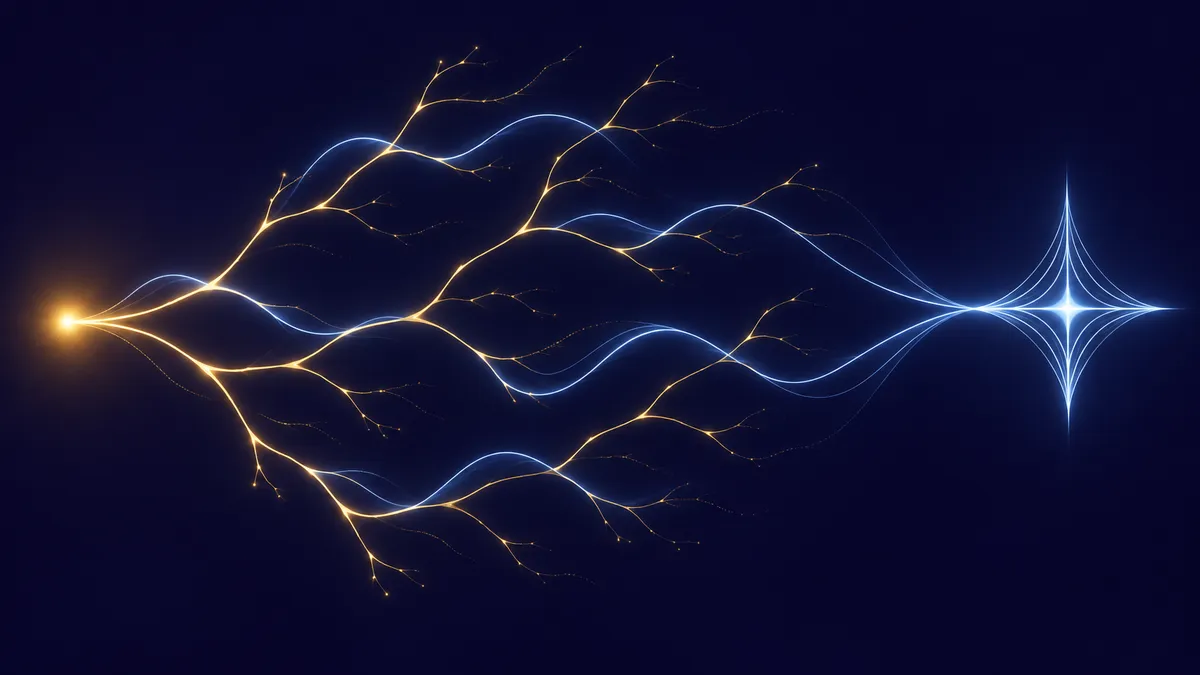
How cold can a quantum algorithm sample a hard spin-glass landscape? Jordan, Nguyen and Zhou connect a quantum decoding method to a classical information puzzle: whether signals sent down a noisy tree still reveal their starting point. Their proof gives an exact threshold match for a broad family of sparse constraint problems, but the comparison with classical sampling remains conjectural.
How cold can a quantum algorithm sample a spin glass before the landscape becomes too difficult? Stephen P. Jordan, Quynh T. Nguyen and Leo Zhou study that question through a family of sparse optimization problems called regular max-k-LINSAT. An instance assigns values from a finite field to variables and scores an assignment by counting the constraints it violates. At higher inverse temperature, the associated Gibbs distribution gives more weight to assignments with fewer violations.
The paper’s goal is to produce samples from that distribution, not merely to find one good assignment. Its quantum method combines Regev’s reduction, which uses a quantum Fourier transform to turn the sampling task into code decoding, with Belief Propagation with Quantum Messages (BPQM). BPQM passes quantum states along the sparse code’s constraint graph and combines information from neighboring branches to infer a symbol. When the full coherent state is measured, it yields an ordinary Gibbs sample; retaining the coherent state is a stronger capability than sampling alone.
The central result links the decoding process to a different question on an infinite tree. Imagine a random root symbol sent through noisy constraints to successive generations. An observer sees only the distant boundary and asks whether it still carries any information about the root. The reconstruction threshold is the point where that information begins to persist as the boundary recedes. The authors prove that this threshold exactly matches the temperature threshold for BPQM decoding on the corresponding tree. They explain the match through a duality between quantum and classical channels: the quantum messages become perfectly distinguishable precisely when the corresponding classical observations lose information about the root.
That equality supports a finite-instance guarantee. For the random regular max-k-LINSAT ensembles they define, Regev’s reduction with BPQM prepares the coherent Gibbs state, with error tending to zero with high probability, at every fixed inverse temperature strictly below the reconstruction threshold. The guarantee assumes the stated random ensemble and asymptotic growth in problem size; it is not a claim that every individual instance is easy, or that quantum sampling works beyond the threshold.
Why should a tree threshold say anything about practical optimization? Earlier statistical-physics work identifies the reconstruction transition with a dynamical glass transition predicted by a one-step replica-symmetry-breaking cavity equation. Researchers have conjectured that local classical samplers, including Glauber dynamics and Metropolis methods, struggle to equilibrate past this point. The paper’s proof does not establish that classical limitation. Rather, it shows that the quantum algorithm reaches the boundary of what those local methods are conjectured to manage, while the authors know of no matching classical sampling guarantee for these broad sparse ensembles.
The authors also compare the tree prediction with simulated annealing. Across 252 parameter settings with a detected finite threshold, the tests use random instances with 6,720 variables and two annealing budgets: 144,000 sweeps and 14.4 million sweeps. The resulting fraction of violated constraints stays close to the tree-based prediction: mean absolute discrepancies are 0.920 and 0.582 percentage points, respectively, with maxima of 2.158 and 2.815 points. These are numerical results at finite size, not a proof of mixing times or an upper bound on better classical algorithms. The authors explicitly note that other algorithms can beat the threshold in some parameter regimes, and leave open a rigorous classical sampling guarantee below it.
The result therefore has two different strengths. The equality between reconstruction and BPQM thresholds, and the resulting quantum Gibbs-sampling guarantee below that threshold, are mathematical claims for the paper’s model. The suggestion that the same boundary predicts where classical local sampling becomes impractical is supported by experiments and prior theory, but remains conjectural. The work identifies a precise frontier for this quantum method; whether that frontier is also a general classical barrier is still unsettled.
- quantum decoding
- quantum algorithms
- spin glasses
- Gibbs sampling
- belief propagation
- tree reconstruction
Related reading
Automatically matched by shared topic keywords. These links do not imply that the sources agree or establish a consensus.