TRANSMISSION // 2611.10282v1
Can a camera learn how to measure light?
Source published
A trainable diffractive optical network helps classify images when photons are scarce, including a test with severe camera noise.
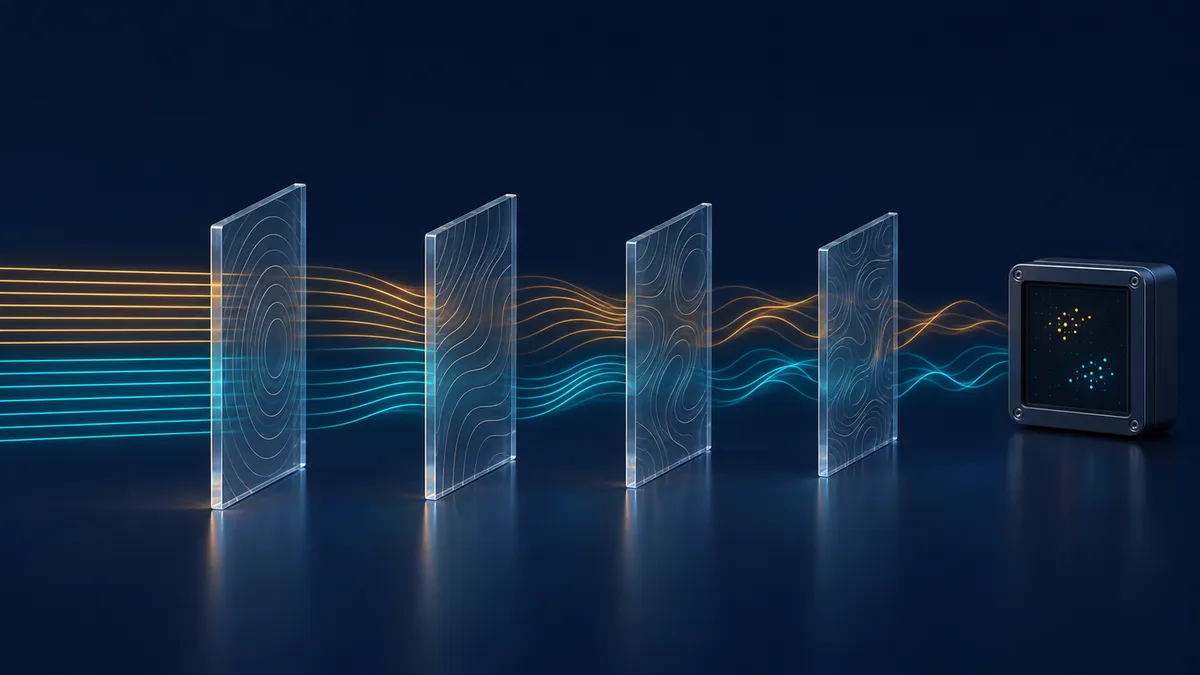
When an image is made from only a few photons, should a camera record a picture first and let software interpret it later? This experiment tests another route: shape the incoming light with a trainable optical network so each detection is more useful for deciding which class produced it.
When light is scarce, taking a conventional picture may throw away information before a computer gets to analyze it. A camera records where photons arrive; later software works with that record. But if the real goal is to distinguish two kinds of scene—not reconstruct every detail—could the optics be arranged to make the arriving photons more informative from the start?
A team tested this idea using a diffractive optical neural network, or DONN: several phase-modifying planes that reshape light as it passes through them. Their experiment treats classification as a quantum-state discrimination problem. Each class is an ensemble of images, represented by the spatial patterns of coherent light they produce. A trainable optical network transforms those patterns, and a detector array records photon locations. The decision is made from the counts, using the likelihood of those detections under each candidate class.
The training objective matters. One version of the network is optimized to classify correctly from a single photon. A second is optimized for how quickly classification errors decrease as more photons arrive. For two classes, that long-run rate is described by a statistical distance between their detector distributions, closely connected to the Chernoff information. The researchers train the optical measurement itself—not a later image-processing system—to make that distance large. They use a digital simulation of the apparatus to optimize phase masks, then test the resulting masks experimentally.
In a deliberately difficult cats-versus-dogs test, the two image classes were chosen so that ordinary direct imaging produced nearly indistinguishable intensity distributions. With noiseless photon sampling, direct imaging’s error fell very slowly as photons accumulated. The four-layer, scaling-optimized DONN separated the classes better over many-photon measurements: its measured error-decay exponent was reported as 16% of the quantum Chernoff bound, compared with 6% for the single-photon-optimized network and about 0.5% for direct imaging. Yet for just one photon, the single-photon-optimized design did better. A measurement best for one detection need not be best when evidence is accumulated across many detections.
The team also tested a ten-class Fashion-MNIST subset in the noiseless regime, using 200 images per category. Here too the scaling-optimized design gained with photon number: its error-decay exponent was 42% of the quantum Chernoff bound, against 28% for direct imaging and 19% for the single-photon design. At 250 photons its error was 3.3 times lower than direct imaging, and at 500 photons it was 10 times lower. The bound for the hardest class pair is not necessarily reachable by one measurement that must distinguish every pair at once.
A second experiment asked whether task-specific optics could help when the detector itself is noisy. The researchers used an electron-multiplying CCD whose clock-induced charge produced roughly 10,000 spurious clicks per signal photon under their stated conditions. Training with a noise model led the network to concentrate light onto a smaller sensor region, reducing the noise contribution in that region by about two orders of magnitude. The signal remained deeply below the noise level, but the measured classification error-decay exponent reached 1.4% of the quantum Chernoff bound. Direct imaging with that camera was not significantly better than random guessing; the noise-aware optical measurement also exceeded the direct-imaging rate measured in the noiseless setup.
These results do not show a general-purpose camera that can recognize arbitrary new objects. The method assumes known class ensembles and coherent fields with known input amplitudes; its inference compares those known possibilities. The physical demonstrations used four phase planes, and the authors attribute much of the remaining gap to the limited expressive power of that shallow optical network. Simulations found that increasing its depth moved performance toward the limit for individual-photon measurements, but did not establish that a practical system reaches the ultimate quantum bound. The experiment also used a programmable spatial light modulator, whose implementation has substantial optical loss; that hardware-specific loss was excluded from the photon-budget accounting because the authors expect manufactured phase plates would avoid it.
The advance is therefore narrower—and more concrete—than replacing ordinary computer vision: for a known classification task under photon scarcity, the measurement can be designed around the answer sought. It can trade away uninformative light, or focus detections to resist background noise, before the digital decision is made. Extending this approach to unfamiliar objects, incoherent scenes, or other tasks such as parameter estimation remains future work. The paper is an arXiv preprint; the source record does not establish peer review.
- quantum state discrimination
- diffractive optics
- photon-limited imaging
- optical neural networks
- camera noise