TRANSMISSION // 2611.10275v1
Heat model challenges buried-ice explanation for asteroid 1998 KY26
Source published
Simulations suggest that Hayabusa2’s extended-mission target is too warm to preserve buried water ice over long periods. The findings challenge an outgassing explanation for its unusual acceleration, but depend on assumptions about its structure and history.
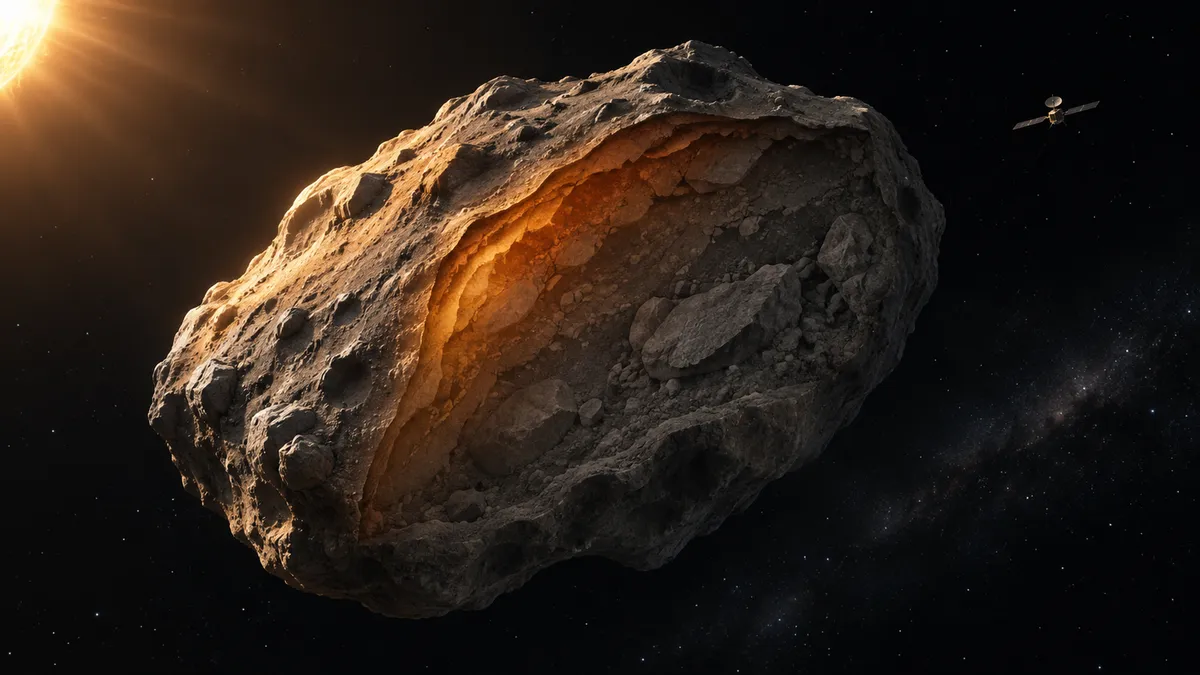
Could a tiny asteroid behave like a comet without displaying a visible cloud of escaping material? For 1998 KY26, a new thermal study argues that sustained water release is unlikely: even its interior appears too warm to keep ice for long.
The near-Earth asteroid 1998 KY26 is the planned 2031 rendezvous target of Japan’s Hayabusa2 extended mission. Estimated to be about 11 metres across, it rotates once every 5.35 minutes. Its motion has also prompted debate about whether it belongs to a proposed population called dark comets.
Here, “dark comet” describes an object whose orbit shows acceleration beyond gravity’s effects, potentially caused by escaping gas, without an observed coma—the surrounding cloud associated with familiar comets. It does not necessarily describe a dark surface. Observations cited in the study suggest that 1998 KY26 is relatively reflective and may belong to the largely water-poor E-type asteroid group.
Korbin Hansen and Masatoshi Hirabayashi investigated whether this small body could retain the buried ice needed to support outgassing. Their study is available as an arXiv preprint; the supplied record also lists an Icarus journal reference for 2027.
The physical question is about storage as much as release. Volatiles are substances, including water, that readily become gas under suitable conditions. In space, water ice can undergo sublimation: conversion directly from solid to gas. Burial can slow that loss, but whether ice survives depends on temperature and how easily vapour escapes through the surrounding material.
The researchers used a three-dimensional thermophysical model, which calculates heating, cooling and heat conduction through an asteroid. They represented the observed shape with a simplified mesh of small volume elements, tracking temperatures at points on the surface and inside. The model includes local shadowing and scattered sunlight.
They tested 13 sets of properties at 20 positions around the orbit, producing 260 simulations. The tests varied size, spin-axis orientation, reflectivity, thermal conductivity and specific heat capacity. Thermal conductivity describes how readily heat travels through material; specific heat capacity describes how much energy is needed to raise its temperature. Results were averaged over the orbit, accounting for the longer time spent farther from the Sun.
In the baseline calculation, the volume-weighted, orbit-averaged temperature was about 226 kelvin, or minus 47 degrees Celsius. That sounds cold by everyday standards, but it is far above the 145-kelvin benchmark the paper uses for long-term survival of buried water ice. This benchmark concerns ice stability under space conditions, not water’s familiar freezing point on Earth.
No modelled location provided a sufficiently cold long-term refuge. Across the main tests, the lowest orbit-averaged temperature at any individual model point was approximately 212 kelvin. In the baseline case, the core was only about one kelvin cooler than the average surface.
Reflectivity produced the largest change in average temperature: more reflected sunlight meant less absorbed heat. The resulting bulk averages ranged from approximately 221 to 230 kelvin. Other parameter changes had smaller effects. A separate calculation using much lower conductivity, intended to represent a rubble-pile structure, gave an average of about 212 kelvin—still well above the buried-ice benchmark.
The authors then estimated water loss through porous material using the baseline temperature. Assuming an initial water inventory equal to one percent of the asteroid’s mass, their calculation depleted that inventory in roughly 2,065 years. They placed the ice at a depth equal to the asteroid’s equivalent radius, deliberately slowing its estimated escape. Using a higher outgassing rate inferred from an acceleration interpretation shortened the estimate to about 62 years.
These are conditional calculations, not measurements of ice or its absence. The model uses a simplified shape, constant material properties and assumptions about porosity, grain size and burial depth. Parameters were largely varied individually, rather than exploring every combination. The asteroid’s actual thermal history and internal structure remain uncertain, and orbit-averaged temperatures do not describe every momentary local condition.
Nevertheless, the tested scenarios consistently make long-lived buried water ice difficult to sustain under the modelled orbital conditions. The results support, without independently proving, an alternative explanation involving sunlight pressure and thermal radiation. They address this particular asteroid, not whether dark comets exist as a broader population.
- 1998 KY26
- Hayabusa2
- asteroid
- dark comets
- thermophysical modelling
- water ice
- sublimation
Related reading
Automatically matched by shared topic keywords. These links do not imply that the sources agree or establish a consensus.