TRANSMISSION // 2611.10252v1
How Many Rhythms Can a Noisy Clock Hold?
Source published
A mathematical bound links the number and sharpness of rhythms in randomly jumping systems to the number of states—and shows how observed oscillations can reveal a hidden clock’s minimum size.
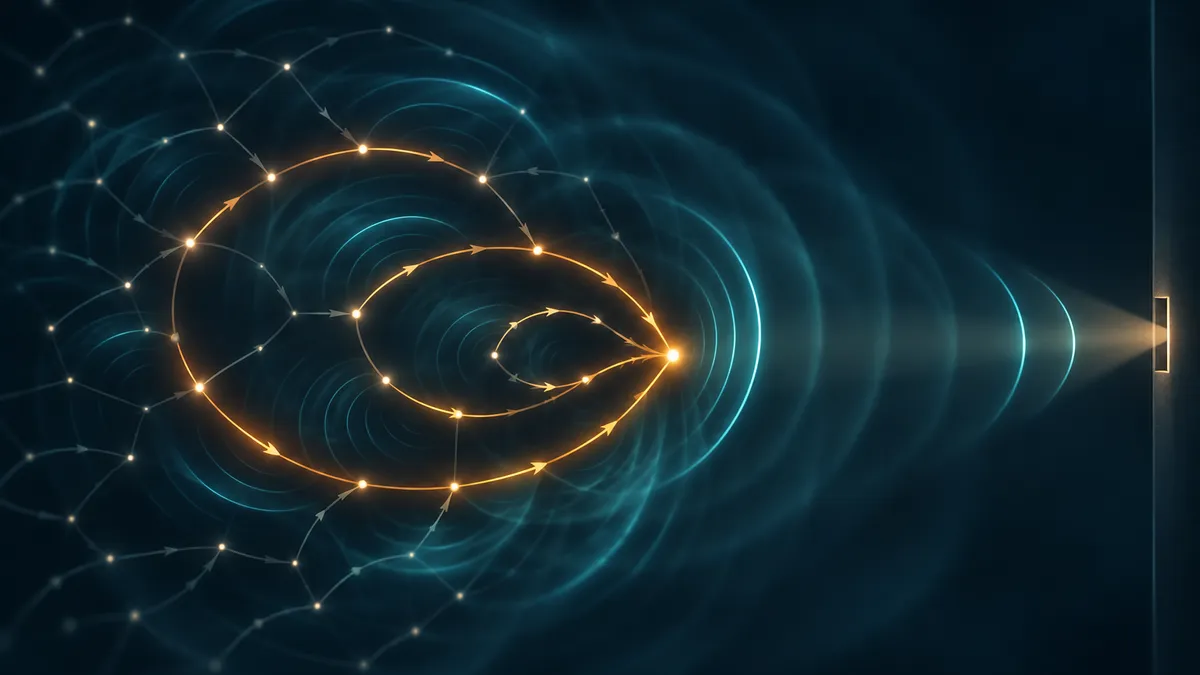
A molecule that jumps randomly can keep time, but every jump blurs its rhythm. How many distinct rhythms can one small network sustain before that noise washes them out? Markus Baumann and Claudia Linnhoff-Popien derive a shared limit for such stochastic clocks, then show how oscillations in measured data can put a lower bound on the size of an unseen system.
A clock made of randomly jumping molecules does not tick at perfectly regular intervals. Each molecule follows the same network of states, but the timing of its jumps varies. Start many copies together and they gradually fall out of step: the average oscillation fades. This raises a basic question: if one network is expected to keep several rhythms at once, how many states does it need to keep those rhythms sharp?
Markus Baumann and Claudia Linnhoff-Popien study continuous-time Markov networks: systems with a fixed set of states and memoryless transition rates. The probabilities of occupying those states evolve linearly. A rhythm appears as a pair of complex eigenvalues, corresponding to an oscillation at frequency ω whose amplitude decays at rate a. The authors measure its sharpness by Q = ω/a; larger Q means more oscillations before the signal fades. At equilibrium, the model has no such oscillations. They require a sustained drive away from equilibrium.
The central result is a shared capacity bound. In a network with d states, the number N of rhythms sharper than a chosen threshold Q must obey NQ < 2(d−1)/π. Equivalently, packing in more sharp rhythms requires a proportionally larger state space. Five rhythms with Q above 10, for example, require at least 80 states under this bound. Each of those rhythms could individually fit in a 32-state one-way ring, but they cannot all be that sharp in one 32-state network. The bound is a necessary limit, not a recipe that guarantees a network with exactly that performance.
The logic is that the same random transitions both advance a clock and blur it. Probability flowing around a cycle gives the system a phase, while the traffic of jumps smooths differences between states. The net circulation on any link cannot exceed the total traffic there. The researchers turn that constraint into a bound on the spectrum of the rate matrix, and then count how many oscillatory modes can fit within it. Their argument applies to finite-state stochastic networks and, more broadly, linear dynamics that preserve nonnegative populations; it does not claim the same limit for arbitrary nonlinear systems or ordinary signed variables.
Networks can share states among rhythms, but the savings have a catch. Separate one-way rings, each devoted to one rhythm, use about twice as many states per sharp rhythm as the theoretical shared limit. The authors construct nested cycles that approach that limit when the rhythms are very sharp. In these networks, shortcuts from a chain of states back to its start create additional cycles and rhythms. Yet the extra rhythms crowd close together—closer than their linewidths—so the apparent capacity counts overlapping spectral components, not clearly separable tones. Numerical optimization found no network with more distinguishable rhythms than separate clocks in the tested sizes of 21, 31 and 41 states. The authors conjecture that distinguishable rhythms generally add their state costs, but say this is not proved for all networks.
Sharp rhythms also require free energy per cycle. The paper derives a lower bound on the total drive for many rhythms and finds that, as their number grows, the cost per rhythm approaches about half the drive needed by a standalone clock. That is not a bound on power, the energy used per unit time. A constructed network can spend most of its time in a parking state, making its steady-state dissipated power approach zero while preserving the rhythms’ frequencies and increasing their decay only slightly. In that limit the rhythms’ weight in stationary correlations also vanishes; a prepared molecule can still reveal them while it relaxes.
The bounds can be used in reverse. A measured signal is a coarse view of the hidden network: observation may hide a mode, but cannot create a new eigenvalue. So identified, statistically supported oscillations imply minimum values for the number of hidden states and the total drive. In a simulated example, a 42-state network with three driven cycles was observed only through a coarse readout. At 95% confidence, the fitted rhythms certified at least 17 states and 39.8 units of drive in kBT, compared with lower bounds of 13 states and 24.1 kBT from the sharpest rhythm alone. Across 600 simulated data sets, the certified state count never exceeded the true count when lower confidence limits were used. This is a demonstration on simulated data, not a validation on experimental traces.
The work is a mathematical preprint, not evidence that every biological clock or molecular motor reaches these limits. Its results concern linear stochastic dynamics and spectral rhythms; the paper leaves open whether distinguishable rhythms always pay additive state costs, whether the drive bound can be reached, and what capacity might apply to open quantum systems. The practical promise is narrower but useful: when stochastic data show several fading oscillations, their sharpness can constrain how complex the unseen machine must be.
- stochastic clocks
- Markov networks
- oscillations
- non-equilibrium thermodynamics
- spectral bounds
- hidden-state inference