TRANSMISSION // 2611.10220v1
Dust and oxygen complicate the story of SN 1987A’s fading light
Source published
Models of SN 1987A from 200 to 800 days after explosion show why oxygen emission alone cannot reliably determine the original star’s mass. Growing dust and contaminating starlight also reshape the interpretation of its fading glow.
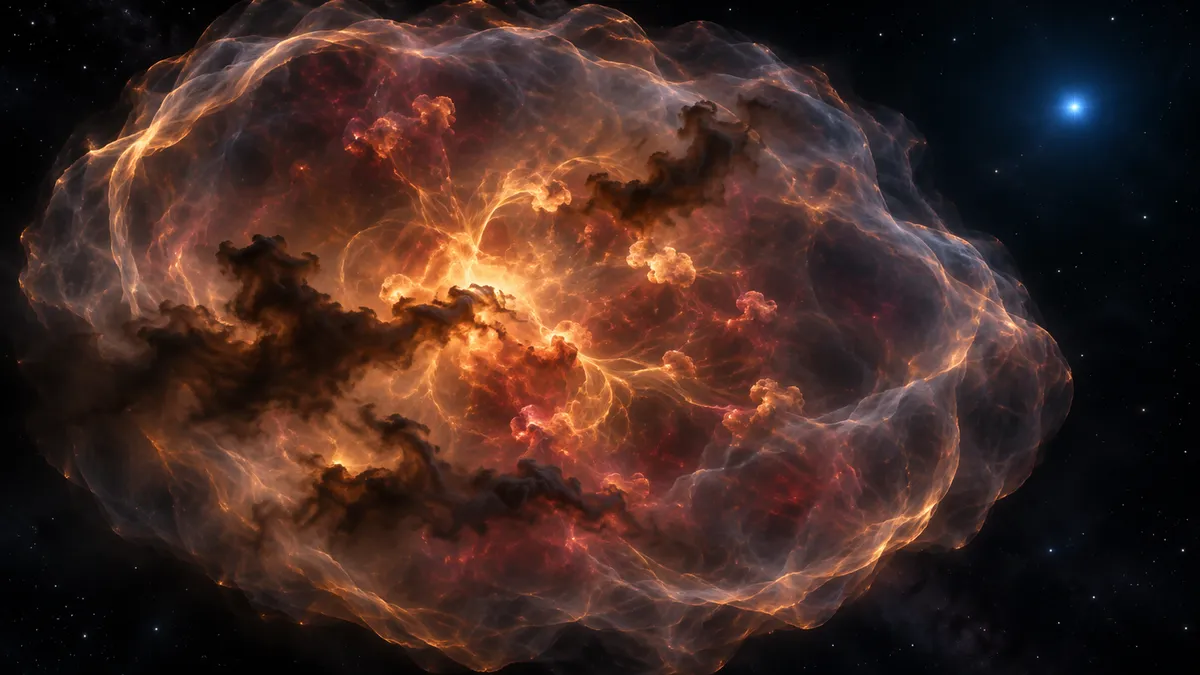
How much can a supernova’s fading light reveal about the star that exploded? A new modeling study of SN 1987A finds that oxygen emission, newly formed dust and background starlight can give overlapping—and sometimes misleading—clues.
Long after a supernova’s initial brilliance fades, its expanding debris continues to glow. Radioactive decay supplies energy, while atoms and molecules release that energy at particular wavelengths. Those emissions offer clues to the material inside the explosion and, indirectly, to the star that produced it.
In a new preprint, Luc Dessart revisits SN 1987A between 200 and 800 days after explosion, comparing calculations with observations spanning ultraviolet, visible and infrared light. The study finds that reproducing this broad wavelength range requires more than matching a few prominent emission lines. Dust changes which regions remain visible, and unrelated starlight can become important as the supernova dims.
Reconstructing the fading debris
Dessart calculated how radiation travels through expanding supernova debris using models of stars born with between 11 and 21 times the Sun’s mass. Their initial abundance of elements heavier than helium was one-third the solar value. Explosion energies were held near the same value, and each model contained approximately 0.07–0.08 solar masses of radioactive nickel-56.
The calculations followed changing temperatures, ionization and energy deposition rather than assuming that the gas remained in a fixed state. Radioactive decay was the only internal power source included; interaction between the debris and surrounding material was excluded.
Remarkably, models across the mass range reproduced much of the observed visible spectrum. The principal visible-light distinction was a pair of emission lines from neutral oxygen, near wavelengths of 6300 and 6364 angstroms. Yet those lines proved less straightforward as a mass indicator than their prominence might suggest.
More oxygen does not always mean brighter oxygen lines
Within this model grid, oxygen emission initially strengthens as the original stellar mass increases. More massive stars generally provide more oxygen-rich material to absorb radioactive energy and radiate it away.
Above roughly 17–19 solar masses, however, the trend reverses. The oxygen-rich debris becomes denser, suppressing these particular emission lines. The 11- and 21-solar-mass models can consequently produce comparable oxygen-line strengths despite their very different oxygen yields.
This creates an ambiguity: a weak oxygen feature need not uniquely identify a low-mass progenitor. The feature also changes with time. Its share of the visible luminosity rises until approximately 500–600 days, then falls as energy deposition shifts toward hydrogen-rich material and other cooling channels become important.
Molecules introduce another uncertainty. The main calculations did not include molecular formation and cooling. Instead, Dessart tested a simplified scenario in which carbon monoxide removes 90% of the energy deposited in one carbon-and-oxygen-rich shell. This reduced the oxygen-line flux by about 10–20%, not 90%, because that shell represents only part of the oxygen-rich material.
Under the tested assumptions, neglecting this cooling could underestimate the initial stellar mass by around one solar mass on the lower-mass branch. Cooling in additional regions, or by silicon monoxide, could produce a larger revision.
Dust explains the extra fading
The model beginning with a 13-solar-mass star provided the preferred overall comparison, allowing for some missing molecular cooling. Without dust, however, it became substantially too bright in visible light after about 500 days.
Increasing escape of radioactive gamma rays could not explain the change: that process evolved smoothly, unlike the observed change in fading rate. Adding dust deep inside the debris improved both the visible light curve and the spectra.
For the silicate grains with an adopted size of 0.1 micrometres, the fitted dust mass rose from about one ten-thousandth of a solar mass at 600 days to 0.004–0.005 solar masses at 700–800 days. These are model-dependent estimates. The dust distribution and grain properties affect the answer, and the calculations did not perfectly reproduce all infrared line shapes.
A background contribution in the ultraviolet
Dessart also argues that the ultraviolet observations contain contaminating light from a hot background star throughout the studied interval. Adding a constant contribution with a blue-supergiant spectrum improved the comparison. As SN 1987A faded, that contribution became increasingly conspicuous relative to its own emission.
The result is a modeling-based interpretation, not an identification of a particular contaminating star. It nevertheless highlights a problem for distant supernovae: neighboring stars can distort late-time measurements, especially where the supernova itself emits little light.
The preferred 13-solar-mass model is likewise not a definitive measurement of the original star. The calculations are one-dimensional, omit gas compression into clumps and do not fully couple molecular chemistry to radiation. Their progenitors also end as red supergiants rather than reproducing SN 1987A’s blue-supergiant progenitor. The study’s central lesson is therefore about interpretation: late-time light carries valuable information, but density, cooling, dust and contamination must be disentangled before it becomes a reliable stellar mass estimate.
- SN 1987A
- supernova
- radiative transfer
- oxygen emission
- dust formation
- progenitor mass
- ultraviolet contamination
Related reading
Automatically matched by shared topic keywords. These links do not imply that the sources agree or establish a consensus.
New model estimates how aging stars replenish a nearby dwarf galaxy
Source published
Shared keywords: radiative transfer
Layered cloud model traces hydrogen’s transition toward star-forming gas
Source published
Shared keywords: radiative transfer
Reading starlight without flattening the star
Source published
Shared keywords: radiative transfer
A new climate model checks the boundaries of the habitable zone
Source published
Shared keywords: radiative transfer
Small white dwarf explosions could resemble the faintest Type Iax supernovae
Source published
Shared keywords: radiative transfer