TRANSMISSION // 2611.10129v1
A giant planet’s heavy hydrogen points to unusually cold building blocks
Source published
JWST observations reveal elevated deuterium in the atmosphere of Epsilon Indi Ab. Combined with its other elemental abundances, the measurement suggests the planet accreted unusually deuterium-rich ice or organic material.
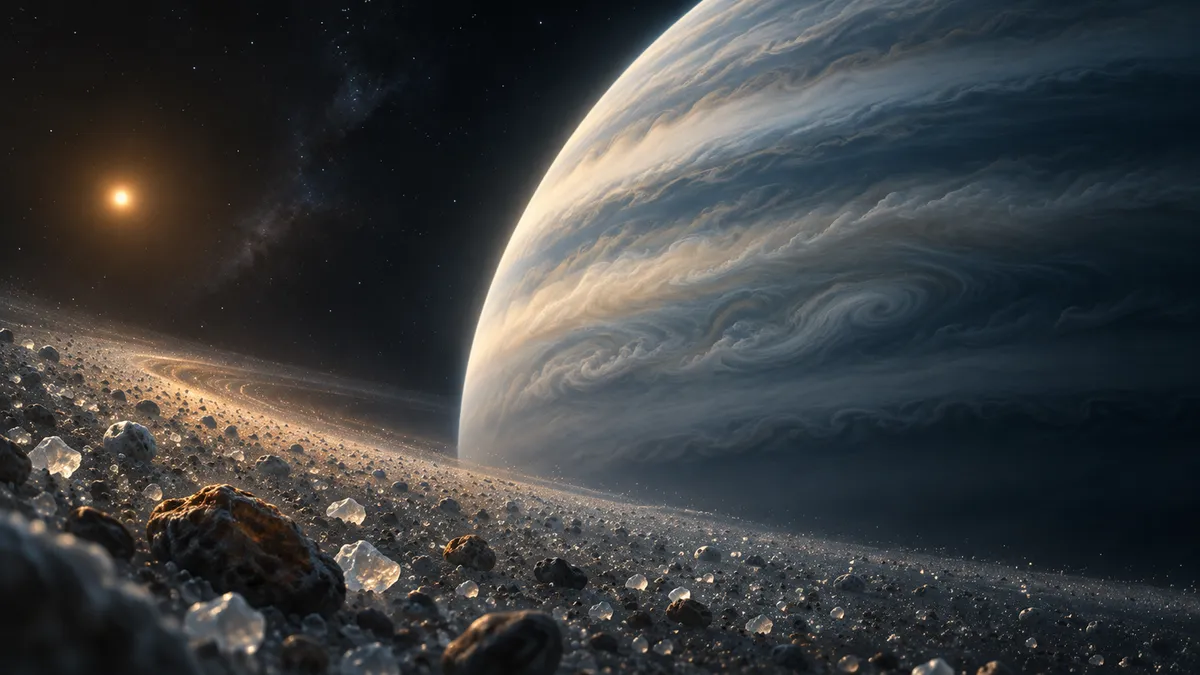
How much of a planet’s earliest history survives in its atmosphere? For Epsilon Indi Ab, a cold giant several times Jupiter’s mass, a rare form of methane offers evidence about the frozen material that helped build it.
Epsilon Indi Ab is about four billion years old and has six to eight times Jupiter’s mass. Yet its atmosphere contains a proportion of heavy hydrogen more like those of Uranus and Neptune than Jupiter. A new arXiv preprint by Jerry W. Xuan and colleagues uses that unexpected combination to investigate the planet’s origins.
The central question is not simply why the planet contains heavy hydrogen. It is how it acquired so much without also acquiring far more carbon and oxygen than the observations indicate.
A chemical record in methane
Deuterium is hydrogen with an extra neutron in its nucleus. The ratio of deuterium to ordinary hydrogen, abbreviated D/H, can help trace the history of planetary ingredients. In very cold environments, chemical reactions preferentially concentrate deuterium in certain molecules, including those incorporated into ice and organic material. This redistributes existing deuterium rather than creating it.
Epsilon Indi Ab provides an opportunity to look for that record outside the Solar System. It orbits a nearby star at roughly 16 times Earth’s distance from the Sun and has an effective temperature near 275 kelvin. Cold atmospheres are particularly favorable for detecting deuterated methane, CH3D: methane in which one hydrogen atom is replaced by deuterium.
The researchers observed the planet with the James Webb Space Telescope’s NIRSpec instrument for 4.4 hours in October 2025. Although the star itself sat outside the instrument’s field of view, diffracted starlight still contaminated the observations. The team modeled and removed that light, exploiting the different spectral features of the hot star and cold planet.
They then compared the planet’s infrared spectrum, together with previously obtained brightness measurements, against atmospheric models. Two telescope orientations supplied separately analyzed datasets, allowing a check on consistency.
The team reports a strong CH3D detection, with a cross-correlation signal-to-noise ratio of about 48. This establishes the molecular signature much more directly than it establishes any particular formation history.
Heavy hydrogen, but modest elemental enrichment
The methane measurements give D/H of approximately 5.4 × 10⁻⁵. However, methane does not necessarily share the isotope ratio of the hydrogen gas that dominates the atmosphere. Chemical exchange can concentrate deuterium differently between them.
Because the relevant hydrogen molecules were not directly detectable in these spectra, the researchers calculated a correction. Two chemical approaches gave correction factors ranging from 1.10 to 1.35. Accounting for that uncertainty, they inferred atmospheric D/H of (4.4 ± 0.7) × 10⁻⁵—roughly twice the value associated with the gas from which the Solar System formed.
Meanwhile, carbon, oxygen, nitrogen and sulfur were each inferred to be enriched to roughly five times their host star’s abundances. That broadly uniform pattern resembles Jupiter’s, even though the deuterium enrichment resembles the Solar System’s ice giants.
Together, these measurements constrain the proposed explanation. Adding enough material with typical Solar System comet-like isotope ratios to produce the measured deuterium enrichment would, in the team’s calculations, raise carbon or oxygen abundances toward roughly 200 times stellar values. That conflicts with the much smaller enrichment observed.
What kind of material could fit?
The authors instead propose accretion of exceptionally deuterium-rich solids. In their illustrative composition model, water ice supplying the excess deuterium on its own would need D/H around 1.5%. If refractory organic material supplied it alone, the required ratio would be around 5%, depending on assumptions about its composition. Contributions from both reservoirs reduce the individual requirements.
These are inferred properties of possible building materials, not direct measurements of ancient ice. The authors compare them with high molecular D/H values reported for the interstellar comet 3I/ATLAS and material around forming stars. Such comparisons concern particular molecules or materials, not necessarily those objects’ bulk isotope ratios.
The proposed picture is that very cold solids retained chemical signatures inherited from the molecular cloud that preceded the planetary system. The planet later incorporated those solids.
A history with unresolved branches
The measurements do not uniquely locate the planet’s birthplace. Formation models favor accreting cold material from beyond the regions where carbon monoxide or nitrogen freezes. The planet might have formed farther out and migrated inward, or icy particles could have drifted inward to it. The supplementary analysis also allows another formation region to match the elemental composition.
Internal mixing is another uncertainty. An atmosphere enriched by late-arriving solids need not represent the whole planet. That could reduce the total solid mass required, although the authors find that unusually deuterium-rich material would still be necessary.
The abundance estimates also depend on atmospheric modeling and noise treatment; uncertainties for one detector were enlarged to match the residual scatter. The methane detection is therefore the observational anchor, while the cold-building-block explanation remains a model-based reconstruction. Measurements of more cold planets could show whether Epsilon Indi Ab records an unusual history or a more widespread route to building giant worlds.
- Epsilon Indi Ab
- deuterium
- deuterated methane
- JWST
- exoplanet atmospheres
- planet formation
- interstellar ice
Related reading
Automatically matched by shared topic keywords. These links do not imply that the sources agree or establish a consensus.
Faster noise modelling could sharpen studies of exoplanet atmospheres
Source published
Shared keywords: exoplanet atmospheres
Measuring the stars behind JWST’s planet spectra
Source published
Shared keywords: exoplanet atmospheres
A proposed Webb survey would map dust, ice and shadows in planet-forming disks
Source published
Shared keywords: planet formation
Gas persists inside the dust gaps of three planet-forming disks
Source published
Shared keywords: planet formation
A new look at the spirals around IM Lup
Source published
Shared keywords: planet formation