TRANSMISSION // 2611.10127v1
Euclid images reveal fainter stars in a remote Milky Way cluster
Source published
A new DOLPHOT module extracts substantially fainter stars from public Euclid images of AM-1 than the standard catalog, while revealing an unresolved calibration discrepancy in one infrared band.
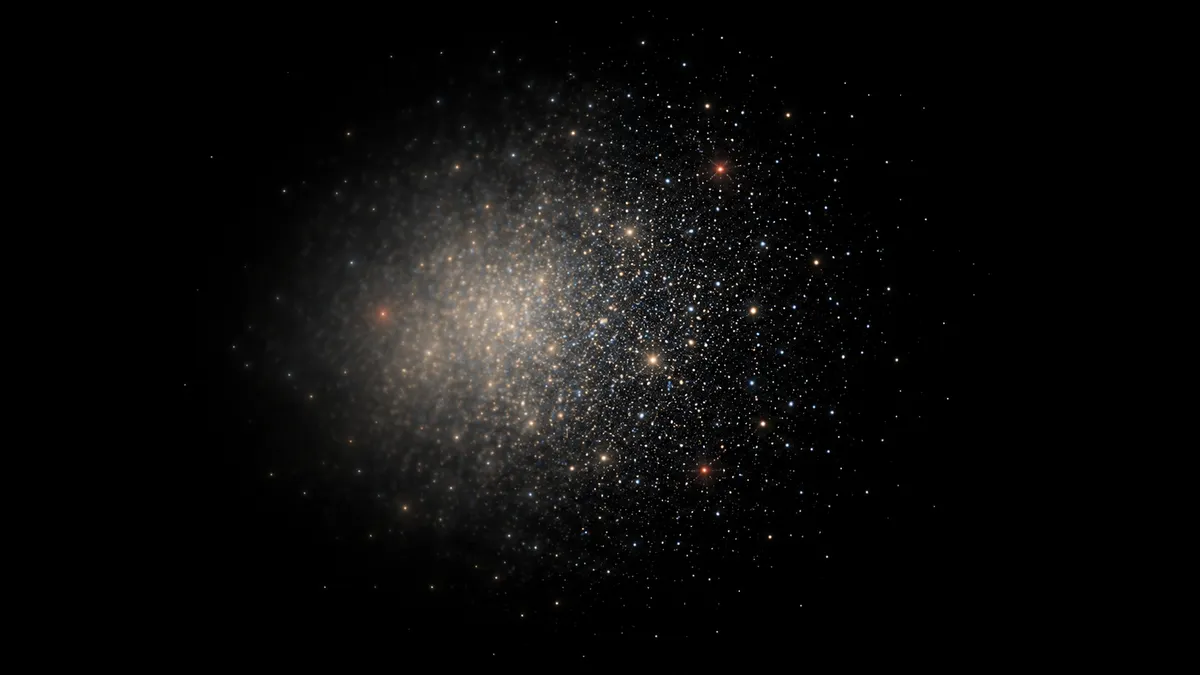
How much stellar detail remains hidden in a survey image after its public catalog is built? For the distant globular cluster AM-1, software tailored to measuring individual stars recovers roughly nine times as many sources in matched color–brightness diagrams, using the same Euclid observations.
AM-1 is a faint, diffuse globular cluster about 119,000 parsecs from Earth, far out in the Milky Way’s halo. Its distance and sparse population make its stars challenging to measure. For Daniel Weisz and colleagues, it also offers a useful test: AM-1 is the only known Galactic globular cluster in Euclid’s Quick Data Release 1.
Their study asks whether publicly available Euclid images can support detailed measurements of individual stars without specialized, consortium-internal calibration tools. The result is both an analysis of AM-1 and a publicly released Euclid module for DOLPHOT, a software package designed for stellar photometry—the measurement of stars’ brightnesses.
Measuring the shape of starlight
A telescope does not record a star as a perfect point. Its optics and detector spread the light into a characteristic pattern called the point spread function, or PSF. Fitting that pattern helps estimate stellar brightness and distinguish overlapping sources.
The researchers built empirical PSF models directly from public Euclid exposures. They selected isolated stars using the Gaia catalog, rejected unsuitable measurements, and combined observations from across all 124 Q1 observations. Typical samples contained about 3,500 stars per visible-light detector quadrant and 12,000 per near-infrared detector.
These models describe how starlight appears in Euclid’s visible-light instrument, VIS, and its near-infrared instrument, NISP. The team then used DOLPHOT to fit stars in the individual exposures covering AM-1.
The accompanying DOLPHOT 2.1 update also addresses a source of false detections. Imperfect subtraction of bright stars can leave residual light that software mistakes for additional stars. The revised noise model accounts for uncertainty in those subtracted stellar patterns, reducing that problem.
Fainter stars from the same observations
The dedicated analysis reaches about 1–1.5 magnitudes fainter than the public Q1 catalog. Larger magnitudes denote fainter objects. Its reported five-sigma detection depths are 27.1 in the visible band and 25.3–25.5 in the three near-infrared bands.
Importantly, a detection threshold does not mean every star that bright is recovered. To measure missed detections and brightness errors, the researchers inserted approximately 100,000 artificial stars, one at a time, and checked whether the software recovered them under the same selection criteria used for real sources.
In matched color–magnitude diagrams covering the same region, the new analysis contains roughly nine times as many sources as the public catalog. These diagrams compare stellar brightness with color, revealing recognizable stages of stellar evolution. The measurements extend about one magnitude below the main-sequence turnoff, where stars begin leaving the long-lived phase of burning hydrogen in their cores.
An old cluster, with a chemical uncertainty
The researchers did not derive AM-1’s age and composition solely from the new Euclid measurements. Instead, they fitted stellar-evolution models to archival Hubble Space Telescope images, then tested whether the resulting population also matched Euclid’s observations.
They infer an age of about 10.6 billion years and a distance of approximately 119,000 parsecs. The preferred iron abundance is about one-tenth the Sun’s iron-to-hydrogen ratio. That abundance is higher than earlier estimates, however. Different assumptions about chemical composition and stellar models explain some, but not all, of the discrepancy. The authors say spectroscopy is needed to establish the cluster’s composition more securely.
The Euclid star positions indicate a round, loosely concentrated cluster. Its projected half-light radius—the radius enclosing half its light—is about 12–16 parsecs, depending on the mathematical profile fitted. This agrees broadly with earlier measurements. The estimated present-day mass is about 21,000 solar masses, including living stars and compact remnants; it comes from population modeling and assumptions about stellar mass loss, rather than a new dynamical measurement.
One band remains unsettled
Independent ground-based measurements from the VISTA Hemisphere Survey agree closely with the Euclid analysis in the J and H infrared bands, with mean differences below 0.02 magnitude. But comparisons using Hubble measurements and stellar models reveal an offset of roughly 0.07 magnitude associated with Euclid’s Y band.
Both model sets predict Y-band brightnesses fainter than those measured. The study cannot determine whether the discrepancy comes from the brightness calibration or from the assumed instrument response used to calculate model magnitudes. Agreement with Euclid’s own public catalog cannot resolve that issue because both analyses share Euclid calibration information.
The PSF models also capture only limited variation across each detector. More detailed spatial models are planned for larger datasets, not demonstrated here. Nor did the team search for tidal tails or newly establish AM-1’s origin: the suggestion that it was accreted comes from earlier dynamical studies.
The demonstrated advance is narrower and practical: specialized stellar measurements can extract considerably more information from public Euclid images, while exposing calibration questions that still need answers.
- Euclid
- AM-1
- globular clusters
- stellar photometry
- DOLPHOT
- Milky Way halo
- point spread function
Related reading
Automatically matched by shared topic keywords. These links do not imply that the sources agree or establish a consensus.
Testing a radioactive clock for the Milky Way’s oldest stars
Source published
Shared keywords: globular clusters, milky way halo
Separating faint light between galaxies from telescope-scattered glow
Source published
Shared keywords: point spread function
Can brightness gradients reveal subtle distortions in distant galaxies?
Source published
Shared keywords: point spread function
What Star Clusters Could Reveal About Faint Galaxies
Source published
Shared keywords: globular clusters
Could nova explosions explain the chemistry of phosphorus-rich stars?
Source published
Shared keywords: globular clusters