TRANSMISSION // 2611.10122v1
Webb detects a long-sought rotational signal from a key interstellar ion
Source published
JWST observations reveal 26 previously unseen rotational emission lines from H₃⁺ in shocked gas. The detection opens a new way to investigate interstellar ionization, but uncertain collision physics limits what the lines can yet reveal.
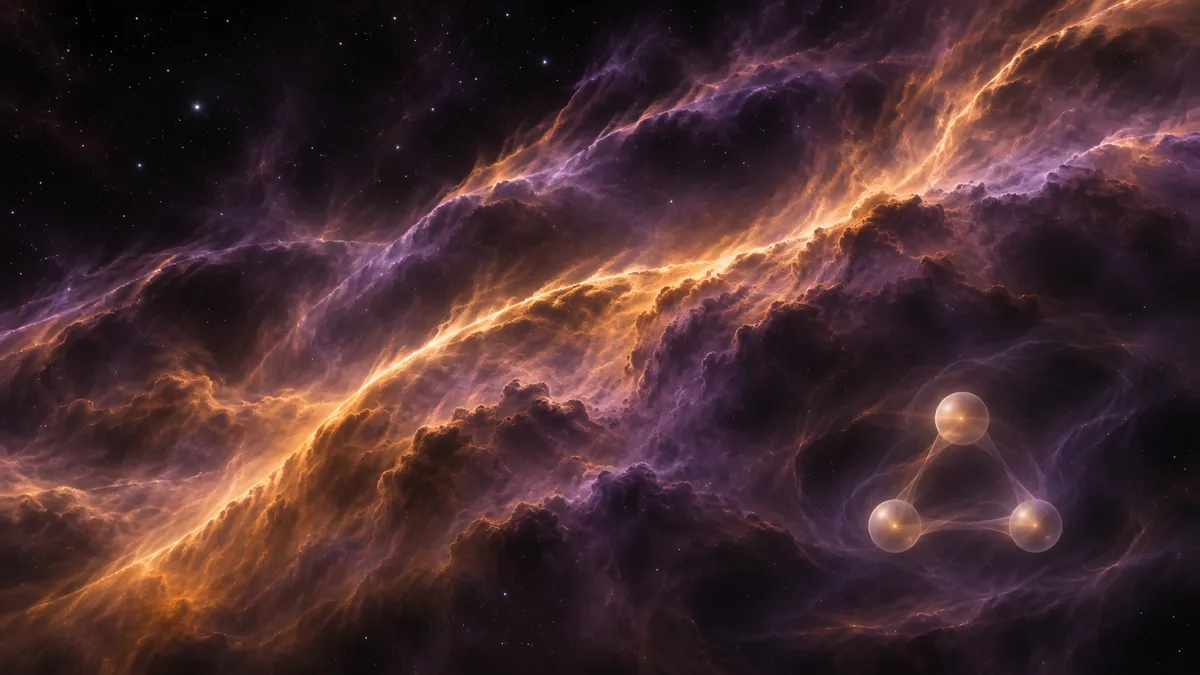
How do you detect the rotation of a molecule whose symmetry makes it almost invisible? In shocked gas in Cepheus A West, astronomers report finding a long-predicted infrared spectrum from H₃⁺, an ion that helps initiate interstellar chemistry.
H₃⁺ is a small but influential molecular ion: three hydrogen nuclei sharing two electrons. In molecular clouds, it forms after cosmic rays ionize hydrogen molecules, setting off reactions that produce H₃⁺. The ion can then donate a proton to other species, helping initiate a wider chemical network.
Astronomers have observed its vibrational spectrum for decades. Its pure rotational spectrum, however, had remained undetected both in space and in the laboratory. David Neufeld and colleagues now report detecting it with the James Webb Space Telescope in HH 168, a shocked region in Cepheus A West about 700 parsecs away.
Why “forbidden” does not mean impossible
H₃⁺ has an equilateral-triangle structure with no permanent electric dipole: its charge distribution lacks the asymmetry that enables ordinary electric-dipole rotational emission. But rotation slightly distorts the ion, inducing a small dipole and allowing weak transitions between rotational energy levels.
These transitions are called “forbidden,” not because they violate physics, but because they depend on an effect absent from the simplest description of the molecule. Calculations had identified this possible route to detecting interstellar H₃⁺ roughly four decades ago.
The team used Webb’s Mid-Infrared Instrument, MIRI, to examine two fields in HH 168. This region offers a relatively uncluttered infrared spectrum, making faint H₃⁺ features easier to distinguish from other molecules.
A detection built from many lines
The researchers measured emission at the predicted positions of 96 candidate rotational lines. They report 26 lines above five times their estimated statistical uncertainty in at least one field, excluding coincidences with known lines of other species. The strongest, at a wavelength of 16.325 micrometers, reaches approximately 72 times that uncertainty in one field and 49 times it in the other.
The identification rests on more than wavelength matches. The lines have velocities consistent with the molecular hydrogen emission, within the instrument’s calibration uncertainty. Different transitions originating from the same energy level generally give consistent estimates of that level’s population.
Their spatial distribution supplies another check. H₃⁺ closely follows hot, shocked molecular hydrogen, rather than the atomic and ionic emission nearby. That association locates the signal in the molecular component of a region containing several different shock conditions. It does not, by itself, determine which kind of shock produces the ion’s emission.
A misleadingly cool thermometer
Comparing the populations of rotational energy levels gives an apparent rotational temperature of about 730 kelvin in both fields. That number is not a straightforward measurement of the gas temperature.
The populations do not follow thermal equilibrium. Levels that lose energy rapidly through radiation are systematically less populated than a simple equilibrium model predicts. Collisions apparently cannot replenish them fast enough—a condition called subthermal excitation.
The team’s simplified collision models instead require temperatures above roughly 2,000 kelvin, with fitted values depending on how efficiently collisions transfer energy into rotation. In magnetic shocks, relative motion between ions and neutral molecules can further increase collision energies without making the neutral gas equally hot.
Important uncertainties remain. Collision rates have not been calculated for the high rotational levels and energetic encounters needed here. Much of the H₃⁺ may also occupy unobserved, long-lived levels, leaving its total inferred abundance uncertain by about three orders of magnitude.
Two shock explanations, neither complete
The researchers compared the observations with two classes of shock model. A continuous, or C-type, shock allows ions and neutral gas to move at different speeds. A jump, or J-type, shock has an abrupt front and, in the model considered here, breaks apart molecular hydrogen.
After scaling each model to the hydrogen emission, the C-type model reproduces those hydrogen lines better but predicts five to six times too little H₃⁺ emission. The J-type model comes closer to the total H₃⁺ signal, predicting about 70% of the observed emission, while fitting the hydrogen lines less well.
That is suggestive, not decisive evidence for a J-type origin. Its modeled speed of 60 kilometers per second exceeds the shock code’s documented validated range. The calculation also omits effects of the shock’s own ionizing and molecule-destroying radiation. Both models predict rotational populations that decline less steeply with energy than observed, highlighting the uncertain collision physics.
Archival Webb observations reveal the spectrum in the HH 211 bow shocks as well. The signal is therefore not confined to HH 168. Its promise is a new probe of ionization in shocked molecular gas; turning that promise into reliable quantitative measurements requires better collision calculations and more complete shock models.
- H₃⁺
- JWST
- MIRI
- HH 168
- astrochemistry
- molecular shocks
- infrared spectroscopy
Related reading
Automatically matched by shared topic keywords. These links do not imply that the sources agree or establish a consensus.
Webb catches a molecular ion shedding the energy of its formation
Source published
Shared keywords: hh 168
Webb traces free-floating carbon cages around Tc 1
Source published
Shared keywords: infrared spectroscopy
Webb separates the dust signals around Tc 1’s carbon cages
Source published
Shared keywords: infrared spectroscopy
Measuring the stars behind JWST’s planet spectra
Source published
Shared keywords: infrared spectroscopy
Infrared spectra reveal contrasting gas regions in nova V5668 Sgr
Source published
Shared keywords: infrared spectroscopy