TRANSMISSION // 2611.10112v1
A quantum model links baby universes to hidden observer information
Source published
A theoretical study finds that a closed universe can become favored when removing an observer from a wormhole lets that wormhole reach a lower-energy state. The model predicts accompanying changes in wormhole length and accessible information, not evidence that baby universes exist in nature.
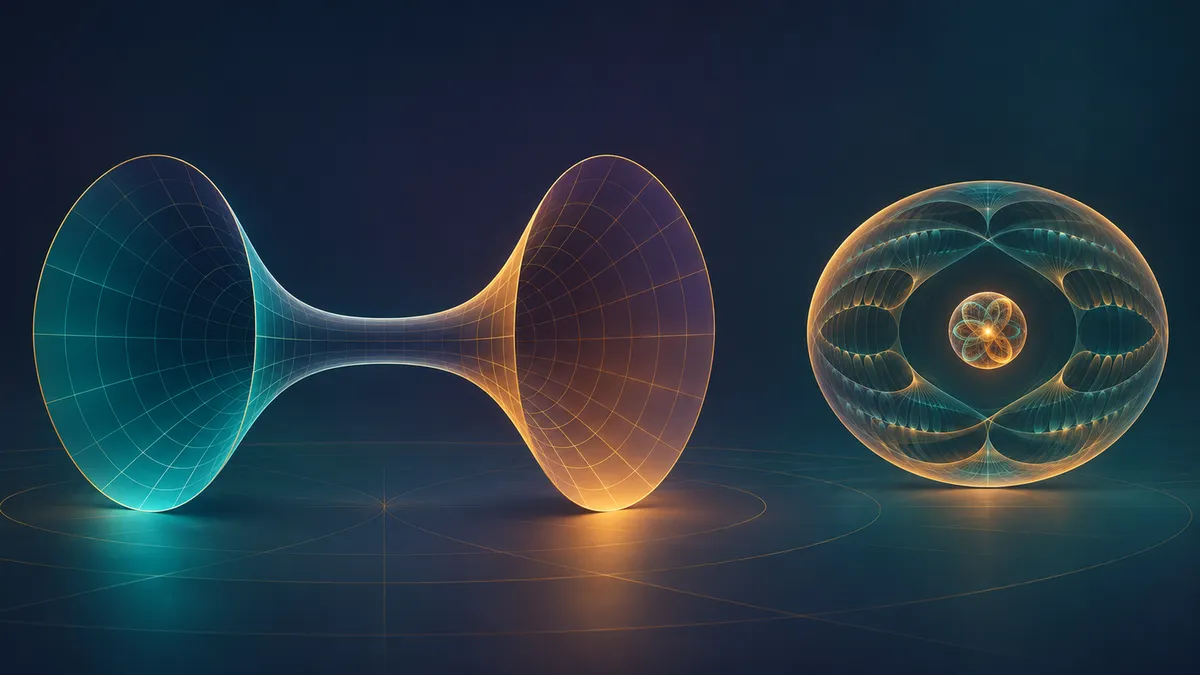
How could a quantum system describe a universe with no boundary? A solvable model explores one possibility: a closed universe carries an observer while the boundary systems lose access to information about that observer’s internal state.
A universe with no boundary poses a puzzle for holography, the idea that a gravitational world can be described by a quantum system associated with its boundary. If a closed universe appears, where does its information fit into that description?
In an arXiv preprint, Sergio E. Aguilar-Gutierrez and Takato Mori investigate this question using a mathematical model. Their central result connects three things: the energy of a wormhole, the number of possible internal states of an observer, and the information accessible to the boundary. The supplied record does not establish peer review. This is theoretical research with numerical calculations, not an experiment or an astronomical observation.
An observer made of quantum ingredients
The researchers couple two Sachdev–Ye–Kitaev systems, or SYK models. These contain many interacting quantum ingredients called Majorana fermions, with randomly chosen interaction strengths. In a special limit, the number of fermions and the number participating in each interaction both become large in a controlled way, making otherwise difficult calculations tractable.
The paired systems admit a gravitational interpretation involving a wormhole connecting two boundaries. The observer is represented by a particle inserted into an entangled state. Here, “observer” does not mean a conscious person: it is a physical subsystem with many possible microscopic configurations.
The authors organize their calculations using chord diagrams, which encode products of quantum operators. The number of open chords has a geometric interpretation as a discretized wormhole length. This correspondence is essential to their interpretation of a closed “baby universe”: a separate, closed component of the gravitational geometry.
Why removing the particle can help
The key competition concerns the wormhole’s allowed energies. Without a particle, an attractive coupling can support discrete, bound states of its length, including a lowest-energy state with constant length. A sufficiently heavy particle removes those bound states. In that regime, the wormhole containing it instead has states whose length grows indefinitely.
Ordinary chord calculations leave the particle in place. The authors also examine rare operator products that reproduce and cancel its fermion string. These contributions permit a description with an empty wormhole between the boundaries and the observer in a closed universe.
Such contributions are initially strongly suppressed. For the integer particle-size parameters emphasized in the paper, their leading suppression is approximately the exponential of minus the observer’s entropy. That entropy is the logarithm of the number of possible observer microstates.
At sufficiently low temperature, however, the empty wormhole’s lower energy can outweigh this statistical cost. The authors identify the resulting switch in dominance as a first-order transition, becoming sharp in their large-system limit. It is a comparison of temperature-dependent state preparations, not a simulation showing a universe splitting off in real time.
To leading order, the transition temperature is the binding-energy gain divided by the observer entropy. The associated latent heat is approximately the transition temperature multiplied by that entropy. Finite-parameter corrections matter; these relations are not exact identities throughout the model.
Two boundary signatures
One signature is a drop in Krylov complexity, a measure of how far a quantum state spreads through a sequence of states generated by its Hamiltonian. In this construction, that spread approximately measures wormhole length. When the empty-wormhole contribution takes over, the inferred length drops toward that of its lowest-energy state.
The authors distinguish this from simply trapping the particle inside a finite-length wormhole. That alternative produces a smooth crossover rather than the same abrupt length change.
A second signature concerns Holevo information, which bounds how much classical information measurements can extract about a prepared observer microstate. In the authors’ approximation, different microstates become indistinguishable at the boundaries when the baby-universe contribution dominates. In the gravitational interpretation, the closed universe carries the information that the boundaries can no longer access.
What remains unresolved
The result depends on a specialized model, its geometric interpretation and controlled approximations. Numerical calculations evaluate the model’s effective chains; direct finite-system diagonalization is proposed as a further test, not reported as completed. The information calculation neglects overlap fluctuations whose control is needed for typical individual realizations.
Nor does every coupling favor a baby universe: the empty wormhole must gain sufficient energy. The work supplies a concrete mechanism within this setting, not proof that closed universes form in our cosmos or a resolution of the broader debate about their holographic description.
- quantum gravity
- holography
- baby universes
- wormholes
- Sachdev–Ye–Kitaev model
- observer entropy
- Krylov complexity
- Holevo information
Related reading
Automatically matched by shared topic keywords. These links do not imply that the sources agree or establish a consensus.
Encoding a black-hole mass model in qubits
Source published
Shared keywords: quantum gravity
Could a quantum horizon timescale shape cosmic expansion?
Source published
Shared keywords: quantum gravity
Can gravity’s quantum phase survive an entanglement washout?
Source published
Shared keywords: quantum gravity
Can gravity seed cosmic structure without an inflaton?
Source published
Shared keywords: quantum gravity