TRANSMISSION // 2611.10103v1
A proposed Webb survey would map dust, ice and shadows in planet-forming disks
Source published
The DMAJOR white paper proposes observing 91 planet-forming disks with the James Webb Space Telescope. Its goal is a consistent infrared view of small dust grains, surface water ice and changing shadows, alongside a search for companions.
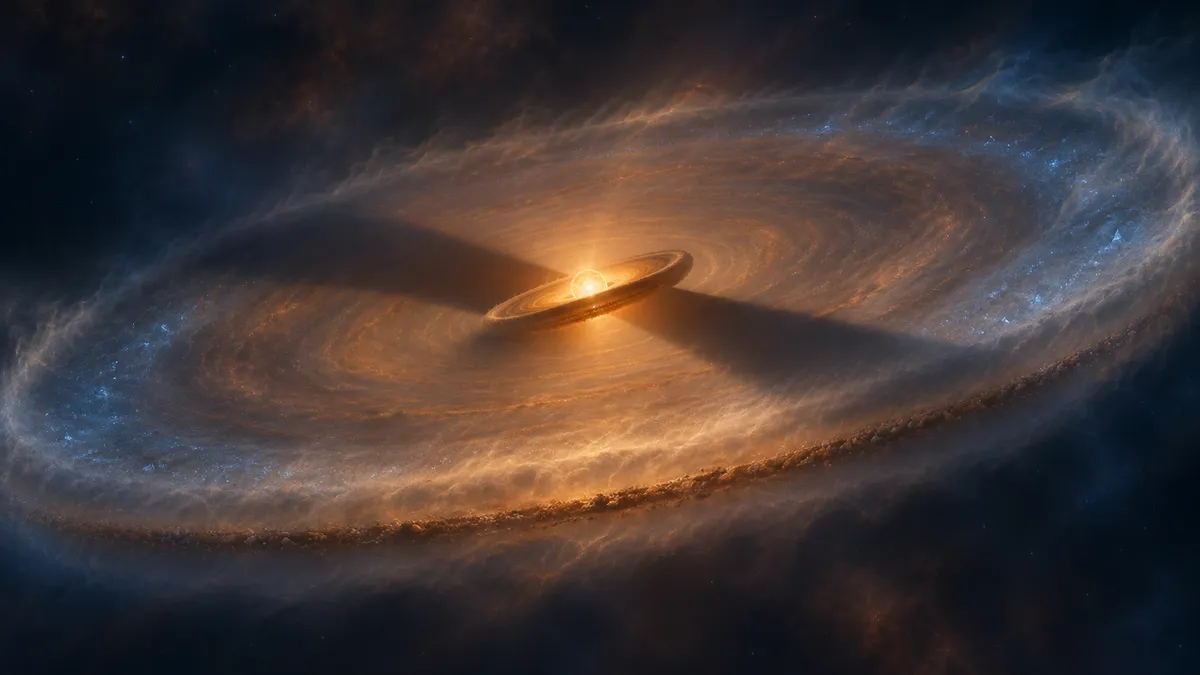
How representative are the spectacular disks astronomers already know? A proposed Webb survey would look beyond a handful of heavily studied systems to compare the material, structures and changing illumination around young stars.
Much of what astronomers know about the appearance of planet-forming disks comes from a relatively small collection of bright, repeatedly observed targets. That leaves a basic question unanswered: which features are common, and which belong to unusual systems?
Benjamin Pope, Yinuo Han and their collaborators propose addressing that gap with DMAJOR, the Disk Motions and Architectures JWST Observational Reference survey. Their white paper outlines a coordinated infrared imaging campaign with the James Webb Space Telescope. It presents a survey concept, target selection and observing-time estimates—not new observations of the proposed sample or a report of an approved program.
Different views of the same disk
A protoplanetary disk contains gas and solid particles around a young star. Different observations reveal different parts of that material. As the authors summarize, millimeter observations with ALMA have shown that millimeter-sized pebbles tend to settle toward a disk’s central plane and occupy a smaller radial extent than its gas.
Small dust grains are expected to follow the gas more closely. Infrared images of starlight scattered by those grains could test that expectation, especially in faint outer regions that ground-based observations can miss. Differences between the gas and small-grain distributions could indicate dust depletion or particles moving differently from the gas.
Comparing these infrared views with ALMA measurements would help connect disk surfaces with their midplanes. That is the basis of the proposal’s ambition to build a three-dimensional understanding: complementary observations constrain different disk regions, rather than a single image revealing every layer.
Water ice is another target. The proposed filters sample the ice absorption feature near three micrometers and neighboring wavelengths. Comparing those images could help map ice on disk surfaces, where stellar radiation and vertical mixing affect its distribution. Such measurements would inform questions about water available during planet formation, but would not amount to measuring all the water hidden throughout a disk.
Two instruments, complementary scales
The provisional sample contains 91 disks: 24 in Taurus, 20 in the Sco-Cen associations and 47 elsewhere. Selection favors disks with estimated outer angular radii of roughly one arcsecond or more. Edge-on systems, which do not require coronagraphy, and disks already extensively observed with comparable Webb coronagraphic imaging are excluded. Some partially observed systems remain so that missing measurements can be completed.
NIRCam would use a coronagraph, which suppresses the central star’s light to make faint surrounding material easier to detect. Its proposed configuration has an inner working angle of about 0.6 arcseconds: material closer to the star is difficult to access with that setup.
Complementary observations with NIRISS aperture-masking interferometry would probe smaller angular separations, down to approximately 0.1 arcseconds. This technique uses interference between light passing through openings in a mask to recover fine spatial information. The full observing estimate includes it for 44 sufficiently bright hosts, not every disk.
The observations would also search for companions and investigate how their presence—or absence—relates to disk structure. Candidate embedded companions would motivate follow-up spectroscopy and tests of whether they share the host star’s motion. Finding a bright feature alone would not establish that it is a forming planet.
Watching shadows change
The first observations would guide later visits. In particular, the team wants to monitor disks whose inner regions cast shadows across their outer surfaces. Changes in those shadows can offer clues to inner-disk dynamics that cannot otherwise be spatially resolved.
Selected targets would be revisited over intervals ranging from days to months or years. These are proposed measurements of variability, not changes already detected by DMAJOR.
Making the campaign efficient also depends on calibration. Rather than relying only on subtracting reference images of stars, the team proposes fitting physical models of the instruments and astronomical scenes together. Telescope wavefront information and observations pooled across nearby targets would help constrain those models. The authors cite earlier calibration advances as motivation; their performance across the planned survey remains to be established.
A benchmark with boundaries
The estimated full program requires about 690 hours, including initial imaging and assumed follow-up for a subset of targets. That total depends partly on assumptions that roughly 10% need companion spectroscopy and 10% need additional imaging to study motion.
Even a uniform observing strategy would not make this a census of every planet-forming disk. Angular-size cuts, brightness requirements, viewing geometry and previous coverage define its reach, and the target list could change. Its proposed value is a consistent benchmark within those limits: a way to compare dust, ice, environment and variability without repeatedly studying only the brightest examples.
- protoplanetary disks
- James Webb Space Telescope
- DMAJOR
- planet formation
- water ice
- infrared imaging
- disk shadows
Related reading
Automatically matched by shared topic keywords. These links do not imply that the sources agree or establish a consensus.
A giant planet’s heavy hydrogen points to unusually cold building blocks
Source published
Shared keywords: planet formation
Gas persists inside the dust gaps of three planet-forming disks
Source published
Shared keywords: planet formation, protoplanetary disks
A new look at the spirals around IM Lup
Source published
Shared keywords: planet formation, protoplanetary disks
Magnesium-rich dust could offer another route to formamide in space
Source published
Shared keywords: protoplanetary disks
DQ Tau’s molecular gas follows a slower rhythm than its accretion bursts
Source published
Shared keywords: protoplanetary disks