TRANSMISSION // 2611.10102v1
Five observations that could sharpen our picture of early galaxies
Source published
A theory-community white paper proposes deeper, more coordinated JWST surveys to distinguish competing explanations for the first stars, unexpectedly bright galaxies and galaxies that stopped forming stars early.
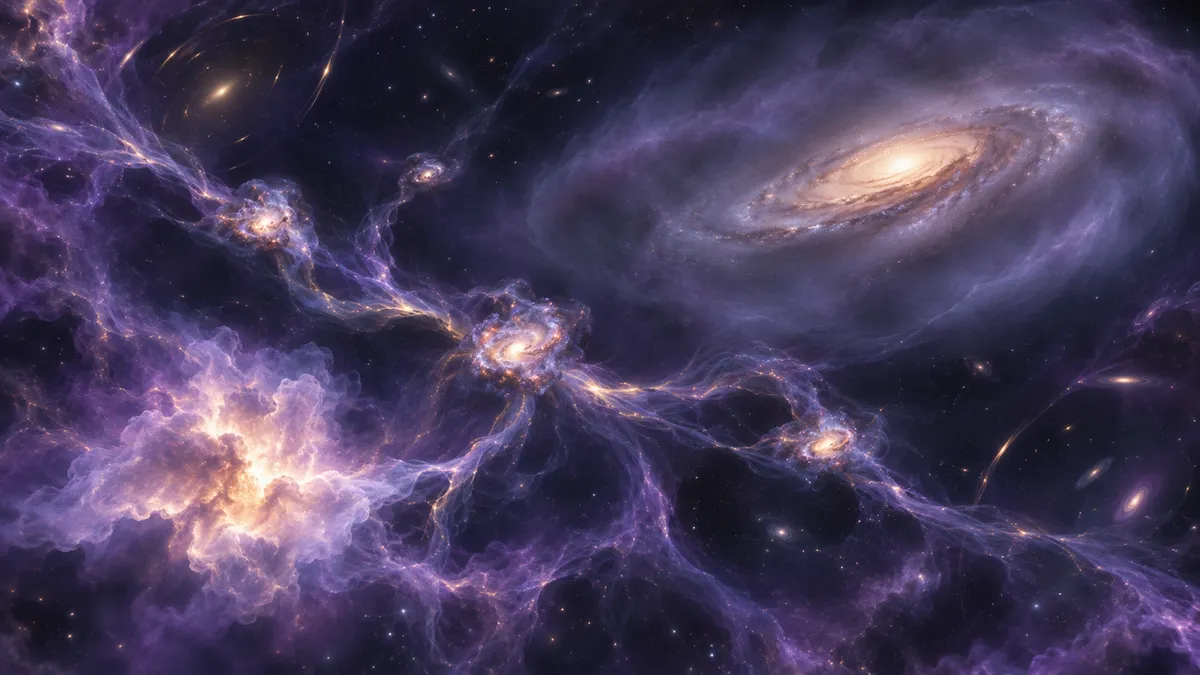
Finding a distant galaxy is not the same as understanding how it formed. A new white paper asks which observations would most effectively expose the missing physics in models of the early Universe.
Why did some early galaxies shine so brightly, while others apparently stopped making stars surprisingly soon? The James Webb Space Telescope has made these questions harder to ignore. But collecting more spectacular objects will not necessarily settle them: theorists need observations designed to distinguish explanations that can produce similar appearances.
A concept white paper led by H. Katz and colleagues, with 101 authors and co-signers, sets out five priorities for dedicated JWST observations. It is an observing agenda built around existing observations and disagreements between models, not a report of a newly completed survey.
Why models need better benchmarks
Galaxy formation spans an enormous range of scales. Gas flows across cosmological distances, while stars and black holes reshape their surroundings through processes occurring on scales smaller than Earth's orbit. Simulations cannot resolve all of this simultaneously. They therefore use approximate prescriptions for unresolved processes, known as subgrid models.
Those approximations leave room for different physical explanations to reproduce the same measurements. The authors argue for deeper observations, larger samples and consistent observing strategies. High redshift identifies the distant, early Universe; larger redshift generally means looking further back in cosmic history.
1. Establish what the first stars were like
Population III stars are stars formed from gas without elements heavier than helium. Their properties remain largely unconstrained by observations. Models disagree about their birth masses, how rapidly they formed and when their formation ended. Many simulations predict that such stars could still form in pristine pockets at redshifts below 10, rather than belonging exclusively to the very earliest era.
These uncertainties matter because the first stars enriched their surroundings. Heavy elements and dust help gas cool, enabling the transition to later stellar populations and potentially more efficient star formation.
The authors recommend very deep observations, probably using gravitational lensing to magnify faint distant systems, to secure a definitive Population III detection. Existing candidates are suggestive, not conclusive. Ultimately, counts across different environments and redshifts would discriminate between models more effectively than one detection alone. Better spectra of massive, chemically poor later-generation stars are also needed: their radiation, winds and chemical output are uncertain ingredients in simulations.
2. Find where faint galaxies become scarce
The ultraviolet luminosity function describes how common galaxies are at different ultraviolet brightnesses. Models often agree reasonably well for bright galaxies but diverge at the faint end, beyond current observational reach.
Most predict a turnover: a departure from the continuing rise in galaxy numbers toward lower brightness. Its location and shape depend partly on how radiation during reionization affects gas in low-mass systems. Reionization was the period when radiation stripped electrons from hydrogen across the Universe.
Heating could suppress fresh gas supply or remove gas already present, with different consequences for how quickly star formation declines. Measuring faint populations before, during and after reionization could help separate these possibilities. The turnover is a theoretical prediction to test, not a detection announced by this paper.
3. Compare like with like
Relationships between galaxy mass, chemical enrichment and star formation rate offer population-level tests of theory. Yet a comparison can mislead if observed galaxies were selected in ways the simulation does not reproduce.
A selection function describes which objects have a chance of entering a sample. Combining surveys with poorly characterized selection and different exposure times or spectral resolutions can obscure whether a disagreement comes from physics or observation.
The proposed remedy is coordinated spectroscopy above redshift 4, with consistent observing methods and explicit selection rules. Researchers could then turn simulated galaxies into mock observations and analyze both samples comparably.
4. Explain unexpectedly bright early galaxies
The paper reports that JWST has found hundreds of imaging-selected candidates and more than 40 spectroscopically confirmed galaxies at redshifts around 10 or higher. Their abundance exceeded most pre-launch expectations.
Several explanations remain viable: less dust obscuration, a greater proportion of massive stars, intermittent bursts of star formation, or more efficient conversion of gas into stars. Accreting black holes could also contribute light that might otherwise be attributed to stars.
Deep, high-resolution spectra could constrain star formation histories and search for black-hole activity or unusual stellar populations. Deeper imaging and measurements of galaxy clustering would supply complementary tests. The proposal does not establish which explanation dominates.
5. Learn why massive galaxies shut down
Massive galaxies with little ongoing star formation present a different challenge. Their inferred abundance at early times is difficult for many models to reproduce.
Energy from active black holes is a leading explanation for quenching, but the relative importance of winds, jets and other mechanisms remains uncertain. Different histories of star formation can also fit similar observations.
The authors propose deep, spatially resolved spectroscopy to constrain masses through internal motions and measure chemical patterns across galaxies. These measurements could narrow down when star formation stopped and which mechanisms were responsible.
Across all five priorities, the limiting resource is not simply telescope depth. It is depth combined with representative samples and reproducible measurements. The authors argue that dedicated multi-cycle programs are needed beyond ordinary General Observer projects. Whether those campaigns resolve the disagreements remains an open question; their purpose is to make competing explanations genuinely testable.
- galaxy formation
- James Webb Space Telescope
- cosmic dawn
- Population III stars
- reionization
- galaxy quenching
- spectroscopy
Related reading
Automatically matched by shared topic keywords. These links do not imply that the sources agree or establish a consensus.
Why Astronomers Want a Bigger JWST Survey of the First Galaxies
Source published
Shared keywords: cosmic dawn, galaxy formation, james webb space telescope
Webb spots a faint oxygen line in a distant galaxy’s core
Source published
Shared keywords: james webb space telescope, population iii stars
Fading galaxies could reveal why the early universe looks so bright
Source published
Shared keywords: galaxy formation
What Star Clusters Could Reveal About Faint Galaxies
Source published
Shared keywords: galaxy formation
Early Galaxies Narrow a Search for Neutrino Interactions
Source published
Shared keywords: james webb space telescope