TRANSMISSION // 2611.10084v1
Finding more cosmological information in DESI’s nearby galaxies
Source published
Tests on simulated galaxy catalogs suggest that combining small-scale clustering with a density-based analysis could tighten some cosmological constraints by up to 40%. Extending the approach to evolving dark energy remains limited by the simulations used to train the model.
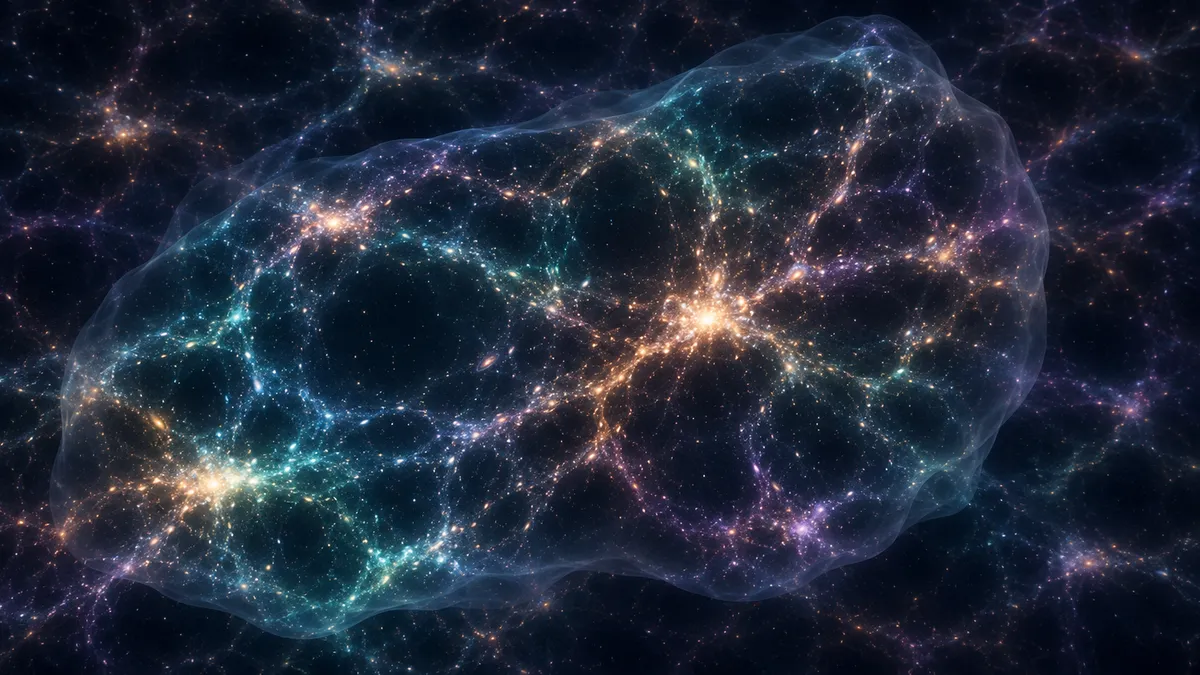
A dense map of nearby galaxies does not automatically deliver precise cosmology: the small cosmic volume it covers imposes its own uncertainty. A DESI study explores whether sorting galaxies by their surroundings can extract more information from that same volume.
More galaxies, but a limited cosmic view
How much can nearby galaxies tell us about the Universe’s expansion and contents? The answer depends not only on how many galaxies a survey measures, but also on which features of their arrangement researchers analyze.
The Dark Energy Spectroscopic Instrument, or DESI, measures galaxy spectra using 5,000 robotically positioned fibers on the Mayall Telescope in Arizona. Its Bright Galaxy Survey, or BGS, provides a particularly dense sample in the redshift range 0.1–0.4. Redshift describes the stretching of light and helps locate galaxies along our cosmic line of sight.
But this nearby sample occupies a relatively small volume. Its cosmological precision is therefore limited mainly by cosmic variance: the uncertainty associated with observing a finite region of the Universe. Adding more galaxies within that region does not remove this limitation.
In a short arXiv preprint, Simon Bouchard and Pauline Zarrouk investigate ways to extract additional information from the BGS. Their reported improvements come from simulated catalogs, not a new measurement establishing how dark energy behaves.
Sorting galaxies by their surroundings
A conventional clustering analysis uses two-point statistics, which describe how galaxy pairs are distributed with separation. These statistics do not capture every feature of the density field. Moreover, the perturbative analytical models used in standard analyses limit access to strongly nonlinear scales, where gravitational clustering has become more complicated.
The study explores density-split clustering. Researchers estimate the local density around galaxies, sort the catalog into groups according to that density, and measure how each group clusters relative to the full catalog. Comparing different environments accesses information beyond the usual two-point description. The paper also describes this approach as a way to reduce the impact of sample variance.
To model small-scale clustering, the pipeline uses neural-network emulators built with the sunbird framework. An emulator learns to reproduce selected statistics from a training collection rather than running a fresh cosmological simulation for every parameter choice.
Here, the training catalogs come from the AbacusSummit dark-matter simulations. They vary both cosmological parameters and astrophysical parameters describing how galaxies populate dark-matter halos. This lets the analysis account for uncertainty in the galaxy–halo connection when constraining cosmology.
The dense BGS sample creates a practical obstacle, however: the authors report that computing-time and storage requirements grow with sample density.
What the tests show
The paper adopts an absolute-magnitude threshold of −20, retaining roughly 70% of the BGS data points. For context, it describes a standard DESI second-release analysis that retains only about 30% using a brighter threshold of −21.35.
The results compare the revised approach against a first-release BGS baseline. The comparison brings together a less restrictive galaxy selection, access to smaller-scale two-point clustering through the emulator, and the addition of density-split information. The reported gain should therefore not be read as an isolated benefit from density splitting alone.
On validation mock catalogs, the analysis recovers the input cosmological parameters within one standard deviation and reports improvements of up to 40% in some model constraints. The illustrated parameters concern dark-matter density, the amplitude of matter fluctuations, and the scale dependence of primordial fluctuations. Similar results are reported for separate DESI cubic mock catalogs representing the BGS.
Dark energy remains an extension
The authors also explore w0waCDM, a model allowing dark energy’s behavior to vary with time rather than fixing it as a cosmological constant. They report still tighter constraints in this extension, but give no numerical improvement for it in the text.
Crucially, the cosmological parameter range supplied by AbacusSummit limits that exploration. The authors argue that new simulation suites are needed to exploit the available information more fully. These mock-based results motivate further development; they do not establish evolving dark energy or demonstrate the same gains on observed BGS data.
- DESI
- Bright Galaxy Survey
- density-split clustering
- cosmic variance
- simulation-based inference
- dark energy
Related reading
Automatically matched by shared topic keywords. These links do not imply that the sources agree or establish a consensus.
Choosing galaxies could shape the science of a future giant telescope
Source published
Shared keywords: dark energy
Could cosmic acceleration end? A dark energy preprint explores the possibility
Source published
Shared keywords: dark energy
Could cosmic voids reveal uneven dark energy?
Source published
Shared keywords: dark energy
Galaxy Motions Help Untangle Models of Dynamical Dark Energy
Source published
Shared keywords: dark energy
A softly broken symmetry offers a route across the phantom divide
Source published
Shared keywords: dark energy