TRANSMISSION // 2611.09892v4
Can a general AI model control a robot arm?
Source published
A preprint reports results from a generalist agent on manipulation benchmarks and real-robot trials. The abstract supports the headline figures but leaves evaluation details open.
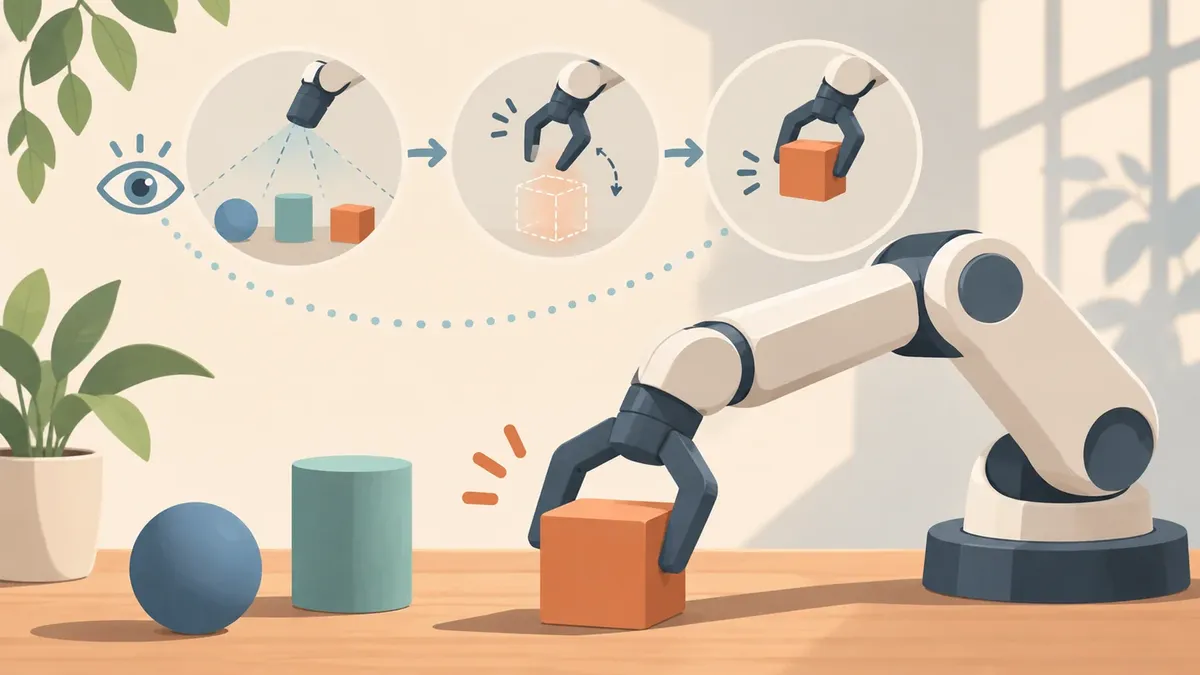
Robot policies are often trained using demonstrations for particular tasks. This preprint examines another approach: a generalist AI model directly commands a robot manipulator and adapts its actions as a task unfolds. The reported results are promising, though the available evidence here is limited to the abstract.
A generalist agent at the controls
Robot manipulation policies can be trained using demonstrations of particular tasks. In On Agentic Manipulation Policies, the authors ask whether a generalist AI model can control a manipulator directly, adapting its actions as a task unfolds. They call this approach agentic manipulation policies, or AMPs.
The authors present AMP1, a reference setup—or “harness”—intended to work across single-arm, bimanual and mobile manipulation. They say the basic harness supplies no grasping, pushing or placing skills and requires no demonstrations or task-specific training. The abstract does not explain the underlying model or give enough methodological detail to assess precisely how observations become robot commands.
What the authors report
On the RoboLab-120 benchmark, the authors report an 85.6% success rate for AMP1 in zero-shot evaluation. They compare this with 49.2% for a leading vision-language-action (VLA) policy and 42.9% for a world-action model (WAM). Here, “zero-shot” refers to the authors’ reported setting without task-specific training; the abstract does not describe the evaluation protocol in detail. These figures concern the named benchmark, not all robot tasks or environments. The authors also report state-of-the-art results on CaP-Gym, but the abstract gives no score for that benchmark.
For real-world evaluation, the authors report success in 104 of 108 trials, spanning twelve tasks and three robot instances. They say AMP1’s failure rate was 20 times lower than that of a strong VLA baseline and 15 times lower than that of a strong WAM baseline. The abstract does not provide the baselines’ trial counts or further comparison details, so the figures should be read as the authors’ reported results rather than independently verified comparisons.
The abstract gives examples of strategies the agent developed, including searching for hidden objects, using objects as tools and calibrating its cameras. It does not provide enough detail to assess how often these behaviors occurred or how they were evaluated.
The authors also report a separate result using a persistent memory store carried across episodes. On RoboDojo bimanual manipulation tasks, this augmented harness had a failure rate 4.6 times lower than zero-shot deployment. This finding applies to the memory-augmented setup, not the basic harness.
What remains uncertain
The reported benchmark and real-world results are encouraging, but the abstract alone cannot establish how reliably AMP1 performs outside the evaluated settings. It does not detail trial protocols, uncertainty estimates, environmental variation or how the comparison systems were matched. Nor does it establish transfer to tasks or robots beyond those described.
This account is based on the paper’s abstract, not a full review of its methods, results tables or supplementary materials. The work is an arXiv preprint, which may not have undergone peer review. Its numerical claims and comparisons should therefore be understood as the authors’ reports, pending examination of the full study and independent replication.
- robot manipulation
- agentic manipulation policies
- robot learning
- vision-language-action models
- robotics
Reviewed cross-references
These connections were reviewed by a model, not independently fact-checked by a human. Similarity does not imply agreement; consult the original papers and the evidence below.
A Robot Learns From Its Own Attempts
Shared method: Both papers add memory to an agentic robot-control harness: AMP1’s persistent memory is carried across episodes, while Embodied-Harness separates short-term execution context from long-term experience used for reflection. The implementations and evaluations differ, so this is a shared design element, not evidence that either method’s results transfer to the other.
Model review: · openai-codex/gpt-6-luna
Evidence and provenance
Selected excerpts, not complete papers. PDF extraction can omit figures or damage equations, tables and reading order; sources may be preprints.
2611.09892v4 — Original paper
Excerpt reference:
static/papers/2611.09892v4.md:15-76
Basis: Paper text
Source SHA-256:51178fcbe555ede3cc0c8b08432bfe4bab6dd33713592965d55869fdca3f49272611.27689v1 — Original paper
Excerpt reference:
static/papers/2611.27689v1.md:13-35
Basis: Paper text
Source SHA-256:00275b6594a1fab79f50439cdf444a4b38f1cb16a39609d906daf069fb62ccb2
Related reading
Automatically matched by shared topic keywords. These links do not imply that the sources agree or establish a consensus.
Teaching Robot AI to Focus on Motion, Not Scenery
Source published
Shared keywords: robot learning, robot manipulation, vision language action models
A robot plan that knows what remains—and when to consult a demonstration
Source published
Shared keywords: robot learning, robot manipulation, vision language action models
How to Help Robot AI Remember Language While Acting
Source published
Shared keywords: robot learning, robot manipulation, vision language action models
Robots may learn more from human corrections when they do not copy them exactly
Source published
Shared keywords: robot learning, robot manipulation, vision language action models
Teaching robots without demanding an exact copy
Source published
Shared keywords: robot learning, robot manipulation, vision language action models