TRANSMISSION // 2611.09855v2
A Raman route to anyon-like behavior in a one-dimensional lattice
Source published
A theoretical study proposes using Raman-coupled potassium atoms in an optical lattice to create density-dependent, direction-sensitive tunneling—the key ingredient for simulating one-dimensional anyons. Numerical results show several signatures of anyonic behavior, but the proposed lattice system has not yet been experimentally demonstrated.
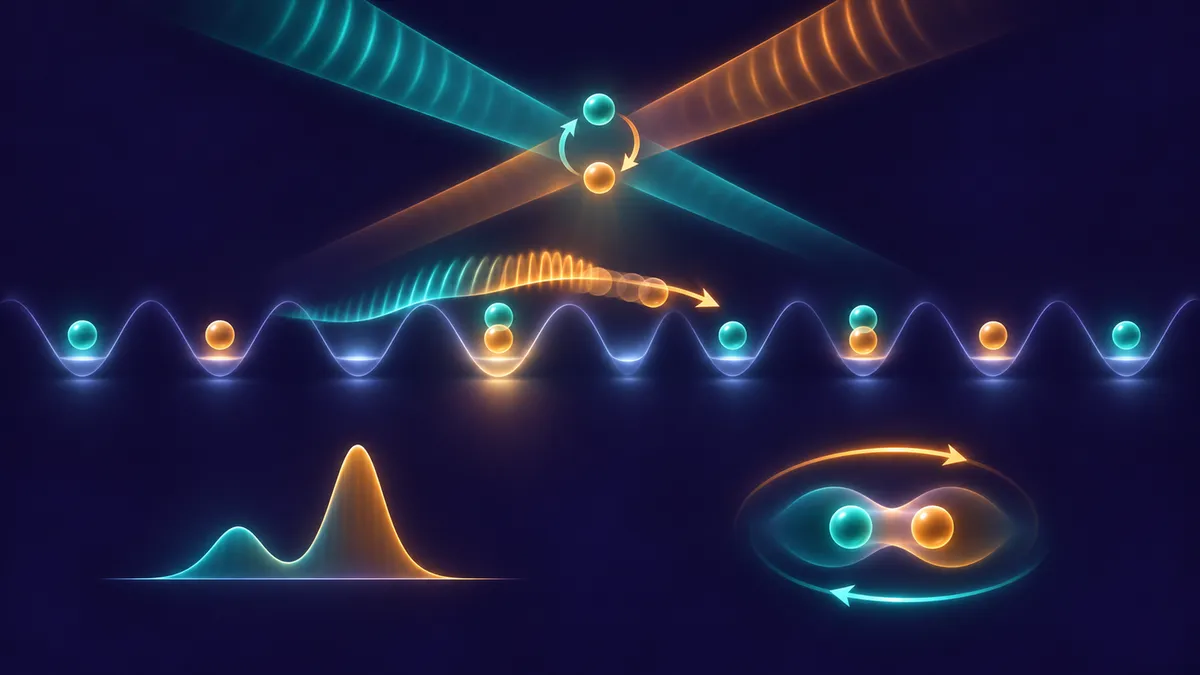
Can ordinary bosonic atoms in a one-dimensional lattice be made to behave like particles with fractional statistics? Josep Cabedo and colleagues propose a route using Raman-coupled atoms with unequal interaction strengths. Their calculations suggest that the resulting system could reproduce several recognizable anyon signatures and, at sufficiently strong coupling, realize a model distinct from the standard anyon-Hubbard model.
Giving bosons a statistical twist
Bosons and fermions are the familiar categories of identical particles. Anyons extend that picture: in one dimension, their unusual exchange behavior is closely tied to interactions, because particles cannot pass one another without meeting. Rather than seeking a new kind of atom, physicists can simulate anyonic behavior by engineering how ordinary particles move and interact.
In this preprint, Josep Cabedo, Claudio Iacovelli, Leticia Tarruell and Alessio Celi propose a method using a gas of bosonic potassium-39 atoms in a one-dimensional optical lattice. Two internal states of each atom are coupled by Raman light. If the interactions between the internal states are suitably imbalanced, the atoms dressed by the light acquire a direction-dependent interaction with nearby density. In the lattice description, this appears as tunneling whose amplitude and phase depend on how many particles occupy neighboring sites.
The authors call the resulting effective description the Raman anyon-Hubbard model. In the familiar anyon-Hubbard model, a density-dependent tunneling phase represents the particles’ statistical behavior. For weak effective coupling, the new model reduces to that standard model. At stronger coupling, it instead has statistical interactions that do not repeat periodically with the coupling strength. The authors therefore describe it as a distinct lattice anyon model, not simply a stronger version of the standard one.
What the team calculated
The proposal begins with a model of a lattice gas whose two internal states form a synthetic ladder. The team derives a simpler description for atoms occupying the ladder’s lower energy band. This reduction assumes strong Raman coupling and, for the basic effective model, sufficiently low density and interaction energies below the band gap. They also calculate corrections from higher-band processes and from tunneling between sites beyond nearest neighbors.
They then use numerical calculations to look for three signatures associated with one-dimensional anyons. First, density-matrix renormalization-group simulations examine the ground-state momentum distribution. Second, calculations of two-particle quantum walks track how an initially symmetric pair spreads. Third, two-particle spectra are used to identify bound states. The authors compare the effective model with calculations for the underlying ladder system, and check how well the simplified description holds in the parameter ranges considered.
The calculations show a ground-state momentum distribution shifted away from zero momentum. The shift depends on both the effective statistical coupling and the particle density. In the simulated expansion, the population moving to the left and right can differ; the imbalance depends on the coupling and on the effective onsite interaction. The calculated two-particle spectrum contains chiral bound-state branches—pairs whose motion is directionally asymmetric—even when the effective onsite interaction is zero.
The distinction from the standard anyon-Hubbard model is clearest at stronger coupling: in the Raman model, the calculated bound-state gap grows with the chiral coupling rather than repeating periodically. The authors report that the bound-state features persist in simulations of the full ladder model across a range of parameters, including cases where interaction energies approach the band gap. That is evidence of robustness within their calculations, not a general guarantee that the effective description works in every regime.
A proposal, not an experimental observation
The paper’s contribution is a theoretical model and an assessment of its experimental feasibility, not a demonstration of the proposed lattice anyons. The authors identify potassium-39, whose interaction strengths can be tuned, and estimate laser and lattice conditions compatible with the calculations. Their scheme uses a static Raman-coupled setup rather than the periodically driven approach used in some earlier lattice proposals. That avoids the particular heating mechanism associated with Floquet driving; it does not establish that a real experiment would be free of heating or other practical limits.
The results also have boundaries. The effective model relies on assumptions about band separation and density, while quantitative agreement with the full ladder can weaken at higher filling or stronger interactions. The transport calculation concerns a specified two-particle initial state, so its detailed density profile is not universal. And although the paper identifies possible future finite-density phases, it does not map out a phase diagram or demonstrate those phases.
This account is based on the supplied arXiv preprint text and abstract. A preprint is a public research manuscript, and the available material does not establish whether this version has undergone peer review. The calculations make a case for testing the proposal; experimental observation will be needed to show whether the predicted signatures can be realized and measured in the lattice gas.
- one-dimensional anyons
- ultracold atoms
- Raman coupling
- optical lattices
- quantum simulation
- anyon-Hubbard model
Reviewed cross-references
These connections were reviewed by a model, not independently fact-checked by a human. Similarity does not imply agreement; consult the original papers and the evidence below.
Uneven ion spacing changes how a quantum of vibration travels
Shared method: Both studies use hopping dynamics to examine quantum-walk-like propagation: the Raman anyon-Hubbard paper numerically studies two-particle walks for asymmetric transport, while the trapped-ion paper experimentally tracks a single local phonon and describes central-chain propagation as quantum-walk-like. This is a limited methodological parallel, not evidence that the systems or transport outcomes are equivalent.
Model review: · openai-codex/gpt-6-luna
Evidence and provenance
Selected excerpts, not complete papers. PDF extraction can omit figures or damage equations, tables and reading order; sources may be preprints.
2611.09855v2 — Original paper
Excerpt reference:
static/papers/2611.09855v2.md:122-180
Basis: Paper text
Source SHA-256:1d25bdee04a2aef88ea570e9493fec2191065860ee8ee6b50337fd1fbfc39c142611.13967v1 — Original paper
Excerpt reference:
static/papers/2611.13967v1.md:1464-1527
Basis: Paper text
Source SHA-256:9251b7af876ff783b1507c9263bfe0224a13a4a2d539fa977c4b7c07b46c60e6
Related reading
Automatically matched by shared topic keywords. These links do not imply that the sources agree or establish a consensus.
When two atoms scatter light as a pair
Source published
Shared keywords: ultracold atoms
How interactions may create Weyl superfluidity from ordinary bands
Source published
Shared keywords: ultracold atoms
When two atoms interact more strongly than they radiate
Source published
Shared keywords: ultracold atoms
Simulating quantum noise by enlarging the quantum system
Source published
Shared keywords: quantum simulation
How many electric-field levels does a quantum simulation need?
Source published
Shared keywords: quantum simulation