TRANSMISSION // 2611.09829v1
Which early-universe patterns could carry a cosmic handedness signal?
Source published
A theoretical preprint identifies one mathematical configuration that could support a mirror-asymmetric four-point clustering signal from inflation. Under statistical isotropy—no preferred direction—the authors find that a third-order perturbation can preserve the necessary geometry, while none of the four configurations built from pairs of second-order perturbations can do so. The study identifies a possible route to a signal, not evidence that the universe follows it.
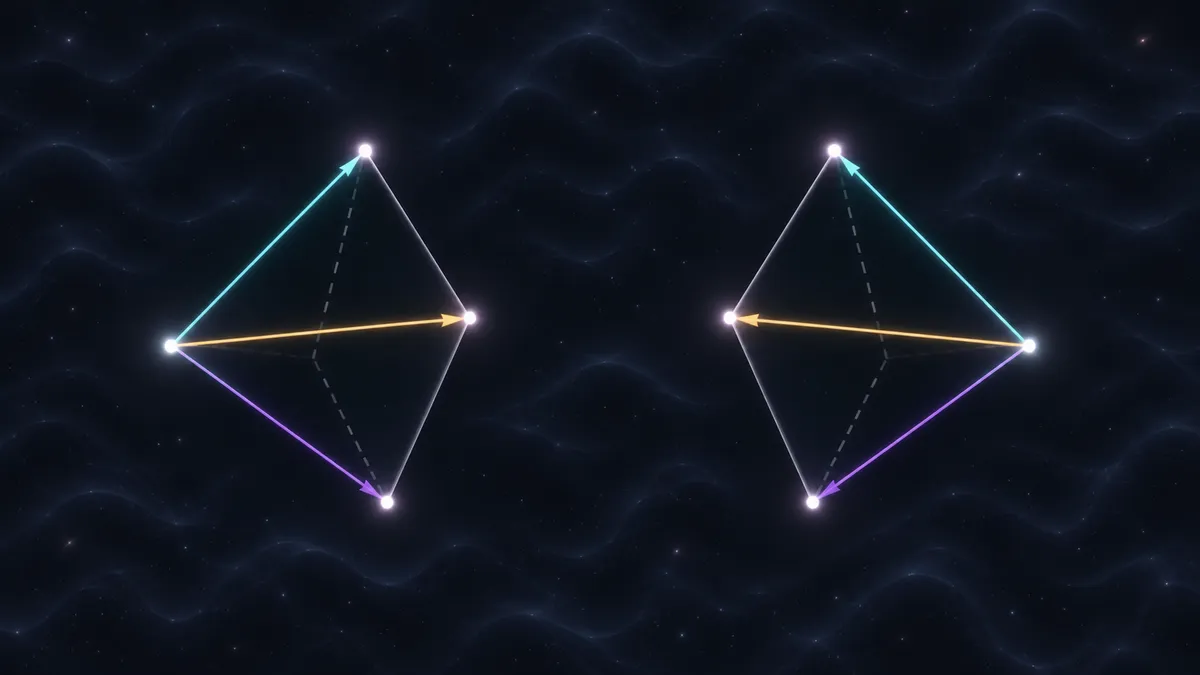
Could the arrangement of matter distinguish left-handed shapes from their mirror images? In a preprint posted on November 6, 2026, University of Florida researchers William Ortolá Leonard and Zachary Slepian examine which mathematical structures could produce such a distinction in primordial density fluctuations. Their result narrows the possibilities within a particular perturbative framework, without identifying a physical mechanism or detecting a cosmic preference for either handedness.
Why four points matter
Parity symmetry means that a physical observable remains unchanged when every spatial coordinate is reversed: a configuration and its spatially inverted counterpart give the same result. A parity-odd contribution changes sign under that reversal.
For the statistically isotropic, three-dimensional scalar clustering considered in this paper, identifying handedness requires three independent spatial vectors. Four points supply them: choosing one point as a reference leaves three separation vectors, describing a tetrahedron.
The mathematical test is a scalar triple product. It combines three vectors into a signed quantity associated with the tetrahedron’s volume. Its sign reverses under spatial inversion, making it sensitive to handedness.
The four-point correlation function measures how often quadruplets occur relative to a random distribution. Its Fourier-space counterpart, the trispectrum, describes correlations among four wave modes—components used to represent a density pattern at different scales and directions. These are the lowest-order scalar clustering statistics able to probe parity violation in the three-dimensional setting studied here. The paper separately notes that two-dimensional fields allow a three-point test.
What the researchers calculated
The authors assume that primordial fluctuations can be described by a perturbative expansion: a linear contribution plus corrections involving products of two, three or more linear fields. The starting linear density field is assumed to be Gaussian, so its higher-order correlations can be reduced to combinations of pair correlations.
A kernel is the mathematical weighting rule that determines how those linear fields combine. A second-order correction combines two copies of the linear field; a third-order correction combines three. These orders describe the construction of the correction, not separate epochs in cosmic history.
The study examines two contributions to the leading non-Gaussian trispectrum: three linear fields together with one third-order correction, and two linear fields together with two second-order corrections. Non-Gaussian here means correlation structure beyond what the Gaussian starting field supplies through its pair correlations.
Using Wick’s theorem—the rule for reducing Gaussian correlations to pairings—the researchers classify the possible pairing patterns. They find two configurations for the third-order contribution and four for the paired second-order contribution.
One third-order configuration retains handedness
In the first third-order configuration, two linear fields inside the correction pair with each other. This is a self-contraction. After integration, the relevant angular dependence involves only one wave vector. Statistical isotropy removes any dependence on its absolute direction, leaving no parity-odd contribution.
In the other configuration, each of the three fields inside the correction pairs with a different external linear field. This non-self-contraction retains three independent wave vectors. They can form the scalar triple product needed for a handedness-sensitive signal.
That makes the configuration capable of supporting parity violation. It does not establish that an actual inflationary model produces it: the third-order kernel must contain suitable parity-odd dependence. Retaining three independent vectors provides the necessary geometric opportunity, not a guarantee of a nonzero signal.
Why the second-order routes fail
The four second-order configurations include internal pairings within both corrections, an internal pairing within just one, connections between the corrections and the external fields, and pairings exclusively between the two corrections.
The authors find no parity-odd contribution from any of these configurations under statistical isotropy. Each second-order kernel has only two vector arguments. Without a preferred direction, their rotationally invariant dependence can be expressed through vector lengths and dot products, which do not distinguish handedness.
An important boundary is that isotropy and parity symmetry are different assumptions. Having no preferred direction does not itself forbid a handedness signal; three independent vectors can still provide one. The authors also explicitly note that an anisotropic second-order kernel could allow a parity-violating contribution in the cross-contraction configuration. Their exclusion therefore is not universal.
A theoretical filter, not an observational verdict
Within the framework examined, the third-order kernel is the lowest-order kernel capable of contributing to the parity-odd leading non-Gaussian trispectrum. The work does not derive its explicit physical form, calculate a predicted signal strength or establish its origin in a particular inflationary model.
The observational motivation remains unsettled. The paper describes earlier BOSS galaxy analyses reporting evidence for parity violation, but also a reanalysis finding between zero and 2.5 standard deviations of evidence depending on the analysis configuration. It reports DESI results with signals in analyses within survey regions but no corresponding evidence in comparisons between regions. Another cited approach found no evidence in either survey.
The proposed next step is to derive suitable kernels from the equations governing specific early-universe models, or use their allowed structure to build templates with adjustable coefficients. Those templates could eventually be compared with galaxy surveys or cosmic microwave background data. The preprint supplies a structural guide for that work—not a completed prediction or a detection.
- parity violation
- inflation
- trispectrum
- four-point correlation function
- statistical isotropy
- Gaussian random field
- cosmic large-scale structure
- perturbation theory