TRANSMISSION // 2611.09496v1
Seizure-detection AI learns to handle different electrode layouts
Source published
A preprint introduces MOSAIC, a model that learns relationships between intracranial EEG channels without requiring a fixed electrode layout. Tests on public recordings suggest that stabilizing those learned relationships improves detection in patients excluded from training.
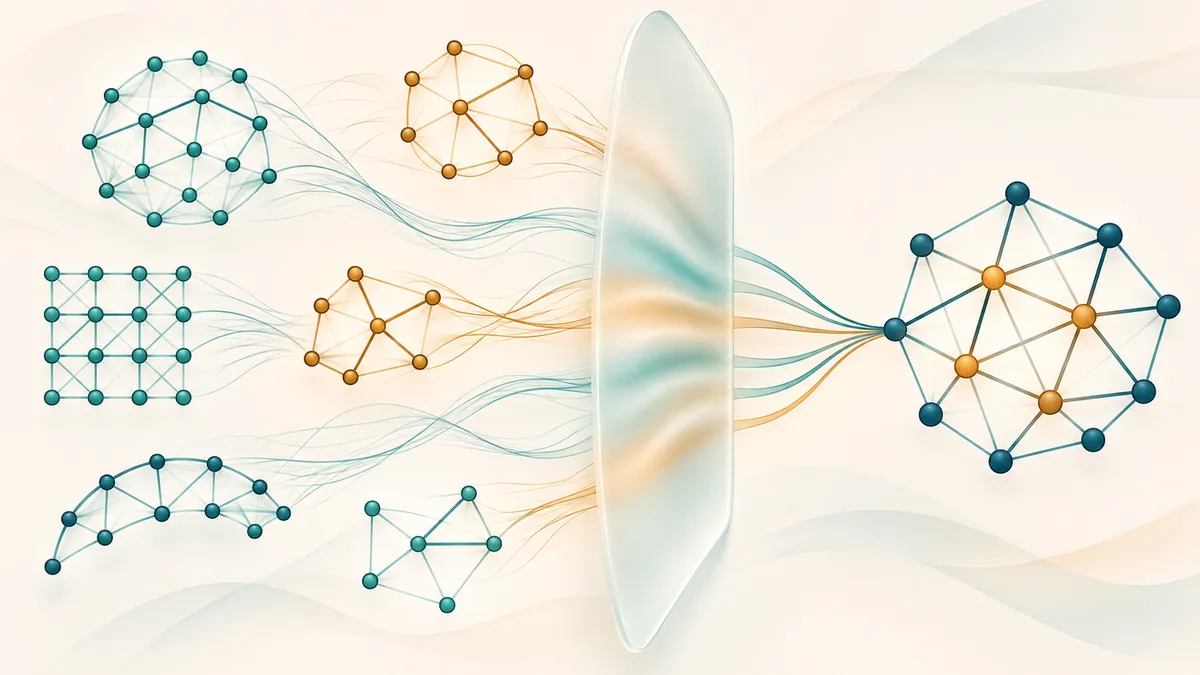
Electrodes implanted to record brain activity are positioned for each patient’s needs, creating a challenge for automated seizure detectors: the signal layout changes from person to person. Researchers at EPFL propose a model that learns how recording channels relate to one another while discouraging those relationships from fluctuating excessively.
Why electrode layouts matter
Intracranial electroencephalography, or iEEG, records electrical activity through electrodes placed inside the skull. It offers detailed recordings of epileptic activity, but electrode placement and channel count vary between patients. A detector built around one fixed arrangement may therefore struggle with another person’s recordings.
In a November 2026 preprint, Arya Jalali and Mahsa Shoaran of EPFL introduce MOSAIC, a machine-learning framework designed for this variation. Their central question is whether a detector can learn useful relationships between channels without assuming a shared electrode layout—and whether making those relationships more consistent improves its performance.
The study uses existing public recordings rather than a prospective clinical trial. Its results concern classification of recorded signal segments, not a demonstrated system for guiding treatment.
Learning a network from the signals
MOSAIC first processes each channel separately using the same convolutional neural network, which extracts patterns over time. It summarizes each channel using both average and maximum feature values. The authors include maximum pooling to preserve sharp transients that averaging could dilute, although their explanation of its relevance to seizure onset is a hypothesis.
An attention module then assigns weights describing how strongly each channel draws information from other channels. These weights form a graph: channels are nodes, and weighted connections govern information exchange. The graph is inferred from each signal window, rather than supplied as a fixed electrode map.
Graph-convolution layers combine information across these connections. Finally, the model pools the channel representations and classifies the window. These learned connections serve the prediction task; they should not be read as verified anatomical wiring.
A second ingredient operates during training. For each training patient, MOSAIC maintains a slowly updated average of its own past connection weights. A penalty encourages each window’s graph to stay reasonably close to that average. This “self-distillation” needs no separate expert labels for connections. The averaged teacher is a training aid, not a patient-specific component required for predictions on an unseen patient.
Testing on patients excluded from training
The researchers evaluated four public datasets. The short- and long-term SWEC-ETHZ datasets contain continuous, multichannel recordings. These were divided into non-overlapping two-second windows and labelled according to overlap with expert-annotated seizure intervals.
For each SWEC-ETHZ evaluation fold, one patient was reserved for testing, another for validation, and the others for training. Results were averaged across five random seeds.
MOSAIC’s F2 score reached 64.1% on the short-term recordings and 52.1% on the long-term recordings, compared with 60.9% and 49.1% for the strongest competing baseline on that metric, a multitask Transformer. F2 gives greater weight to recall than precision, emphasizing the cost of missed positive windows.
Cohen’s kappa, a measure of agreement adjusted for chance, also improved: 51.1 versus 49.3 on the paper’s percentage scale for short-term data, and 50.6 versus 47.3 for long-term data.
The other datasets, Mayo and FNUSA, contain single-channel clips labelled for pathological activity, physiological activity, noise or artifact. The researchers combined noise and artifact with the physiological class. These tests therefore differ from continuous seizure-window detection. With only one channel, MOSAIC reduces to its shared encoder, so these datasets do not test its inter-channel learning. It led the reported metrics on FNUSA but trailed the best Mayo F2 score by 0.8 percentage points.
Stability, not attention alone
Component-removal experiments help explain the multichannel gains. On short-term SWEC-ETHZ data, learning connections without self-distillation produced the same F2 score as simply assigning uniform connections. Adding the stabilizing penalty improved performance beyond both controls.
The authors also report substantially less window-to-window variation in connection weights with self-distillation. This supports their interpretation that stabilizing learned relationships, rather than attention alone, contributes to the improvement.
There are important boundaries. Because the teacher merely averages the model’s own outputs, it cannot independently correct a persistent mistake, such as repeatedly favoring one dominant channel. Moreover, window-level scores do not establish seizure-event detection rates, false alarms per hour or clinical usefulness. Scalp EEG remains future work. The preprint offers evidence for a modeling approach across differing implantations, not proof of readiness for clinical deployment.
- intracranial EEG
- seizure detection
- graph neural networks
- self-distillation
- electrode layouts
- MOSAIC
- preprint
Related reading
Automatically matched by shared topic keywords. These links do not imply that the sources agree or establish a consensus.
PhysioWave-T compresses biosignal inputs without expanding the token count
Source published
Shared keywords: seizure detection
An AI Agent’s Past Attempts Become a Checklist for Training
Source published
Shared keywords: self distillation
Confucius4-R2T2 adapts speech recognition to release text it will not revise
Source published
Shared keywords: self distillation
SIMBAD tests when traffic forecasts should trust the past
Source published
Shared keywords: graph neural networks
A graph-learning method updates its view as connections appear
Source published
Shared keywords: graph neural networks